.svg&w=384&q=75 "logo")
England’s New Pace Cartel: A Familiar Echo of 2005
England’s new pace cartel is starting to sound familiar. Too familiar to ignore.
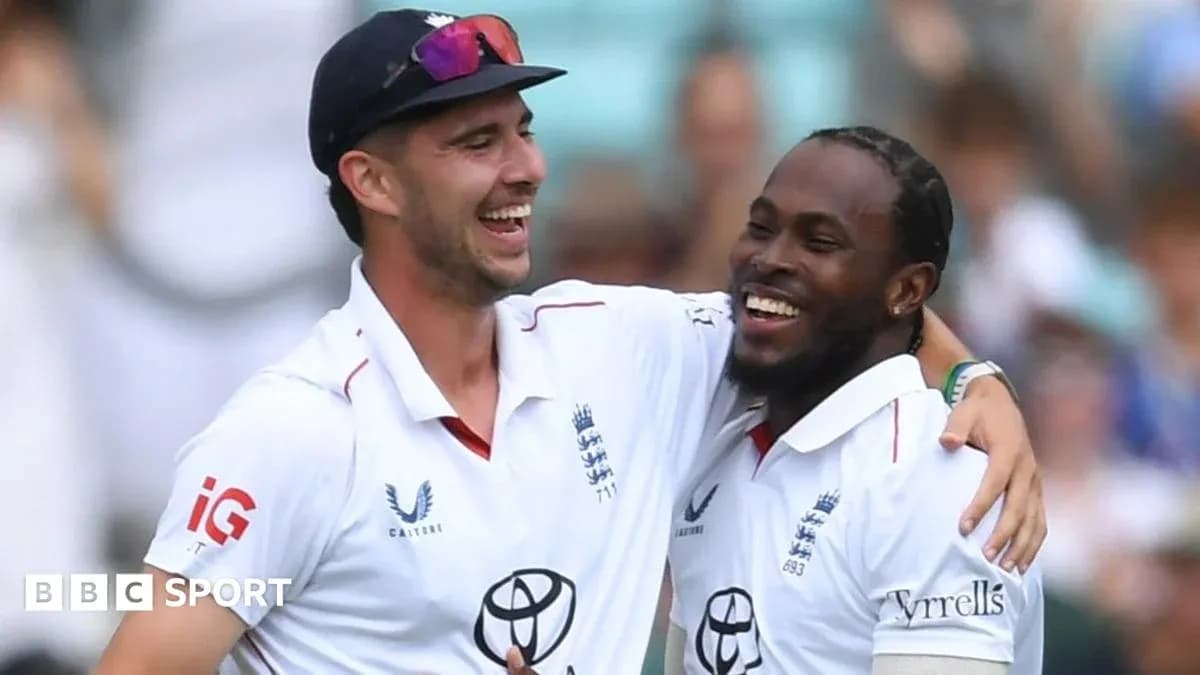
Marcus Trescothick, who watched the 2005 Ashes revolution from slip, now finds himself in charge of a very different England side – but one with echoes of that famous quartet. Back then it was Stephen Harmison, Matthew Hoggard, Simon Jones and Andrew Flintoff. Now it is Ollie Robinson, Jofra Archer, Gus Atkinson and Josh Tongue dragging England out of a rut and into a series win over Pakistan.
The names have changed. The template has not.
A new foursome, an old memory
Trescothick knows exactly what a great Test attack looks like. He opened the batting while Harmison roughed up Australia, Hoggard nipped it around corners, Jones reverse-swung the old ball and Flintoff did a bit of everything at hostile pace.
Looking at Robinson, Archer, Atkinson and Tongue, he sees the same kind of blend.
“We do have some real skill, and you look back to 2005 and the sort of comparisons of Harmy, Fred, Simon and Hoggy, you could easily make those sort of comparisons,” he said, careful not to overplay it, but clearly encouraged by what is building under his watch.
The context matters. England had won only two of their previous 10 Tests. Ben Stokes’ reign as captain ended in a haze of fatigue and frustration, and with it went the all-rounder who had balanced their XI almost by force of will. Joe Root has returned to the captaincy, Trescothick has stepped in as interim coach before Stephen Fleming arrives in the winter, and England were searching for a new identity as much as new wins.
They have found both through the ball.
Back-to-back victories over Pakistan have delivered a first series success since 2024 and, crucially, a clear method: four frontline seamers, no specialist spinner, and Dan Lawrence on standby with some part-time off-breaks if the pitch really demands it.
Pace, craft and contrast
Under Stokes and Brendon McCullum, England often chased pure speed. Now the attack feels more layered.
Archer, Tongue and Atkinson all push 92mph. They intimidate, they hurry, they force mistakes. Then there is Robinson, the outlier in this age of radar guns, often operating below 80mph with the wicketkeeper standing up, nagging away on a length, making the ball talk. Twenty-three wickets this summer at an average of 8.3 tell you how effective that contrast has been.
“We’ve got a good contrast in what we’re trying to do at the moment,” Trescothick said. “What we do have is three guys bowling at 92 miles an hour, which is really nice to have in your armoury and to have the potency in what you’re trying to do.
“And the more that they play together and the more experience that everyone gets together, then it fits into place to how you want it to be.”
The pressure has not just come from raw pace. It has come from rhythm, from partnerships, from the sense that any of the four can be the spearhead in a particular spell. That was the hallmark of 2005: no let-up, no easy overs. This group is a long way from that legacy, but the shape is recognisable.
Michael Vaughan, the captain who lifted the urn 21 years ago, laid down the marker in his Telegraph column. Comparisons, he said, only really stand when you win a major series. That is the bar. Yet even he admitted this group “are certainly capable of doing something really special, and winning back the Ashes for England next summer.”
That is the scale of the expectation building around them.
No room for sentiment at Edgbaston
Before any Ashes talk can be taken seriously, there is a job to finish. England lead Pakistan 2-0 and head to Edgbaston on 9 September hunting a 3-0 clean sweep. Trescothick’s stance on rotation is blunt.
“First and foremost I want to win the series 3-0, and I think if you’re going to do that you want to play the most consistent team possible,” he said.
There were seven pace bowlers in the squad at Lord’s. Brydon Carse started in that group, only to be removed after an incident outside a nightclub in Derby. He is not expected to be considered again until police and Cricket Regulator investigations are complete.
Without him, Sam Cook, Sonny Baker and Matthew Fisher sit as the reserve seamers, between them just four Test caps. Tempting, perhaps, to blood one or two with the series already secured. Trescothick hinted that temptation will likely be resisted.
“We’ve got to see how they all pull up from this game, and they’ve got four or five days now of break which they’ve not had for a good period of time because the schedule has been so busy,” he said. “Once we know that then we’ll be able to make that decision, but emphasis massively on winning the series 3-0.”
That is the tone now. Less experimentation, more edge. England have stumbled through too many campaigns to treat a winning run as a laboratory.
The squad for Birmingham will be named in the coming days. If the four quicks come through their rest intact, they will almost certainly go again together. One more performance, one more statement, and the whispers about a new great England attack will grow louder.
The last time Trescothick heard those kinds of comparisons, England ended up with the Ashes in their hands.