.svg&w=384&q=75 "logo")
England Women’s Cricket Team Roars to Life with Record Chase
At the Uptonsteel County Ground, on a flat Leicester strip that begged to be chased, England’s new era did not so much begin as roar into life.
Set 282 by Ireland, a total that looked robust at halfway, England mowed it down with 11.5 overs to spare, finishing on 283-4 and sealing a six-wicket win that was as emphatic as the margin suggests. It was their highest successful chase in women’s ODIs. It felt routine.
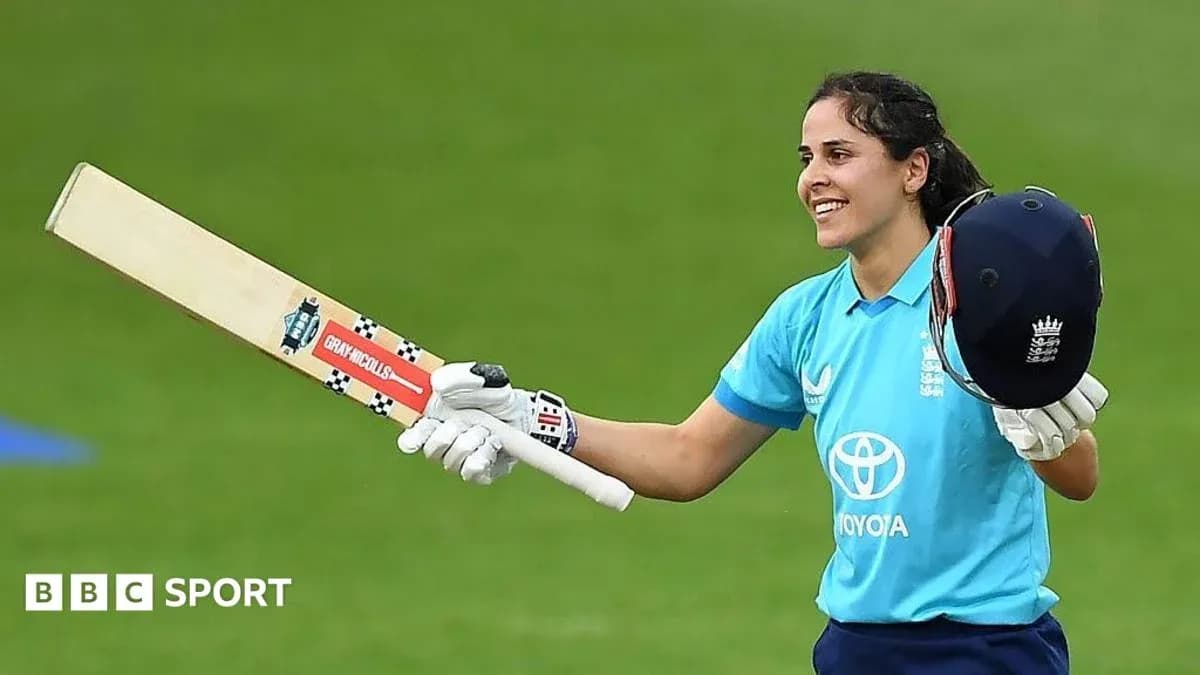
At the heart of it, finally, was Maia Bouchier.
Bouchier grabs her moment
Bouchier has been around this England side long enough to know the feeling of being on the fringes: in squads, in conversations, but rarely inked in. On Wednesday, she wrote her name across the top of the team sheet.
Her 104 from 95 balls was not a dash from the off. She crept to eight from her first 19 deliveries, watchful, almost subdued. Then came the sixth over, and with it Jane Maguire. A flurry of boundaries flipped the mood and the innings. The timing sharpened, the feet moved, and suddenly the new-look top order made sense.
Alongside her, Sophia Dunkley went the other way: straight at Ireland. Dunkley’s 73 from 61 balls was a statement of intent, all clean striking and ruthless targeting of a wilting attack. Her fifty came in 47 balls, the fastest of her ODI career, and Ireland’s seamers and spinners alike felt the brunt.
By the end of the powerplay England were 72-0, the chase already tilting heavily their way. Dunkley dominated early, Bouchier content to let her. The roles reversed as the innings matured.
The opening stand of 143 set the tone for the series and, perhaps, the summer to come.
Life after Knight and Beaumont
This was England’s first ODI since the retirements of Heather Knight and Tammy Beaumont from international cricket, and they were also without injured captain Nat Sciver-Brunt. Five batters from last year’s World Cup semi-final XI were missing. On paper, this was a side in transition.
On grass, it looked like a team liberated.
Head coach Charlotte Edwards has made no secret of her need to reshape the top order with next summer’s Ashes looming. Opportunities are suddenly there for the taking. Bouchier and Dunkley both reached out and grabbed them.
Dunkley’s dismissal, a sharp caught-and-bowled by Cara Murray in the 20th over, briefly quietened the ground. At 143-1, the door was ajar for Ireland. They needed a surge. Instead, they got a trickle.
Jodi Grewcock, on debut, looked understandably tight, scratching to nine as Bouchier assumed control of the chase. The opener began to dictate, picking gaps, rolling her wrists on anything even slightly off line. When Grewcock departed, Bouchier was still there, the anchor and the aggressor rolled into one.
Her hundred arrived as much with a sense of inevitability as joy. The only real disappointment came with its end: a misjudged swing, a lapse in concentration, and a catch at long-on with just 59 needed. The reaction told its own story. Bouchier knew she had the game won, but she wanted to be there at the finish.
Others made sure her work was not squandered.
Capsey and Kemp slam the door
If Ireland were searching for respite, they found only more firepower. Alice Capsey walked in with purpose, immediately busy, immediately proactive. Freya Kemp followed and went harder still.
Their partnership – 54 from 38 balls – turned a comfortable position into a procession. Kemp’s 36 from 22 balls showcased the kind of middle-order muscle England have long craved, hammering home the depth in a side missing so many senior names. Capsey, cool and clinical, finished unbeaten on 41, driving the winning boundary to cap a chase that never truly felt in doubt.
Ireland’s bowling and fielding never matched their earlier composure with the bat. Lines drifted, catches went down, pressure slipped away. On a surface offering little, they needed discipline and sharpness. They delivered neither.
Ireland’s batters show their teeth
The irony for Ireland was that they had done a lot right in the first half.
After losing an early wicket, captain Gaby Lewis and Amy Hunter stitched together a superb stand of 136 for the second wicket, a partnership built on calm judgement and sharp strokeplay. Lewis’ 69 from 89 balls and Hunter’s 62 from 90 gave Ireland exactly what they needed: a platform, overs in hand, and the chance to launch late.
That final push came from Rebecca Stokell. Her unbeaten 54 from 48 balls was a clever, counter-attacking knock, exploiting an England attack that lacked bite in the middle overs. With Lauren Bell and Sophie Ecclestone rested, England’s threat dipped once the ball softened. Ireland seized that window.
At 281-5, they had something substantial. On many days, on many grounds, it would be enough.
Not here. Not against this England.
Once Bouchier and Dunkley settled, the gulf in experience and depth became glaring. Only Orla Prendergast, with ball in hand, hinted at the kind of sustained threat that troubles the world’s best. Across 38.1 overs, that was never going to be sufficient.
A new hierarchy forming
This was only the first ODI of a three-match series, and sterner examinations lie ahead. Edwards and her batters know that. Stronger attacks than Ireland’s will test the new order’s technique and temperament.
But some days are about laying markers down.
England’s record chase, built on an opening stand that felt like a handover from one era to the next, did exactly that. It showed that life after Knight and Beaumont can be dynamic, fearless, and deep. It showed that Bouchier and Dunkley are not merely squad players fighting for minutes, but potential pillars of a side being rebuilt with the Ashes in mind.
The series moves to Derby on Thursday. Ireland will arrive knowing their batting can compete, but that their bowlers must find another level. England will walk in with a different question hanging in the air.
If this is how the “transitional” line-up looks in game one, what might it become by the time the real battles of next summer begin?