
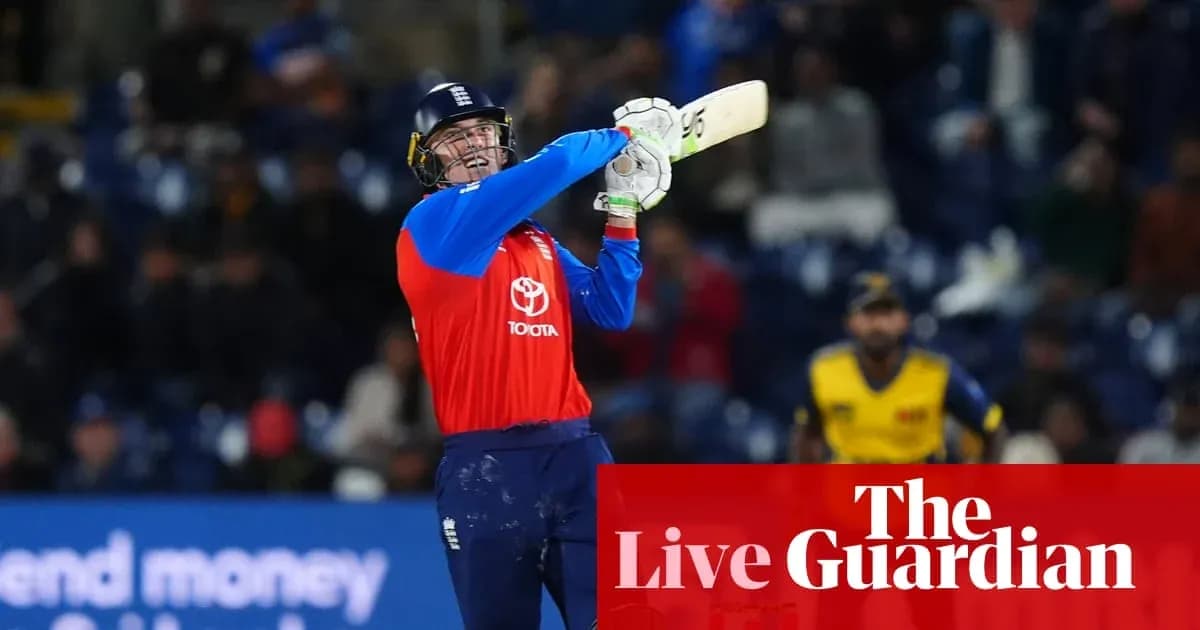
England Crush Sri Lanka as Brook and Buttler Shine in T20
England’s white‑ball revival gathered more momentum as they brushed aside Sri Lanka in a one‑sided T20, chasing 146 with a mix of cold efficiency and outrageous flair that underlined just how dangerous this side already looks under Harry Brook’s command.
By the time Brook walked off, having turned a routine pursuit into a personal highlight reel, Sri Lanka’s earlier promise felt like a different match entirely.
Dawson’s spell flips the script
Sri Lanka actually began with intent. 55 without loss and cruising, they had the platform they so often lack. The ball was coming on, the outfield quick, England searching for a grip on the innings.
Liam Dawson provided it.
Brought on in the fifth over, the left-armer immediately altered the mood. His two wickets broke the opening stand and, with it, Sri Lanka’s composure. From there, England’s attack squeezed ruthlessly.
Jofra Archer hit his lengths and his pace, Reece Topley’s replacement Baker nailed his variations, and Adil Rashid did what Adil Rashid does at the death: removed hope just when batters think they might launch.
Charith Asalanka tried to hold it together. His 31 carried responsibility more than threat, a man forced into the anchor role because everything around him kept collapsing. When he finally aimed over the top at Rashid and picked out Craig Overton at long-off, the innings lost its last senior pillar.
Wanindu Hasaranga flickered briefly. He skipped down to Dawson and sent him over long-on, then hammered another blow straight back over the bowler’s head. A six and a four in the 16th over hinted at the counter-attack Sri Lanka so badly needed. But it never turned into a surge.
Baker, clever and calm, kept taking pace off, forcing mistimed swings. Hasaranga eventually skied him into orbit, Dawson settling under a swirling, awkward chance at cover and insisting on claiming it. Another wicket, another reset for the batters, another over gone.
From 55-0 to 142-8, the scoreline told the story. Archer’s final burst underlined it. A full, straight rocket uprooted Dushmantha Chameera’s middle stump, the sort of ball that empties a dugout’s shoulders. Ratnayake soon picked out Brook at mid-on, the captain having pushed his fielder up and then reaping the reward himself.
Sri Lanka staggered to 145-9, 149-8 by the close, a total that looked 20 light on this surface and against this batting.
Buttler rewrites the record books
Any hope the visitors had of defending that total evaporated within three overs of England’s reply.
Jos Buttler began quietly enough, dabbing his first ball for a single. Then he caught sight of Pramod Madushanka’s length and tempo, and the familiar rhythm returned. Leaning into one, he stroked four past mid-on. When Madushanka tried to adjust, Buttler simply adjusted faster, reverse-scooping a change of pace for another boundary. The speed of his hands, the clarity of his decision-making – it all felt brutally inevitable.
The numbers added a layer of history. A nudge into the off side took him past Kieron Pollard and out on his own as the highest run-scorer in T20 internationals. No fuss, no roar, just a single and a new peak for one of the format’s greats.
He celebrated the only way he knows: by tearing into the bowling. A shimmy down the pitch, a cover-drive to the rope, then a lofted blow towards deep backward that somehow held up just short of the fence. When he finally did miscue, top-edging a pull off Chameera to short third, he left with 30 from 20 and the chase already broken open.
Donald’s homecoming and Brook’s carnage
At the other end, on his home ground, Donald refused to play the junior partner. He’d punished Chameera in the warm-up and clearly fancied a repeat. Stepping away to off, he flipped the seamer over his own head for six, then cuffed another ball over Chameera’s for four. It wasn’t all timing; some of it was just muscle and nerve. But it was enough.
Fourteen runs came from the first three balls he faced from Chameera. Shanaka scrambled his field, chasing the ball with his placements, but Donald kept finding space. By the time he miscued a slower ball from Malinga and picked out Hasaranga at mid-on for 21, England were 51-1 and cruising.
Enter Harry Brook.
First ball from Malinga, he simply leaned back and opened the face, steering a deft four through third man. No sighters, no caution. Just instant authority.
He then took on Hasaranga with the kind of disdain that breaks a spinner’s spirit. Sri Lanka had managed two sixes in their entire innings. Brook matched that in two swings. Waiting on the leg-spinner, he hauled one over square leg for six, then moved his feet beautifully to clear his front pad and launch another over wide long-on.
The pressure finally told. Hasaranga tossed it up again. Brook stayed still this time and dematerialised a third six over midwicket. Three in the over, each from a different method, each more demoralising than the last.
England needed 91 off 88 when he began that assault. By the time he miscued and found Malinga at deep square – the fielder flinging himself forward to cling on to a spectacular catch – the contest was long gone. Brook’s 23 had come in a blur, a cameo that felt much larger than the number beside his name.
Tom Banton, quietly accumulating at the other end, nudged and pulled England towards the line with minimal fuss. Singles, twos, the odd release shot: the kind of innings that rarely makes headlines but finishes matches.
A gap to 2028 – and a team that can’t wait
What will irritate England most is that there is no global trophy at stake for this form of the game until 2028. This is a side taking shape quickly: Brook captaining with imagination, Buttler still rewriting records, Dawson and Rashid tying down the middle overs, Archer and Baker turning the screws at the death.
Sri Lanka, by contrast, looked like a team stuck between eras. A bright start, a few defiant strokes from Asalanka and Hasaranga, but not enough depth, not enough conviction, not enough finishing power.
England needed 146 to win and secure the series. They treated it as a stage, not a hurdle.
If this is what they look like now, with years to go before the next T20 World Cup, how much more dangerous will they be when there’s a trophy on the table again?





