.svg&w=384&q=75 "logo")
Dinusha's Defiance Leads to Draw in Colombo Test
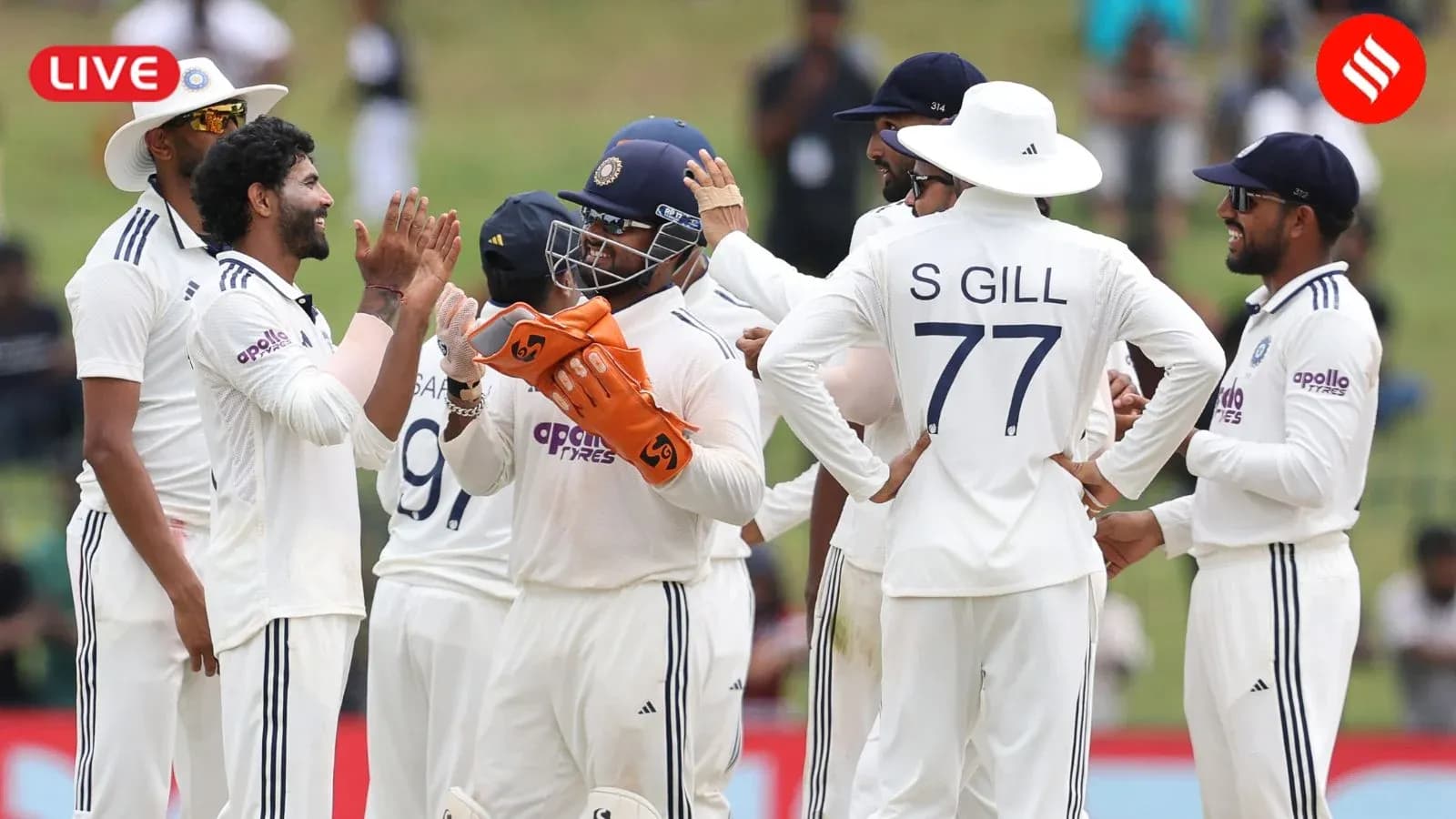
By the time the umpires wandered over to consult the captains in Colombo, everyone inside the ground already knew the answer. India had hunted, prodded and rotated their resources all through a draining fifth day. Sri Lanka, led by the stubborn figure of Sonal Dinusha, simply refused to budge.
The second Test, which India once threatened to dominate from start to finish, eased to a draw. Not with drama, but with a slow, relentless suffocation of Indian hopes.
A Follow-On That Wouldn’t End
India had done the hard work early. They bundled Sri Lanka out for 290 in the first innings on the fourth morning, Saransh Jain finally prising out Dinusha for a superb century and then Lahiru Kumara to collect his maiden Test wickets. With a hefty lead in the bank and weather hovering in the background, Shubman Gill did the obvious thing: enforce the follow-on.
The script, at that point, looked familiar. Prasidh Krishna and Mohammed Siraj shared the new ball. Siraj struck first, bouncing out Lahiru Udara for 10/1. Ravindra Jadeja then pinned Kamil Mishara in front with one of those stump-hunting darts that define his career. At 83/2 by lunch on Day 4, trailing by 130, Sri Lanka were still miles from safety.
Then the pitch went to sleep. And the Test changed.
Pasindu Sooriyabandara and Kamindu Mendis began to play with a freedom that had been missing all series. They swept, drove and pulled India’s spinners off their lengths. The 100-run stand between them turned a rearguard into a genuine counter-attack. Kamindu raised a fluent fifty, Pasindu followed, and suddenly India were the ones searching for answers.
Gill shuffled his bowlers constantly. Manav Suthar, impressive earlier in the match, was targeted. Saransh Jain beat the bat often but couldn’t find the edge. When Prasidh finally bounced out Kamindu for 179/3, it felt like a necessary jolt rather than a turning point. Dhananjaya de Silva arrived, looked assured, and the partnership with Pasindu dragged Sri Lanka to 199/3 at Tea, just 14 behind.
India needed something clever. They got something simple.
Suthar’s Burst, Then the Weather
The evening session of Day 4 began with the game delicately balanced. One big Sri Lankan partnership and India would be batting under pressure. One incisive spell and the follow-on gamble would be vindicated.
Suthar provided the first crack. Dhananjaya, set and serene, feathered an inside edge via pad to gully. Devdutt Padikkal did the rest. Soon after, Pasindu charged Suthar, was dragged wide, and Rishabh Pant completed a sharp stumping. From 199/3, Sri Lanka slid to 218/5, then 221/6 when Saransh Jain trapped Niroshan Dickwella in front.
The resistance that had looked so sturdy was suddenly flimsy. The runs dried up. Dinusha, back at the crease in yet another crisis, had to start again with the tail. India’s quicks, especially Siraj, hammered the middle of the pitch, probing that awkward rib-cage area that had troubled Dinusha all series.
And then, just as India tightened their grip, Colombo’s skies turned. Dark clouds rolled in, the light vanished, and the drizzle followed. Play was abandoned late on Day 4 with Sri Lanka 228/6 and still 14 behind. India had momentum, but not enough time.
Those overs lost would loom large 24 hours later.
Dinusha Digs In – Again
Day 5 began with a simple equation: India needed four wickets quickly, then a clean chase. Sri Lanka needed time. Lots of it.
From the first over, Sri Lanka showed their hand. This was about survival. About batting India into the ground and the clock into irrelevance.
Dinusha and Keshara Nuwantha settled into a trench. The new ball was taken at 257/6, with Siraj and Prasidh searching for that early-morning seam movement. The ball did a bit, but not enough. The surface, which had offered modest turn since Day 2, refused to misbehave. Batsmen could trust their defence, leave on length, and play each ball on merit.
The partnership moved past fifty. The lead nudged beyond 50, then 100. Dinusha swept with the assurance of a man who had been doing it all series. Nuwantha played within the line, rarely flirting outside off stump. Gill tried everything: spin at both ends, seam in short spells, fields that oscillated between attacking and suffocating.
India’s frustration spiked just before lunch when Nuwantha was given out, padding up, only for DRS to rescue him. Sri Lanka reached the interval at 330/6, leading by 116. A draw, once a slim possibility, was now a live result.
Manav Suthar finally broke the stand after the break, finding Nuwantha’s edge for Dhruv Jurel to snap up. But even that small victory came with a sting. Prabath Jayasuriya, no mug with the bat, blocked everything. The surface, if anything, got better. India’s spinners beat the bat repeatedly without reward.
Jadeja, India’s most probing bowler across the innings, began to flag. The overs, the heat, the humidity – and then, in the afternoon, a heel niggle forced him off the field mid-over. The one bowler who looked capable of making something happen had to limp away.
Kumara, the Unlikely Wall
Sri Lanka were 355/8 when Prabath finally perished, driving Jadeja to the infield. India had a sniff again. The lead, though, was already climbing into the danger zone for any last-ditch chase.
Lahiru Kumara walked out with a clear brief: survive. Nothing else.
He did it with remarkable calm. In the first innings he had soaked up 52 balls. This time he went further. Kumara dead-batted everything, wore the short stuff, and trusted his defence in a way few tailenders dare to. The more he stayed, the more the tension drained from Sri Lanka’s dressing room and seeped into India’s.
Dinusha, batting with a visible back issue, adjusted his game. Singles early in the over, the strike handed to Kumara, then retreat into his shell. The left-hander’s earlier fluency gave way to grim determination. Every sweep, every leave, every forward press was a small victory.
By Tea, Sri Lanka were 383/8, the lead 170, Dinusha marooned on 98. India’s bowlers, who had already shouldered close to 90 overs in the first innings before the follow-on, looked weary. The ball had gone soft. The outfield had taken the sting out of the seam. And the pitch, as Sairaj Bahutule had predicted, was now a batting ally.
The hundred came in the final session – Dinusha’s third of the series, all fashioned under pressure. It was the innings that separated a Sri Lankan collapse from a Sri Lankan escape. More than that, it confirmed him as the defining figure of this series for the hosts, a left-handed all-rounder who had tormented India with bat and, at times, ball.
From there, the game simply drifted. India’s fields spread. The appeals grew half-hearted. Kumara’s survival, over after over, told its own story. Sri Lanka’s lead ticked towards 170, then beyond. Any realistic chance of a chase evaporated.
India’s Plans Meet a Flat Pitch
This was a Test where India did plenty right. They enforced the follow-on at the right time, hunted in bowling partnerships, and kept the pressure on for long stretches. Prasidh Krishna’s bounce, Siraj’s hostility and Jadeja’s relentlessness all shone at different points. Saransh Jain, on debut, showed control and temperament, even if the wickets didn’t come easily.
But the surface never deteriorated into the minefield India might have hoped for. The turn was there, but predictable. The rough outside the left-hander’s off stump could be managed. Edges fell short, lbw shouts sailed over, and the ball, as Bahutule had warned, grew softer and less threatening after 30 overs.
Gill’s captaincy will invite scrutiny. His reluctance at times to employ a slip for his quicks, his timing with the new ball, and the heavy workloads on Jadeja and Suthar will all be dissected. Yet on a pitch that simply refused to break down, creativity had its limits.
Sri Lanka, for their part, will look back at this as the day their lower order grew a spine. Nuwantha, Jayasuriya and Kumara all played their roles, but everything revolved around Dinusha. His technique, his temperament, his refusal to fold – they turned what could have been a routine Indian win into a grinding stalemate.
India leave Colombo without the clean sweep they wanted, their World Test Championship haul trimmed by a stubborn final-day stand. Sri Lanka walk away with something more intangible but just as valuable: proof that, with a young core and a fighter in Sonal Dinusha, they can still bend a Test match to their will on home soil.
The question now is simple: was this just resistance in a dead rubber, or the first sign that Sri Lanka’s red-ball spine is finally returning?