.svg&w=384&q=75 "logo")
Charlotte Hornets' Bold Offseason: A New Era Begins
The Charlotte Hornets didn’t just pivot this summer. They slammed the wheel, floored the gas and accepted every ounce of risk that came with it.
LaMelo Ball is gone, shipped to Minnesota in a blockbuster that sent Naz Reid, a 2033 unprotected first-round pick, three second-rounders and three first-round pick swaps back to Charlotte. Miles Bridges is gone too, moved in a separate deal. The most exciting Hornets team in a decade, broken up before it ever reached the postseason.
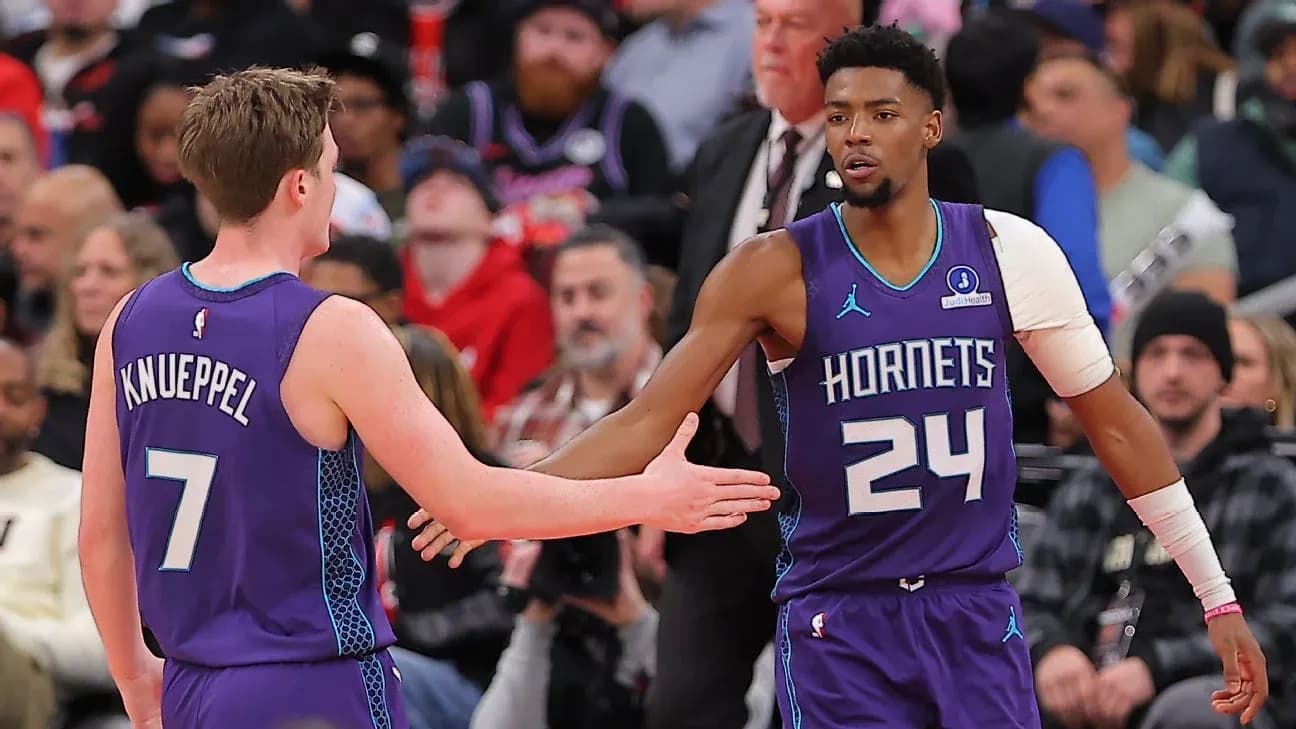
All of it for a bet: that this franchise’s ceiling is higher with Brandon Miller and Kon Knueppel at the controls than it ever was with Ball as the centerpiece.
A sharp turn after their best season
Charlotte didn’t look like a team in need of a teardown last season. The Hornets won 44 games, rode the league’s best five-man lineup for long stretches and finished as a top-five offense after the All-Star break. They finally had an identity. They finally had momentum.
They also had doubts.
Inside the front office, the question wasn’t whether Ball could put up numbers. He did that: 20.1 points, 7.1 assists, a 32.0 usage rate, all on a max rookie extension. The question was whether that version of Ball could ever anchor a title contender. Six seasons, zero playoff appearances, persistent concerns about shot selection, defense and durability. The organization decided the answer was no.
So they walked away early, before comfort turned into complacency.
Hornets president Jeff Peterson made the ambition plain: the goal isn’t a one-off play-in run or a token playoff cameo. It’s something bigger, something Charlotte hasn’t touched since its last postseason trip in 2016. That vision demanded a reset, even if it meant detonating the most entertaining team the franchise has put on the floor in years.
The result is one of the leanest cap sheets in the league. With Ball and Bridges off the books, Charlotte is now the only team without a single player committed at $25 million or more next season. It’s a “Moneyball” gambit in a star-driven league, a calculated attempt to avoid the kind of treadmill that trapped Trae Young’s Atlanta Hawks in the middle of the Eastern Conference.
Building around Miller and Knueppel
This is Brandon Miller and Kon Knueppel’s team now. The organization has stopped hinting and started acting like it.
Miller, a smooth-scoring wing with All-Star upside, and Knueppel, another high lottery pick with a polished perimeter game, are the pillars. Around them, Charlotte has layered shooting, depth and flexibility rather than another high-usage star.
Coby White, re-signed on a three-year, $74 million deal, steps into the starting point guard role. He’s not the playmaker Ball is, but his last two full seasons in Chicago — just under 20 points, five assists and three 3-pointers per game — hint at a guard ready for more responsibility and volume.
Naz Reid arrives from Minnesota as more than just ballast in a star trade. The former Sixth Man of the Year candidate finally walks into a situation where a full-time starting role is on the table. His stretch shooting, physicality and versatility at the 4 and 5 give coach Charles Lee another offensive weapon and complicate an already crowded frontcourt.
The Hornets also added a line of battle-tested wings and guards: Grayson Allen, Dennis Schroder, Royce O’Neale and Dorian Finney-Smith. None of them are franchise-changers. All of them know how to play in structure, space the floor, and defend their position. They’re the kind of pros you bring in when you want your young stars to learn how to win, not just how to score.
Zach Kram’s offseason grade of A- reflects that bigger picture. Charlotte sacrificed short-term wins to amass one of the league’s largest draft pick stashes and to realign around a younger core. One step back, the front office believes, for several strides forward.
Who replaces LaMelo’s firepower?
Strip away the theory and the cap sheet, and one reality remains: someone has to replace 20 points and 7 assists a night.
Ball’s fingerprints were all over Charlotte’s offense. His pace, his creativity, his willingness to pull from anywhere on the floor — that chaos powered the Hornets’ surge after the break. Without him, Lee’s team won’t be able to simply hand the keys to a single successor.
This will be done by committee.
Miller and Knueppel are the headliners. Both carry All-Star potential, both will see their usage spike, and both will be asked to do more than just finish plays. They’ll initiate, they’ll create, they’ll live with the growing pains that come when young scorers learn to read playoff-level defenses in the regular season.
White and Schroder will ease that transition. White offers scoring punch and off-the-dribble shooting; Schroder brings years of experience running an NBA offense and can steady second units when the game starts to fray.
What won’t change is the volume from beyond the arc. Charlotte already played like a modern, perimeter-heavy offense, and that trend should only intensify. Miller, Knueppel, White and Allen all averaged more than six 3-point attempts per game last season. Expect the Hornets to live from deep and die from deep, trusting that their shooting depth can keep them afloat even on nights when the ball doesn’t zip quite like it did with Ball at the helm.
They probably won’t be as good in the short term. That’s the cost. Ball’s playmaking was central to their rise. But Charlotte is betting that a more balanced, more scalable attack, driven by multiple young creators, will age better than one built around a single, mercurial star.
A crowded, crucial center rotation
If the backcourt is where the questions start, the center spot is where the intrigue lives.
Hannes Steinbach, Moussa Diabate and Ryan Kalkbrenner form a three-man rotation with no obvious odd man out. Steinbach arrives as this year’s lottery pick, a strong rebounder with the pedigree that typically demands minutes. Diabate was a key part of last season’s elite starting group, his energy and mobility giving Charlotte a defensive backbone. Kalkbrenner opened his rookie year with a flurry before injuries stalled his progress, but his size and rim protection remain tantalizing.
Add Reid to that mix and Lee has 48 minutes of quality center play almost by default. The challenge — and opportunity — lies in figuring out how many of these bigs can share the floor without clogging the offense or stretching the defense too thin.
Two-big lineups featuring Reid at the 4, or pairing a rim protector like Kalkbrenner with a more mobile option like Diabate, could give Charlotte different looks for different opponents. They could also create rotation headaches if roles aren’t clearly defined. How Lee juggles that group will go a long way toward determining whether the Hornets merely stay competitive or punch above expectations.
Numbers, expectations and the long view
The analytics aren’t convinced yet. Dean Oliver’s projection of the top seven — Kon Knueppel, Brandon Miller, Coby White, Moussa Diabate, Grayson Allen among them — doesn’t scream contender. The predicted Net Points per 100 possessions suggest a roster that, on paper, looks like a step down from last season’s golden starting five.
ESPN’s Basketball Power Index slots Charlotte at No. 20, with post-free agency power rankings putting them 21st. That’s the profile of a team hovering around the play-in, not storming toward the top of the East.
But that’s the paradox of this Hornets offseason: the front office is willing to risk a slide now to chase a higher peak later. They’ve loaded up on picks, cleared their books and handed the franchise to two young wings who haven’t yet brushed against their ceiling.
Fantasy players will eye this roster and see opportunity. White, stepping into a full-time starting role with the ball in his hands, has a clear path to career-best numbers in points, assists and 3s. Reid, finally freed from a bench role, can translate his Sixth Man production into starter minutes. Those are individual gains that reflect a broader theme — this is a team that will give its new core room to breathe, to fail, and to grow.
The divorce between Ball and the Hornets will be judged in stages. In Minnesota, he’s expected to taste the playoffs for the first time alongside Anthony Edwards. In Charlotte, Miller, Knueppel and White will try to prove that the franchise chose the harder, smarter path.
Who wins that bet in 2027? What about 2030?
The Hornets have made their choice. Now they have to live with the noise, the losses that might come, and the possibility that, for the first time in a long time, they’re finally playing for something bigger than the middle.