.svg&w=384&q=75 "logo")
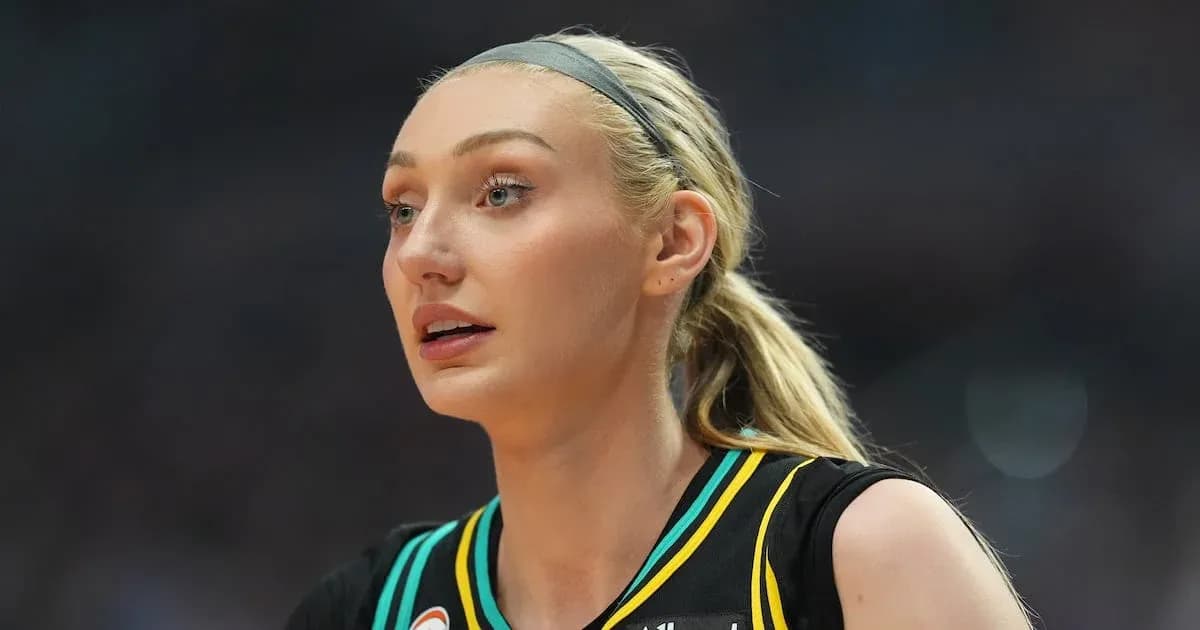
Cameron Brink Denounces Transgender Debate as Clickbait
Cameron Brink has little patience for manufactured outrage.
The Los Angeles Sparks forward cut straight through the noise this week, dismissing the current debate over transgender players in the WNBA as exactly what she believes it is: a bad-faith spectacle.
Speaking to The Mirror’s Jarrod Castillo, the 24-year-old didn’t bother dressing it up.
“When it comes to the trans issue...I think it’s a non-issue. I think it’s just people trying to come for the trans community and I just don’t stand for that,” Brink said.
In a league celebrating its 30th season, with no current trans players on any roster, Brink sees the firestorm as something whipped up from the outside rather than a genuine concern from within. The WNBA has had exactly one openly trans and non-binary player in its history — Layshia Clarendon, who retired in 2024 after 11 seasons. That’s the reality. The rest, in Brink’s eyes, is performance.
The conversation flared after an ESPN feature last month on Indiana Fever guard Sophie Cunningham, who publicly opposed transgender girls and women competing in girls’ and women’s sports. That piece opened a door. Others rushed through it.
What followed was a wave of stunts. Former NBA center Enes Kanter Freedom and ex-NBA forward — and 2024 GOP Senate candidate in Minnesota — Royce White mockingly declared themselves transgender and vowed to enter the WNBA Draft, a move clearly designed to provoke rather than participate.
On Sunday, the sideshow spilled into an arena. Freedom was escorted out of a Chicago Sky game after a confrontation with Natasha Cloud. The incident only amplified his presence in the discourse, which is precisely what Brink believes he’s chasing.
She didn’t bother with diplomacy when his name came up.
“I think what — I don’t even know what the f--k his name is — Enes Kanter, he’s a stupid piece of s--t,” Brink said. “And I think a lot of people think that and I think he’s just trying to stay relevant.”
Then she widened the lens.
“I think people are tuned in for the right reasons and it’s great that we can all talk about things that are important and hard and you can have your opinions on that,” she continued. “But taking something that’s a non-issue right now and just trying to use it for clickbait, for views, for likes and then targeting a vulnerable community is just really low.”
That word — “clickbait” — cuts to the heart of her frustration. To Brink, the current uproar isn’t about protecting women’s sports or defending competitive integrity. It’s about engagement metrics, political theater, and turning a marginalized group into a prop.
Her stance also reflects the generational pulse of a league that has rarely shied away from social issues. WNBA players have long been at the forefront of conversations around race, gender, sexuality, and politics. Brink, just a few seasons into her career, is stepping directly into that lineage.
She has the platform to do it. A native of Princeton, N.J., Brink arrived in the pros with serious expectations after a standout career at Stanford. The Sparks took her with the second overall pick in the 2024 WNBA Draft, betting on her blend of length, touch, and mobility.
Three seasons in, she has settled into a productive role. Through 28 games this year, Brink is averaging 9.4 points on .500 shooting, 5.0 rebounds and 1.7 assists in 18.5 minutes a night — efficient, impactful minutes for a young forward still carving out her ceiling.
On the court, she spaces the floor, battles on the glass, and gives Los Angeles a modern frontcourt piece. Off it, she’s making it clear she won’t sit quietly while the league she’s helping to build is dragged into culture-war theatrics.
The WNBA’s 30th season was supposed to be about growth, star power, and a rising tide of attention. It still is. The arenas are fuller. The television numbers are climbing. The talent pool has never been deeper.
Brink’s message is blunt: keep the focus there — on the game, on real issues, on real people — and stop turning a “non-issue” into a circus at the expense of a vulnerable community.