Atlanta Hawks: From Promise to Proof in 2025-26
The Hawks traded star power for steel last season. This year, they’re doubling down on it.
Atlanta walked out of 2025-26 with a 46-36 record, a sixth-place finish in the East and a first-round exit that still stings. Up 2-1 on the New York Knicks, they had the champs wobbling. They never landed the knockout blow.
What they did find, especially after the All-Star break, was an identity.
A team that flipped the switch
The number is staggering: plus-11.0.
That’s how many points per 100 possessions better the Hawks were after the break (plus-9.7, fourth in the league) than before it (minus-1.3, 19th). No team in the last 27 years has made a bigger in-season leap.
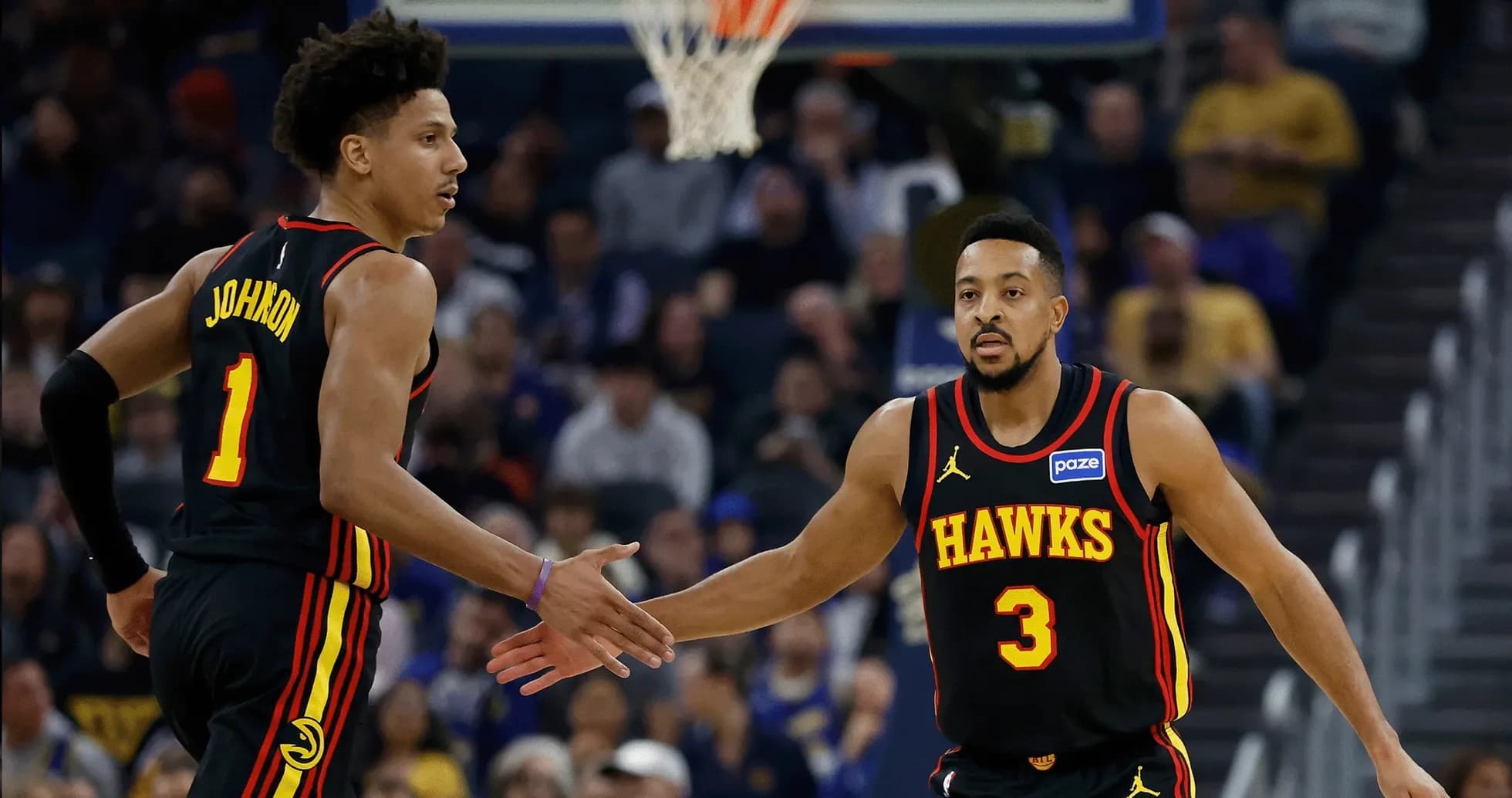
The catalyst was clear. Once CJ McCollum arrived in the Trae Young deal, Atlanta stopped drifting and started climbing. With McCollum in uniform, the Hawks went 27-14, surging from ninth to sixth in the East over the final two months.
Yes, the schedule helped. Only eight of those 20 post-break wins came against teams that finished with winning records. But in the playoffs, against the eventual champions, the Hawks took two games off New York. The Knicks’ three other opponents combined for just one win.
This wasn’t empty-calorie improvement. It was the outline of something real.
Deep, mean and built on the perimeter
Quin Snyder now has the kind of roster that keeps coaches up at night in a good way. The Hawks are long, switchable and unapologetically defensive on the perimeter.
Dyson Daniels, Nickeil Alexander-Walker and new arrival Luguentz Dort give Atlanta a trio of guards and wings who can hound ball-handlers, blow up actions and turn lazy passes into fast breaks. Snyder wants a defense that attacks. He wants turnovers. He wants chaos that turns into threes.
He also wants volume from deep — close to 40 attempts per game — and he has the personnel to let it fly.
Jalen Johnson is the centerpiece of this new era. Last season he vaulted into the league’s elite with his first All-Star nod and first All-NBA selection, averaging 22.5 points, 10.3 rebounds, 7.9 assists and 1.2 steals. He’s the connective tissue: initiator, rebounder, mismatch hunter, late-clock problem-solver.
Alexander-Walker matched Johnson’s rise with a breakout of his own. The Most Improved Player put up 20.8 points, 3.7 assists and 3.4 rebounds per game while flirting with the vaunted 50/40/90 efficiency line (45.9% from the field, 39.9% from three, 90.2% at the line). Once a role player, he’s now a pillar.
McCollum, the veteran voice in the room, added 18.7 points per game and a steadying presence. Between him, Johnson and Alexander-Walker, Atlanta has three players living around the 20-point mark, each capable of carrying stretches of offense.
On the interior, Onyeka Okongwu quietly continues to grow into a modern big. He averaged 15.2 points, 7.6 rebounds and 3.1 assists last season, anchoring the defense while offering short-roll playmaking and enough touch to keep defenses honest.
If Snyder opens the season with a starting five of McCollum, Alexander-Walker, Daniels, Johnson and Okongwu, he’ll still have a bench that most coaches would envy.
Dort, Aaron Wiggins, Jock Landale, Zuby Ejiofor, lottery pick Kingston Flemings, Asa Newell, Buddy Hield, Corey Kispert and Ryan Nembhard give Atlanta layers of shooting, defense and size. It’s not just depth for depth’s sake; it’s matchup flexibility. Snyder can go small and switch everything, go big and physical, or surround Johnson with shooters and dare teams to pick their poison.
Last season’s Hawks finished 14th in offensive efficiency and 10th on defense. Solid, not spectacular. The expectation inside the building is that this version can push both numbers higher.
Aaron Wiggins, waiting to pop
Every deep team needs a swing piece — the player who turns a good roster into a dangerous one. In Atlanta, that might be Aaron Wiggins.
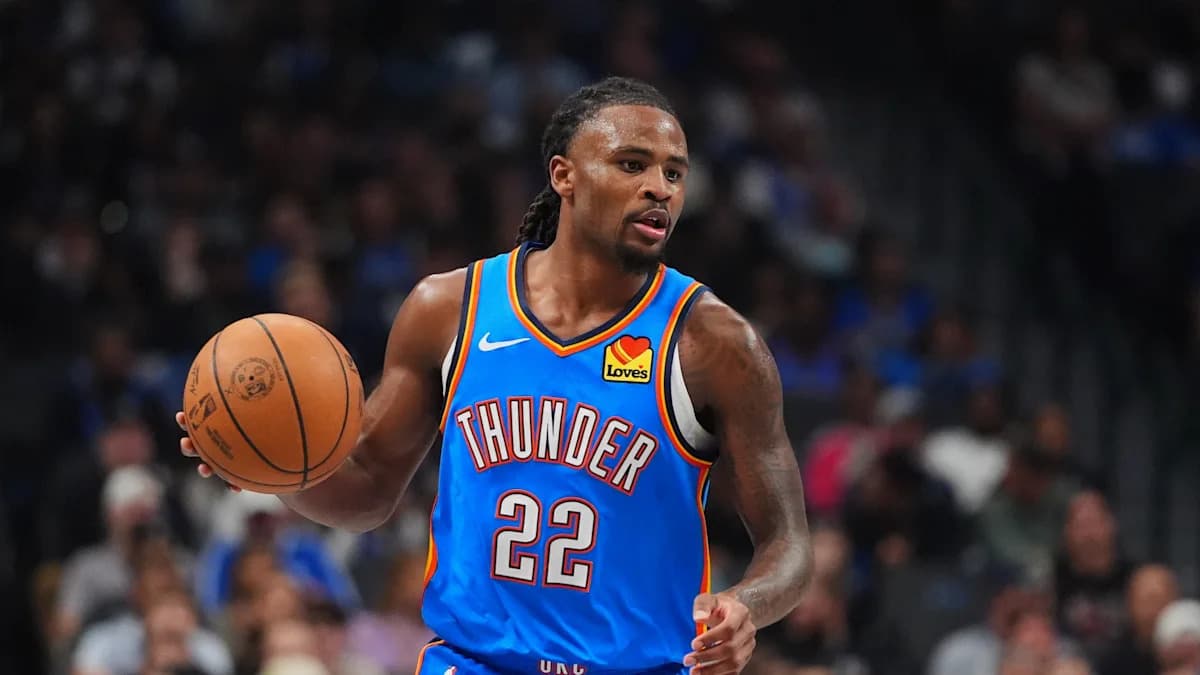
He comes in with championship experience from Oklahoma City’s 2025 title run and their 2026 trip to the Western Conference Finals. He’s been on the floor in big moments. He’s also been stuck behind stars.
Across five seasons with the Thunder, Wiggins never topped 24.2 minutes per game, and that came as a rookie in 2021-22. He’s averaged double figures in scoring just once, at 12.0 points per game in 2024-25.
The efficiency, though, has always been there. For his career, Wiggins has hit 48.7% of his shots from the field and 38% from three. Atlanta, already a good three-point shooting team last season, needs more precision from deep, not just volume. Wiggins fits that demand perfectly.
If Snyder carves out a regular role for him — and the Hawks’ depth means he’ll have to earn it — Wiggins has a clear path to a scoring bump and a chance to tilt games with his shooting and off-ball movement.
The rookie watch and rotation puzzles
Training camp and preseason will be less about who can play and more about who plays when.
Snyder already has data he trusts. The lineup of McCollum, Alexander-Walker, Daniels, Johnson and Okongwu went 20-10 last season with a monstrous plus-20.3 net rating. That group crushed opponents at both ends.
Now add Dort and Wiggins to the mix. The question isn’t whether they help. It’s how Snyder staggers minutes so that the defensive edge never dips and the floor spacing never collapses.
Kingston Flemings, the lottery pick, will draw plenty of eyes. How quickly can he absorb lessons from McCollum? How comfortable will he look when the game speeds up and the schemes tighten? His development won’t define this season, but it could accelerate the Hawks’ long-term ceiling.
Behind Johnson, the backup power forward spot is a genuine battle. Mouhamed Gueye, Newell and rookie Ejiofor are all chasing those minutes. Whoever claims that role will likely be the beneficiary of playing alongside at least two high-level creators and a spacing-heavy second unit.
The choices Snyder makes in October could echo into April.
Dates that will shape the narrative
Some games on the calendar carry more weight than others. Atlanta has a handful that already feel like checkpoints.
On Oct. 21, the Hawks host the Orlando Magic in a Southeast Division clash that should set the tone. The division is loaded with belief — at least four teams see themselves as playoff material — and last season the top four were separated by just three games. This one pits the teams that finished first and second in the Southeast.
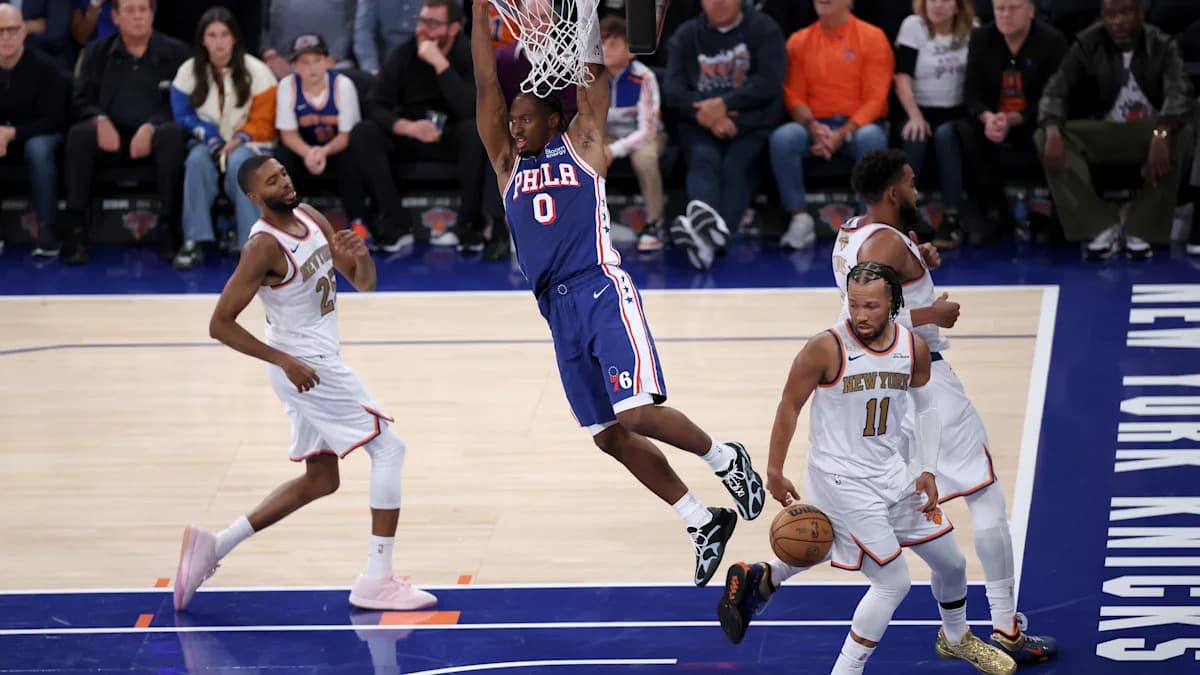
On Nov. 29, the Knicks return to Atlanta. It’s the first meeting since that playoff series, when the Hawks led 1-0 and 2-1 and still watched New York rip off three straight wins before steamrolling through the rest of the East. If Atlanta wants to measure its growth, this is the mirror.
Feb. 1 in Washington brings a different kind of tension. That’s Trae Young’s first game against the Hawks in Atlanta colors — or rather, Wizards colors — since the trade. Emotions will run hot. So will the takes.
One week later, on Feb. 8, the Miami Heat come to town for a game that could have real implications at the top of the division. It lands just before the Feb. 11 trade deadline, when front offices decide whether to double down, pivot or stand pat. The result might not just influence standings; it might shape strategy.
And then there’s April 4 in Philadelphia. The Hawks will be deep into a grueling stretch — eight road games in 11 contests — when they run into a 76ers team loaded with star power. By then, the East’s hierarchy will be coming into focus. Atlanta will know exactly what’s at stake.
From promise to proof
The Hawks didn’t walk away from the Trae Young era with a treasure chest of picks or blue-chip prospects. They chose a different route: get better now. McCollum delivered on that bet last season.
The next step is harder. Sustaining that post-break surge over 82 games. Turning flashes of defensive dominance into a nightly standard. Converting a 2-1 lead over the eventual champions into a series win the next time they’re in that position.
Atlanta has depth. It has defense. It has star-level production from Johnson and Alexander-Walker, and a veteran guard who has seen just about everything in McCollum.
Now comes the only question that matters: is this the year the Hawks stop threatening the East’s elite and start joining them?