.svg&w=384&q=75 "logo")
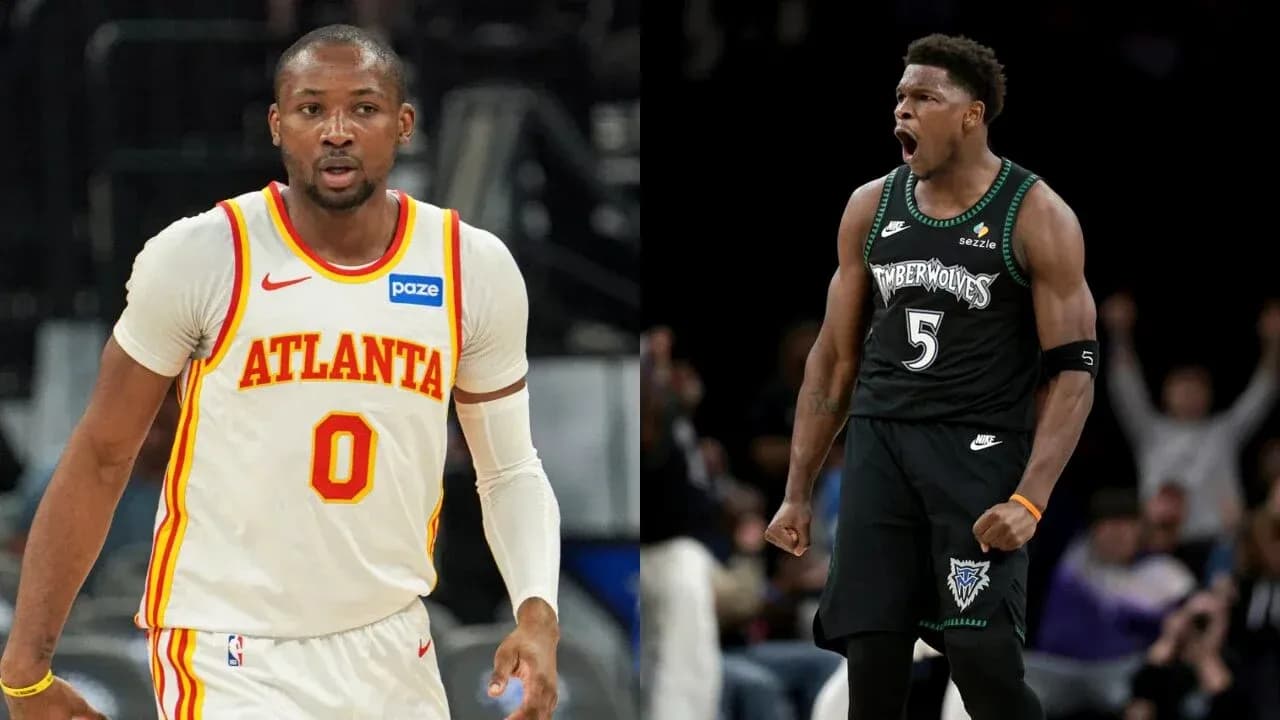
Anthony Edwards Shapes Minnesota Timberwolves' Offseason
The Timberwolves didn’t just steal a player this summer. They stole a narrative.
In late August, Minnesota landed 2022 NBA champion Jonathan Kuminga, a move that stunned a league expecting the explosive forward to walk straight into a starting role with the Los Angeles Lakers. The money pointed to L.A. The role pointed to L.A. The market pointed to L.A.
Kuminga chose Minnesota.
And at the heart of that decision stood Anthony Edwards.
Edwards’ Pitch: Be Yourself, Loudly
Kuminga’s agent, Aaron Turner, laid it out plainly in an interview with Kevin O’Connor. This wasn’t some elaborate PowerPoint presentation or a front-office hard sell. It was a star talking to a star-in-waiting.
"Ant was a massive part of this whole thing," Turner said. The message from Edwards was simple and sharp: Minnesota wanted the version of Kuminga they’d battled in the playoffs — the attacking, fearless, downhill force.
The Wolves weren’t asking him to fit into a neat box or reinvent his game. They wanted the problem.
"The pitch was, ‘Hey JK, we want you to come here and be the guy that we had to play against in the playoffs. Like, we want that dude. Like, we’re not asking you to go be something else. We’re asking you to be yourself.’"
That resonated. Turner pushed back at the idea that Kuminga would need to bend himself around Minnesota’s system.
"But this whole thing of like, oh, he has to adapt. No," Turner said on the podcast. In his telling, Edwards’ stance was clear: an unselfish star, secure in his own status, inviting another dynamic scorer into his space and telling him to turn the volume up, not down.
"I want you to come here, and I want you to do everything you do and do it loudly," was the spirit of Edwards’ pitch, as Turner described it. "I can understand what you’ve dealt with through these parts of your career, and I want you to come in here and be Jonathan Kuminga."
That’s not just recruitment. That’s empowerment.
The Money Question — And the Twist
On paper, the Lakers made the stronger financial offer.
Rob Pelinka, according to reports, put a three-year deal in front of Kuminga worth roughly $36 million. Around $12 million a year for a projected starting forward in Los Angeles — a number Turner openly questioned on FanDuel’s "Run it Back," saying he couldn’t believe the franchise expected to lock in a starter at that price, which he described as "pretty decently below the midlevel."
Then came the twist.
Kuminga agreed to an even cheaper deal with Minnesota: two years, $12.4 million. A shorter contract. Less total money. A smaller annual figure.
From the outside, it raised eyebrows. If the Lakers’ number wasn’t good enough, how did a lower Wolves offer get him over the line?
The answer circles back to role, trust, and Edwards’ influence. Kuminga wasn’t just signing with a franchise. He was aligning himself with a star who wanted him unleashed, not managed.
LaMelo, Kuminga, and a Star Who’s Watching Everything
The timing of Kuminga’s move also matters. Minnesota had already made a bold play by bringing in LaMelo Ball, a high-usage, high-vision guard to pair with Edwards in the backcourt.
Add Kuminga to that mix, and suddenly the Wolves’ offense looks younger, faster, and far more volatile — in the best sense.
For Kuminga, it’s a chance to reset his trajectory. For Edwards, it’s proof his franchise is listening.
NBA insider Brian Windhorst summed up the mood around Edwards on his show: "Ant is very pleased with the Wolves' offseason," he said, pointing directly to the arrivals of Ball and Kuminga. Windhorst went a step further, suggesting that if Edwards’ extension were up for discussion right now, this kind of aggressive summer might already be enough to pull him toward another long-term commitment.
"Going to get LaMelo (Ball), making this deal happen for (Jonathan) Kuminga," Windhorst said, framing the moves as the kind that could convince Edwards that Ball is "going to be a perfect fit."
Edwards is only six years into his Minnesota tenure, with three seasons still left on a five-year deal that runs through 2029. Yet the conversation has already shifted from "How long will he stay?" to "What else can they build around him?"
That’s a powerful place for a small-market franchise to be.
A New Standard in Minnesota
This is what keeping a star happy actually looks like in practice. Not just max contracts and billboards, but personnel moves that reflect his ambitions and playing style.
Minnesota didn’t just ask Edwards what he thought. They acted on it. They put LaMelo Ball in his backcourt. They brought in Kuminga, a player he’d battled and respected. They backed their franchise cornerstone and let him help shape the identity of the team he leads.
If this new core — Edwards, Ball, Kuminga — can turn all that promise into a deep playoff run, maybe even a championship push in the next few years, the question around 2029 might not be whether Edwards leaves.
It might be how much more he wants to build in Minnesota.