
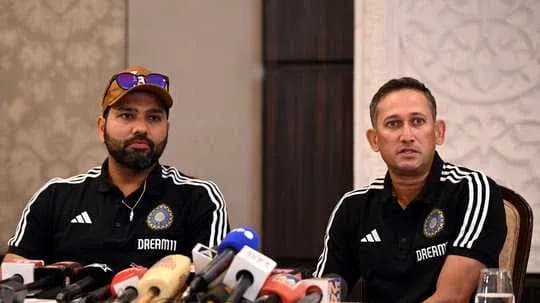
Ajit Agarkar's Uncertain Future as Chief Selector of India
Ajit Agarkar’s future as India’s chief selector remains unresolved, with the BCCI’s Annual General Meeting on Friday (September 18) ending without a clear verdict on his position. The only firm move was a procedural one: the board’s office bearers have been formally empowered to decide the fate of the senior men’s selection committee.
For now, the suspense lingers.
Agarkar in limbo
Agarkar’s status has been under the scanner for weeks. His absence from a recent review meeting on India’s tour of the UK raised eyebrows, even as the BCCI publicly played it down. The noise grew louder after the Rohit Sharma episode before the Lord’s ODI, when selectors reportedly told the former captain he was not in the immediate plans, only for the board to step in.
That moment exposed a fault line. Who really runs selection?
Agarkar, appointed in July 2023, is understood to have a contract through to October 2026. On paper, he is secure. In reality, his position feels far less settled.
Yet, inside the selection room, the wheels have not stopped turning. The meeting to pick squads for the West Indies ODIs, the Irani Cup and the India A sides went ahead earlier this week without drama. Those close to the process described it as routine, the selectors going about their work as if nothing were amiss.
The uncertainty, however, sits above them like a cloud.
If the BCCI does decide to move on from Agarkar, it cannot simply plug in a new chairman overnight. The board will have to issue a fresh advertisement, sift through applications, conduct interviews and only then appoint a replacement. That timeline guarantees a gap between decision and implementation.
In that context, one name has already started doing the rounds: former India wicketkeeper-batter Parthiv Patel. He is understood to be a potential candidate should the board choose to change the guard at the top of the committee. For now, though, it remains just that — a possibility, not a move in motion.
Junior selectors on hold
The uncertainty is not confined to the senior panel. The new junior selection committee is also stuck mid-process.
The BCCI advertised for five junior selector positions on August 24, and there had been an expectation in board circles that the revamped committee would be unveiled around the AGM. That did not happen. Interviews are yet to be conducted, and the latest word is that the process will stretch until the end of the month.
Age-group and pathway cricket, which feeds directly into India’s senior pipeline, will have to wait a little longer for clarity.
Ranchi keeps its Test
While selection questions swirled, one rumour around next year’s Border Gavaskar Trophy was firmly put to bed.
Reports had suggested that Ranchi might lose its Test, but Jharkhand State Cricket Association secretary Saurabh Tiwary dismissed the speculation outright. The five-match series against Australia, a marquee event on the calendar, will go ahead as scheduled: Nagpur to open on January 21, followed by Chennai, Guwahati, Ranchi and Ahmedabad.
“There is no change in the venue. If anybody has to write to the BCCI about it, it should be me and I have not written it,” Tiwary told the media, shutting down the chatter with a single, pointed clarification.
For Ranchi, and for the JSCA, that confirmation is significant. Hosting a Border Gavaskar Test is both a financial boost and a statement of status within the Indian cricket map.
Governance questions on the horizon
Away from selection and scheduling, the AGM also touched on an issue that could shape the board’s legal and administrative future: the National Sports Governance Act.
The Supreme Court has asked the BCCI to clarify its position on the legislation, effectively pushing the board to put its stance on record. The BCCI has long maintained, including in its submissions in the Odisha Cricket Association matter, that cricket should not be treated as a “designated sport” under the Act.
That line has held so far. The question now is whether it can hold in the face of judicial scrutiny.
So the day ended with a familiar picture: Indian cricket’s most powerful body moving on several fronts at once — a chairman of selectors in limbo, a junior committee still to be formed, a Test venue defended, and a looming legal debate over how the sport is governed in the country.
The selections will keep coming. The bigger call is whether the people making them, and the rules they operate under, are about to change.





