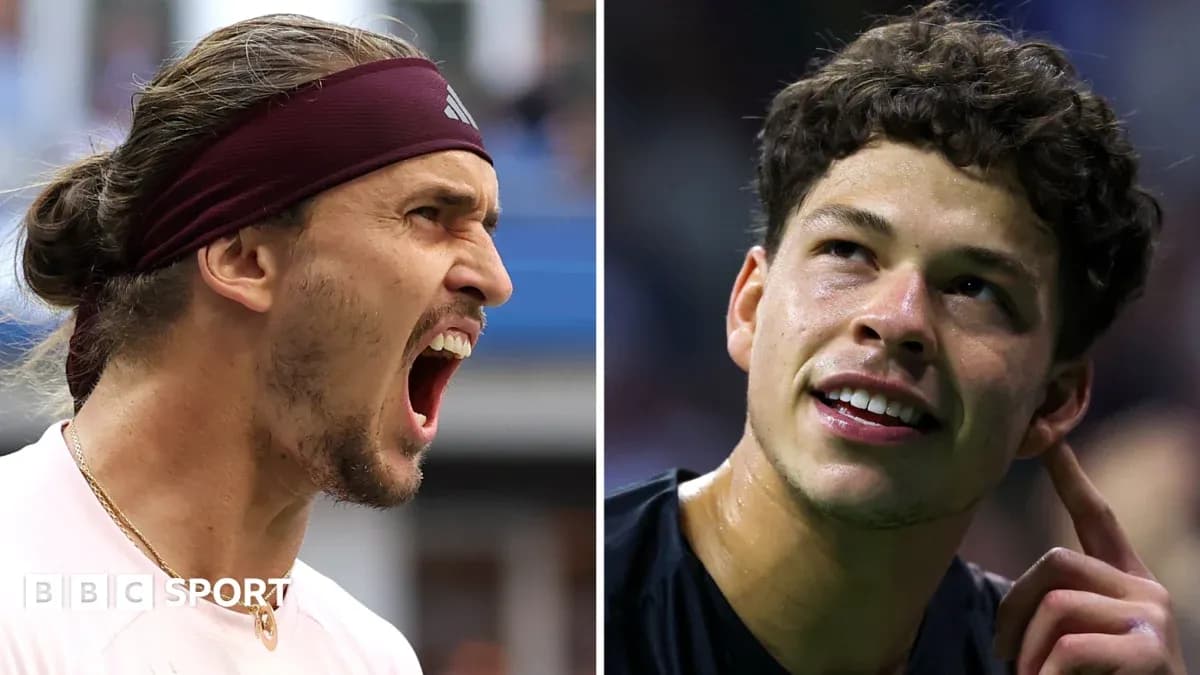
Zverev vs Shelton: US Open Final Showdown
Alexander Zverev and Ben Shelton will walk into Sunday’s US Open final already having changed the shape of their seasons. One of them will walk out having changed the shape of his career.
For Zverev, this fortnight in New York has felt like vindication delayed. For Shelton, it has felt like a door kicked open.
Zverev’s second life at the Slams
At the start of 2026, the idea of Alexander Zverev holding two Grand Slam titles in the same year sounded fanciful. He had the talent, yes, but the story always seemed to end the same way: deep runs, big stages, and then the nagging sense that the generation behind him – Jannik Sinner and Carlos Alcaraz – had stolen the future.
They even had a nickname. “Sincaraz.” Between them, they swept all four majors in 2024 and 2025, turning tennis’ biggest trophies into a private duopoly.
Zverev looked like the nearly man. Three major finals, three defeats. The most painful of all came here, at Flushing Meadows in 2020, when he led Dominic Thiem by two sets in his first Grand Slam final and still walked away beaten. That loss left a mark. In the years that followed, he moved through the latter stages of majors with the air of someone who wasn’t entirely convinced his moment would ever arrive.
This year, the script finally cracked.
The German broke through in Paris, beating Flavio Cobolli in the French Open final to lift his first major. He backed it up by reaching the Wimbledon final, only to run into Sinner at full force. Now he is in his third straight Grand Slam final, a run that speaks of hardened belief as much as shot-making.
Crucially, the iron grip of Sinner and Alcaraz has loosened. Injuries have ripped open a gap in the draw that Zverev has been sharp enough to stride through: Alcaraz missed Roland Garros and Wimbledon, Sinner was ruled out of the US Open. When Zverev was asked if he thought he could end 2026 with more majors than the pair who have defined the last two seasons, he didn’t flinch.
“I believed in it. I believed that it's possible,” he said. “I think not many of you guys did.”
He knows the question that hung over the year: would Carlos and Jannik simply play all four Slam finals between them again? Not this time. Not with Zverev standing in the way.
His route in New York has not been spectacular, but it has been efficient. He has survived a string of late-night battles, often below his best, and yet he has not faced a top-20 opponent. The tennis has sharpened as the fortnight has gone on. The legs have held. The confidence from Paris has not faded.
Now comes the real test. Ben Shelton is a significant jump in quality, a very different problem to solve, and – just as importantly – a player who will have almost every one of the 24,000 fans in Arthur Ashe Stadium roaring for him.
Shelton, the noise, and the weight of history
For Ben Shelton, everything about this tournament has felt new. New territory. New expectations. New history within reach.
“For me, this whole tournament has been uncharted territory,” he admitted. “I'm in positions I've never been in before. I've beaten guys I've never beaten before.”
The 23-year-old American has turned potential into proof. This run has already delivered a landmark: his first Grand Slam final. But the stakes on Sunday stretch far beyond his own ranking or bank balance.
Shelton is trying to become the first American man to win a Grand Slam singles title in 23 years, since Andy Roddick lifted this very trophy in 2003. He is also chasing something even more profound: the chance to become the first black American man to win a singles major since Arthur Ashe in 1975.
When a reporter mentioned the “lot of history” on the line after his semi-final win over Frances Tiafoe, Shelton grinned and asked, “Is there?” He knows the answer. Everyone in the sport does.
Former world number four James Blake, who helped carry the flag for African-American men’s tennis in the 2000s, understands the scale of what a Shelton victory would mean.
“Having another black American in the final leaves you wondering how many kids and adults are watching that maybe wouldn't have been otherwise,” he told BBC Sport. “They are going to be inspired to hear Ben's story and see someone that looks like them out there playing and competing in a sport that has historically been dominated by the sense of a country club white sport.”
Shelton’s game has always had the kind of raw electricity that fills stadiums. His serve has thundered past 140mph over the past two weeks, a weapon that can flip a game in a heartbeat. But this run is not just about power.
He has rounded out the edges. The backhand, long the weaker wing, now holds up under pressure. The defence, once patchy, has grown into a genuine platform. He is prepared to “suffer a little bit in the rallies,” as his father and coach Bryan put it, using his athleticism to stay in points he used to abandon.
The results are written across his season. Four titles, each on a different surface – Dallas indoors on hard courts, Munich on clay, Stuttgart on grass, and the Canadian Open outdoors on hard. That versatility is no longer a theory; it’s a résumé.
The signature moment came in New York. Shelton walked into a quarter-final against Alcaraz having never beaten a top-three opponent. He walked out, at 3:34am, with a watershed victory over the seven-time Grand Slam champion, who was playing his first event in almost five months. It was chaotic, dramatic, and it announced Shelton as a player who can hurt the very best on the biggest stage.
Now he faces the one man he has never managed to solve.
A rivalry that isn’t one – yet
Shelton has played Zverev five times. He has lost all five.
To win his first major, to end the American drought, to inscribe his name alongside Ashe and Roddick, he must beat the German for the first time. That is the scale of the task.
Zverev brings experience and scars into this final. He knows what it is to walk into a US Open title match and feel it slip through his fingers. He knows what it is to rebuild from that. He also knows that, for all the talk of Sinner and Alcaraz, this is his chance to plant himself firmly in the era they were supposed to own.
Shelton brings noise, momentum and a sense of something larger than himself. He will hear it in every roar when his serve booms in, in every gasp when he chases down one more ball.
One man is trying to double his major tally and finally step out of the “what if” bracket. The other is trying to rip up the old order and drag a new generation of American fans with him.
On Sunday night in New York, only one of those stories can be completed. Which one will tennis be talking about when the season ends?