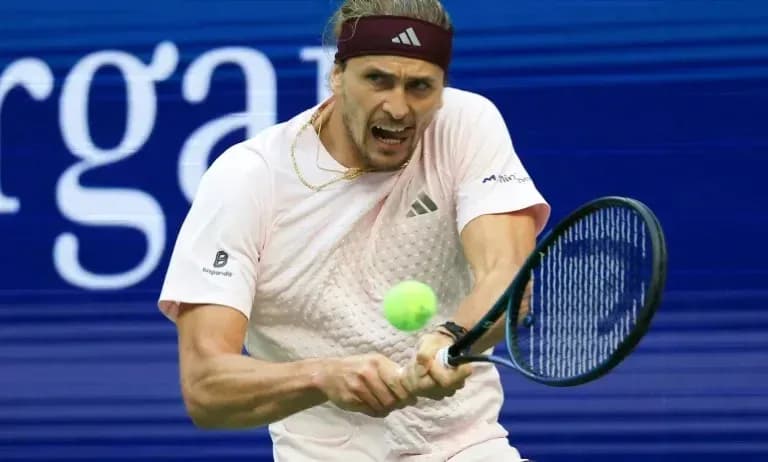
Alexander Zverev Reaches US Open Final After Tight Win Over Khachanov
Alexander Zverev is heading back to the big stage in New York, and this time he’s arriving with the aura of a man who has learned how to live in the deep end of Grand Slams.
The top seed powered past Karen Khachanov 6-3, 7-6 (9/7), 7-6 (8/6) on Friday to reach his third consecutive major final, adding the US Open showpiece to his runs at Roland Garros and Wimbledon this season. It took him just under three hours, but the straight-sets scoreline barely hints at how tight the margins became.
For Zverev, this is familiar territory with a very different feeling.
Zverev survives, then sharpens
He arrived in New York looking anything but invincible. Nine hours and 26 minutes on court in his first two matches, both dragged into five sets, left questions hanging over his legs and his nerve. Since then, he has methodically stripped those doubts away.
Against Khachanov, he started like a man intent on keeping the evening short. Zverev controlled the baseline, protected his serve and moved through the first set 6-3 without offering the Russian a single break point. The top seed’s weight of shot and accuracy left Khachanov searching for a way in that never came.
The second set changed the tone.
Khachanov, ranked 50 in the world and chasing a place in history as the lowest-ranked Grand Slam finalist since Marcos Baghdatis in 2006, finally cracked open the match. Down a break and staring at a long night, he ripped a passing shot by Zverev to start the fourth game, grinned, then raised his arm to the crowd three points later when a forehand winner gave him his first break point. Zverev double-faulted. Suddenly, they were level and the contest had teeth.
From there, the set became a test of nerve. In the tiebreak, Zverev twice stood on the brink of a two-set lead, only for Khachanov to smash the door back open with a heavy forehand and then a backhand down the line that drew gasps. The Russian had dragged himself into a shootout.
Zverev refused to blink. He edged the breaker 9/7, stealing the set with the kind of point-by-point clarity that has defined his season.
“Straight-set win, but anything but straightforward in a way,” he said. “He played incredibly well, fought incredibly well.”
A match decided in inches
By the third set, the rallies had turned into trench warfare. Neither man earned a single break point. Serve dominated, tension climbed.
The tiebreaker felt inevitable.
Khachanov, who lost to Zverev in the Olympic gold medal match in Tokyo in 2021, looked ready to turn the story around when he surged to a 6-4 lead in the decider. Two set points. A chance to drag the match into a fourth set and test whether Zverev’s early-tournament mileage would finally catch up with him.
Then the forehand deserted him.
Both set points vanished on errors from that wing, the racket that had kept him alive now betraying him at the worst possible time. Zverev stepped through the opening, fired down his 15th ace for match point, and watched Khachanov send one last forehand long.
“Second and third set I think it's more than obvious that they could have gone both ways,” Zverev said. “I just played a few points better here and there, and I'm happy with the win.”
A few points. That was the difference between another draining night and a clean, three-set passage to Sunday.
Chasing away old ghosts
Four years ago, Zverev walked off this court shattered, having let a two-set lead slip against Dominic Thiem in the 2020 final. That scar still sits in the background of any conversation about him in New York.
Now, he returns to the US Open title match as a reigning French Open champion and Wimbledon runner-up, carrying the momentum of three straight Slam finals and the authority of a player who has turned “potential” into hardware.
Waiting for him will be an American—either Ben Shelton or Frances Tiafoe—after their all-US semi-final. Zverev expects a spectacle.
He called their clash “absolutely epic” in prospect, and he knows what’s at stake for whoever survives it: the chance to become the first American man to win a Grand Slam since Andy Roddick lifted this trophy in 2003.
“Hopefully I can not make the American dream come true on Sunday,” he said, half-smiling, fully serious.
Shelton arrives on the back of the biggest win of his life, a wild, five-set victory over defending champion and seven-time major winner Carlos Alcaraz that ended at 3:34 am, the latest finish in US Open history. He is chasing his first Grand Slam final. So is Tiafoe, who has long carried the hopes of the home crowd and now stands one win away from a shot at ending that 23-year drought.
Their rivalry is already rich for a pair so young. Shelton leads their head-to-head overall, but they are dead even at Flushing Meadows: Shelton took their quarter-final in 2023; Tiafoe hit back in the third round a year later.
Whoever emerges will carry the noise of Arthur Ashe Stadium and the weight of a nation’s impatience. Zverev will carry experience and a growing sense of inevitability.
A day of tennis and remembrance
The semi-final unfolded against a more somber backdrop. On the 25th anniversary of the September 11 attacks that destroyed the World Trade Center towers, national anthem ceremonies in both the day and night sessions carried a quieter, heavier tone. The roar of the crowd gave way, briefly, to reflection.
The women take their turn on Saturday, with Elena Rybakina trying to stop Aryna Sabalenka from claiming a third straight US Open crown, just days after the Kazakh ended the Belarusian’s near two-year stay at world number one by reaching the semi-finals.
By Sunday night, though, all eyes will be back on Zverev and the American who survives the other side of the draw.
A home hope chasing history. A top seed hunting redemption in the city that once broke him.
Only one of those stories can end the drought.