Alexander Zverev's Grand Slam Journey Continues at US Open Final
Alexander Zverev once knew the feeling that haunts American men’s tennis right now — waiting, year after year, for a first grand slam. He’s ended his own vigil. He has no intention of ending theirs.
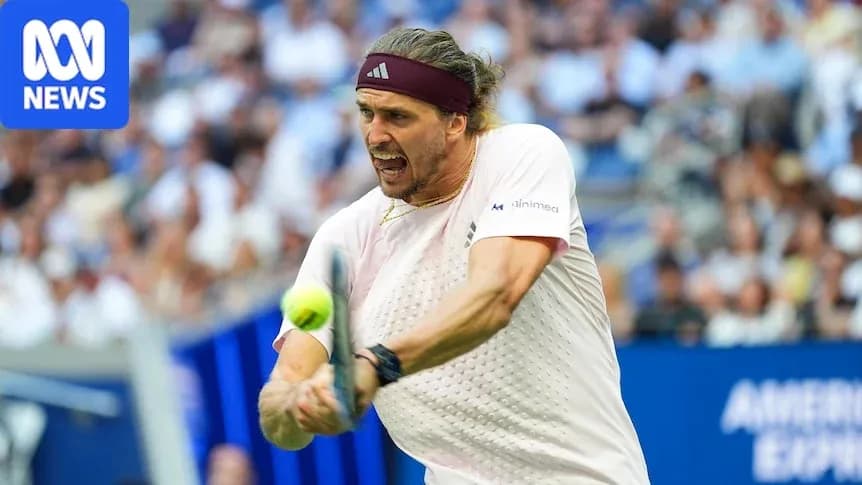
The German marched into the US Open final with a 6-3, 7-6 (9-7), 7-6 (8-6) win over Karen Khachanov, booking a shot at a second major title this season and stretching one of the most ruthless grand slam runs of the year.
On Monday morning (AEST), he will face either number eight seed Ben Shelton or number 11 Frances Tiafoe — one of them guaranteed to become the latest American hope in a drought that has lasted since Andy Roddick lifted the trophy here in 2003. Both have felt the heat of a semifinal in New York. Neither has stood in a major final.
“Hopefully I can not make the American dream come true,” Zverev said, half-smiling, fully serious.
From nearly man to serial contender
For years, Zverev carried the label no elite player wants: best man on tour without a major. That burden finally lifted in Paris this year when he claimed his first grand slam at Roland Garros. He backed it up with a run to the Wimbledon final, where he fell to Jannik Sinner, and now owns a staggering 24-2 record in majors this season.
“Sometimes just things go your way and I feel like I've had a lot of struggles at the major level. I was so close so many times and maybe this year God has said that this is going to be your year and just enjoy the time on the court,” he said.
Enjoyment hasn’t always been the word he’d use for New York.
This is the tournament that slipped through his fingers in 2020, when he led Dominic Thiem by two sets in the final and still lost in a fifth-set tiebreak. Thiem became the first man since 1949 to win the US Open after dropping the opening two sets. Zverev left with a scar that never quite faded.
Now he returns to the same stage with a different aura. Hardened. Efficient. Relentless.
Khachanov’s surge, Zverev’s steel
Khachanov arrived in New York with a losing record for the season. He leaves it having reminded everyone of his danger at the majors. This was his third grand slam semifinal, his second at Flushing Meadows, and he spent long stretches of the night looking every bit like a man ready for a breakthrough.
Just not against this version of Zverev.
The top seed — handed that status at a major for the first time after Sinner’s withdrawal with a knee injury — came out sharp. He controlled the opening set 6-3, then surged to a 2-0 lead in the second. At that point, it looked like a routine march to the finish.
Khachanov refused to play along. He began to swing more freely, found his range off both wings, and finally broke Zverev’s serve to drag the set back on level terms. The rallies lengthened. The tension rose. The second-set tiebreak turned into a mini-epic.
Zverev twice held set point and twice Khachanov wiped it away. Then came the rally that broke the deadlock: 34 shots of patience, pressure, and stubborn refusal to miss. Zverev won it, took the breaker 9-7, and roared. That was a gut-check, not a formality.
The Russian still wasn’t done. In the third-set tiebreak he jumped to 3-0, then 5-2. The door was open. Zverev slammed it shut.
Point by point, he clawed back, turning defence into counterpunch, tightening his margins while Khachanov’s blinked. The German ran off five of the last six points to seal the match in straight sets, a scoreline that barely hinted at the knife-edge drama of the final two sets.
Khachanov’s level late on would likely have been enough to beat the Zverev who stumbled through the first week. It just came too late against the one standing in front of him now.
From early chaos to cruising form
Zverev’s path to the final hasn’t been the smooth, untouchable glide of a dominant top seed. It started with chaos. He became the first number one seed in grand slam history to go five sets in each of his opening two rounds, dragged deep by Lorenzo Sonego and Quentin Halys and forced to spend nearly nine and a half hours on court before the third round had even begun.
He didn’t hide from how bad that looked.
He and his team, he said, laughed about it after the second match — about just how poorly he was playing. That gallows humour loosened him up. Since then, he has been a different player.
The numbers tell the story: 13 consecutive sets won heading into the final. Sharper serving. Cleaner hitting. A willingness to step in on big points instead of retreating and hoping.
“Moving forward, I was playing much better tennis. Obviously I have improved a little bit. Otherwise, I wouldn't be in the US Open final,” he said.
One man’s rise, one nation’s wait
While Zverev surges toward another piece of history, American men’s tennis stands at a familiar crossroads. Shelton and Tiafoe, both crowd magnets, met on the 25th anniversary of the 9/11 attacks in a night session billed as the marquee event of semifinal day. Their clash commanded the spotlight, the noise, the anticipation.
By comparison, tickets for Zverev-Khachanov were available at strikingly low prices. On paper, it was the undercard. On court, it was the match that produced the tournament’s most in-form finalist — and denied Khachanov the chance to become the lowest-ranked US Open finalist since the ATP rankings began in 1973.
Now the script is set.
On one side, a resurgent champion who has finally learned how to close the biggest matches. On the other, whichever American emerges from Shelton and Tiafoe carrying two decades of expectation on his shoulders.
Zverev knows what it is to wait for a moment that feels like it may never arrive. He’s living proof that it can. The only question in New York now is whether he’ll let that American moment happen on his watch.