Alexander Zverev: From Prodigy to Grand Slam Champion
Alexander Zverev has been chasing this version of himself for more than a decade. In New York, he finally caught up.
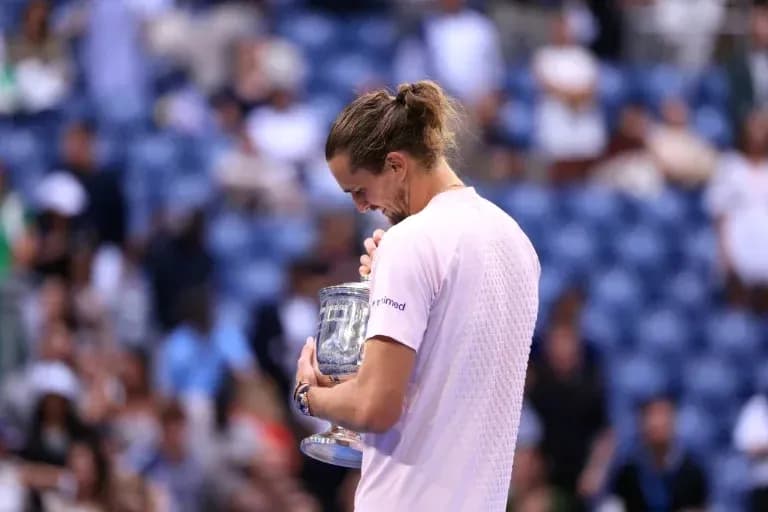
With his US Open triumph over Ben Shelton, the 29-year-old sealed a second Grand Slam title in less than four months, backing up his breakthrough at Roland Garros and turning years of unfulfilled promise, public scrutiny and physical pain into a sustained run of dominance at the very top of the sport.
For a player long filed under “maybe one day,” the floodgates are no longer theoretical. They are open.
From prodigy to survivor
Zverev’s story was never supposed to be this complicated. Born into a tennis family, with both parents high-level players in the former Soviet Union, he grew up as the prototype: tall, powerful, technically polished, raised on the sport’s grammar from the moment he could walk.
Destined for the top? That label arrived early and never really left.
He idolized Roger Federer, copied the greats, and surged through the junior ranks. The men’s tour quickly followed. Titles came. So did expectations. A first major final at the 2020 US Open seemed like the natural next step in a smooth ascent.
Instead, it became a scar.
Two sets up on Dominic Thiem, Zverev watched the title slip away in five. His serve, so often the barometer of his confidence, wobbled. He has spoken candidly about that night, about living with the feeling that his delivery could fall apart at any moment.
“That was exactly the time when I had real struggles with my serve and my second serve,” he said of that final. “I knew that my serve could break down at any moment. That's one difference that I do feel now, luckily for me.”
The mental label stuck. Talented, yes. But could he finish? Could he hold under suffocating pressure?
Pain, surgery and a long road back
Just as he seemed to be hardening into a perennial threat, his body gave way. In the 2022 Roland Garros semi-finals, locked in battle with Rafael Nadal, Zverev tore ankle ligaments in a gruesome fall. Surgery followed. His career, briefly, felt precarious.
He already lived with diabetes, managing a chronic condition alongside the demands of the tour. Now he had to rebuild a shattered joint and a shaken belief in his own movement.
He returned in January 2023. The road was not instant redemption, but there were markers: a 20th career title in Hamburg, deeper runs at the majors, a growing sense that the legs and lungs were back, and the head was clearing. By 2024, he was charging again, into the French Open final and up to world number two, steadily dismantling the old narrative of mental fragility.
The scoreboard did not always flatter him. Jannik Sinner beat him in straight sets in the 2025 Australian Open final, a third defeat in a Grand Slam title match. Each loss reopened the question: would he ever actually finish the job on the sport’s biggest stages?
Allegations, scrutiny and a divided court of opinion
Zverev’s climb has never been confined to the baseline. Off the court, his career has unfolded in the shadow of serious domestic violence allegations from two former partners, Olga Sharypova and Brenda Patea, allegations he has consistently and strenuously denied.
The ATP investigated one claim and announced it had found insufficient evidence to sanction him. In Germany, a separate case involving Patea, the mother of his daughter, resulted in a penalty order and fine in 2023. Zverev appealed. The legal process ended in June 2024, when the two reached a settlement just hours before he walked on court for his French Open semi-final.
His public image remains polarizing. His tennis, though, has grown increasingly unambiguous.
Gold, doubt and a new era
There were always flashes of the player he believed he could be. The gold medal at the Tokyo Olympics in 2021 stands out, a week when he stunned Novak Djokovic and then overpowered Karen Khachanov in the final. It felt like a coronation, a sign that the Grand Slams would soon follow.
They didn’t. Not immediately. As the years ticked by, a new generation seized the spotlight. Sinner and Carlos Alcaraz split nine straight majors between them, reshaping men’s tennis while Zverev lingered as the nearly man.
The question hardened into a challenge: in this new landscape, was there still room for him to break through?
He insists he never stopped believing.
“I believed in it. I believed that it's possible,” he told reporters in New York, before adding with a laugh: “I think not many of you guys did.”
Learning to live with the highs and lows
What has changed is not just his results, but his relationship with them. Zverev talks now like someone who has seen the sport from its highest peaks and its darkest corners.
“In the life of a professional athlete, you will have the highest highs and the lowest lows,” he said. “Getting caught up in the lows is the biggest mistake that you can make. You shouldn't try to evaluate everything when times are tough, you should try to find ways to get better when you're on a high.”
His serve, once a fault line, has become a pillar again. His movement, post-surgery, looks assured. The player who once flinched on the brink now appears to lean into the moment.
Two majors in four months, three consecutive Slam finals, a ranking near the summit, an Olympic gold already in the cabinet: this is no longer a story about potential. It is about realization, however belated and however complicated.
Zverev has always said his family is everything, that he owes them his career. The boy raised in a tennis household has finally grown into the heavyweight champion his early years promised. The debate around him will not quieten; the off-court questions will not vanish.
But on court, in New York and Paris, he has answered the one that chased him the longest: when the stage is at its biggest, can he stand there as the last man?