Alexander Zverev Claims First US Open Title
Alexander Zverev stood alone on Arthur Ashe Stadium, staring at the big screen in confusion. The crowd roared, Ben Shelton’s last return had sailed long, the umpire had called “game, set, match” – and the new US Open champion was still hitting balls back as if there was another point to play.
Only when Zverev finally glanced up did it hit him. It was over. Again.
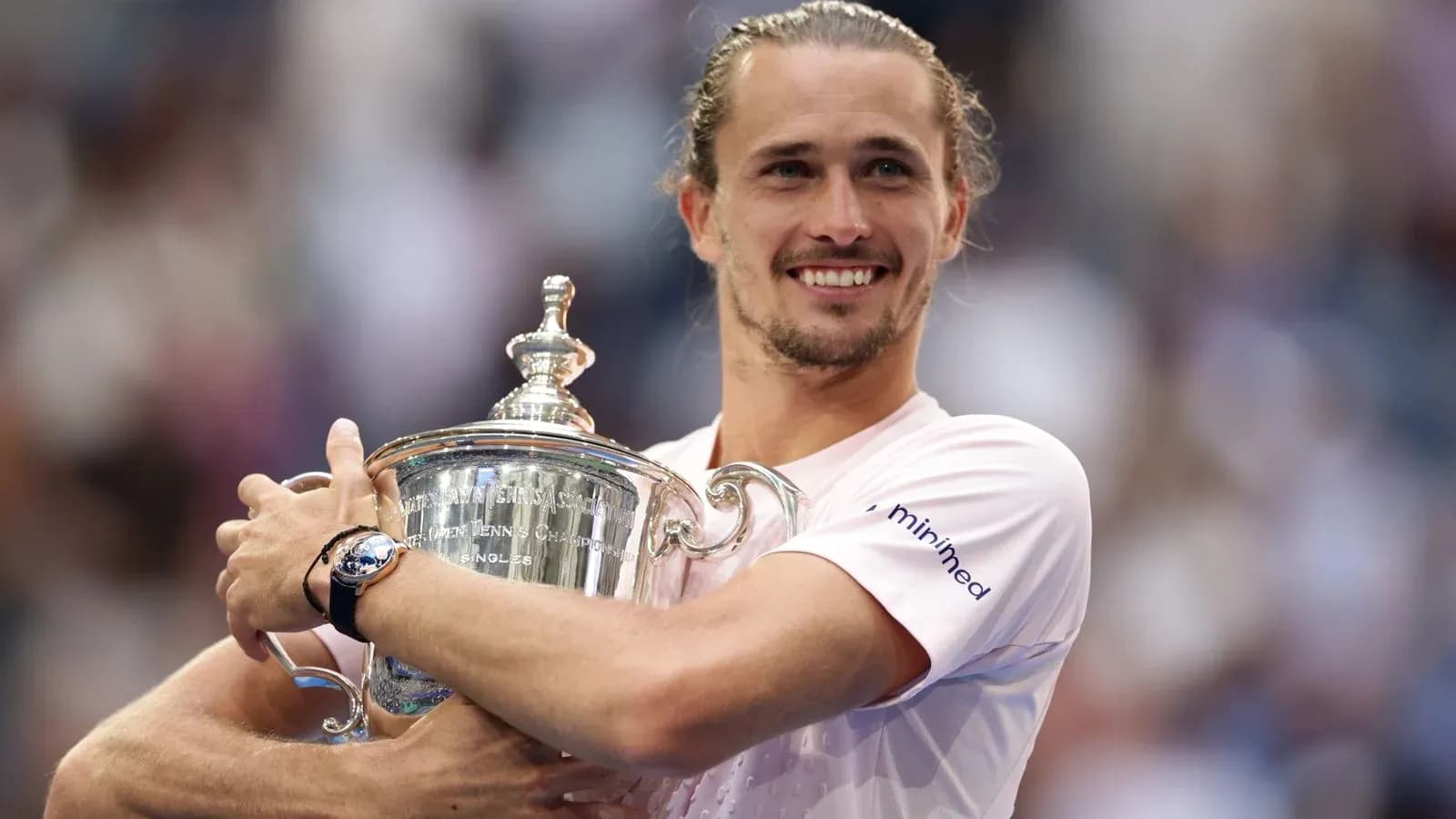
The German, already a Roland Garros winner this year, completed the most significant season of his career by beating Shelton 6-3 7-6 (7-2) 5-7 6-2 to claim his first US Open crown and second Grand Slam title in three months. For a player once branded the best of his generation without a major, the label has been ripped up in the space of one relentless, unforgiving summer.
“I thought the score was 5-1,” he admitted on court, still laughing at himself. He had broken Shelton twice in the fourth set, but in the fog of the moment lost track of the scoreboard. “Teachers in tennis say play each point and forget about the score. Well I forgot about the score and it helped me.”
On this evidence, it has helped him all year.
Zverev’s new reality
This was not the Alexander Zverev who used to tighten on the biggest stages, who once watched a two-set lead slip away in a US Open final and seemed destined to carry that scar forever. This was the top seed at a Grand Slam for the first time, serving with authority, dictating with his backhand, and playing as if the weight of expectation had finally shifted from burden to armour.
“Three months ago if I was told you are going to win one Grand Slam in your career and nothing else, I would have signed the paper straight away,” he told Sky Sports Tennis. “Now standing here with two Grand Slam trophies in the space of the months is incredible.”
He has ridden a season shaped by the absences and fitness issues of Carlos Alcaraz and Jannik Sinner, but that does not cheapen what he has built. Zverev has done the hard yards. Across this fortnight he spent more than 23 hours on court, nearly three of them – according to the numbers – simply bouncing the ball between serves. His rituals can fray nerves in the stands; they no longer fray his own.
Tim Henman, watching for Sky Sports, saw a player reborn.
“I was looking back at his Grand Slam results, and his game was going backwards,” the former British No 1 said. “But he has transformed himself to be more aggressive… Shelton did a great job getting that third set, but losing his serve first game of the fourth settled Zverev down and gave him more energy. He coasted to the line from there.”
Coasted is not a word often associated with Zverev at majors. It fits now.
Shelton’s stage, Zverev’s start
If this was Zverev’s coronation, it unfolded on Shelton’s stage.
The 21-year-old American walked into Ashe to a wall of sound, 23,000 people desperate to see the first home men’s Grand Slam champion since Andy Roddick in 2003. He was also chasing history of a different kind, aiming to become only the second black man after Arthur Ashe himself, in 1975, to win a major singles title.
The stadium that bears Ashe’s name shook for Shelton. Hollywood came to watch: Brad Pitt, Rami Malek, Pierce Brosnan, all dotted around the stands. A mischievous director cut to Brosnan with the match clock at 0:07. The theatre wrote itself.
The script on court did not.
Shelton won the toss, chose to serve, and within minutes had handed Zverev the early break with a missed routine shot and a double fault. Marion Bartoli, the 2013 Wimbledon champion, called the moment for what it was.
“The difference in their experience was absolutely massive,” she said. “Look, it’s not easy to come out in front of your home crowd and play your first ever Grand Slam final in those circumstances… Zverev made only one unforced error in the first set, and it just made Shelton’s life so difficult.”
Zverev pounced. He broke again on set point, sealing the opener 6-3, and never allowed Shelton a single break point in the first two sets. The German’s serve, long a barometer of his confidence, held up under the glare. Heavy, accurate, repeatable. The No 1 seed was playing like one.
Shelton came into the final with five straight losses to Zverev, but also with a new belief forged in New York. He had never beaten Stefanos Tsitsipas or Carlos Alcaraz before this tournament. He knocked them both out. That kind of fortnight changes how a player walks into a final, even against a nemesis.
Zverev, though, shut down the rebellion. He dominated the second-set tie-break, 7-2, leaning on his backhand and first serve, and moved within a set of the title.
The crowd knew the score. So did Shelton. Zverev, apparently, did not.
Shelton swings back – briefly
Shelton refused to go quietly. The third set finally cracked open when Zverev’s level dipped for the first time. The German’s serve wobbled, the double faults crept in, and Shelton pounced, dragging the match into the kind of chaos he thrives on.
He carved out three break – and set – points, the stadium rediscovering its voice in full, and converted the second. The American, who had spent his childhood watching others carry the US flag at majors, had a foothold in his first final.
Henman saw the moment as Shelton’s best work of the day.
“Shelton did a great job getting that third set,” he said. For a few minutes, the energy inside Ashe suggested something bigger might follow.
But the pressure had only been delayed, not redirected.
Zverev reset. He broke in the opening game of the fourth set, then broke again, this time slamming the door shut on any talk of a comeback. The match, as a contest, died right there.
Shelton’s shoulders dropped a fraction. Zverev’s didn’t move at all.
The German even absorbed a time violation for his endless ball-bouncing, shrugged it off, and kept landing first serves. Three hours and 33 minutes after they began, Shelton’s final forehand flew long. Zverev finally looked up, finally realised, and finally let himself believe it.
The family fight behind the trophies
The tennis story is only half of Zverev’s New York night.
On court, with the trophy at his side, he turned quickly to his family – and to the battle that has framed his life since childhood. Diagnosed with type 1 diabetes at four, Zverev has spoken often about the doubts that came with it. On this stage, he put the spotlight firmly on his mother, Irina, a former professional herself.
“When your four-year-old son is diagnosed with diabetes and doctors in the office tell you that life and sports will be very limited for that child, it takes a very strong mother to say ‘my son will be whatever he wants to be’,” he said.
“If he wants to be a tennis player, he’ll be a tennis player. If he wants to do something else, he’ll do something else but this illness will not define us.
“My mother is the most important and strongest person I know because it takes an unbelievably strong woman to do what she did.”
The second Grand Slam trophy of the year felt like a family prize as much as a personal one.
Respect for the runner-up
Shelton, who was not yet one year old when Roddick lifted the US Open trophy in 2003, handled defeat with the poise of a player who knows this is a beginning, not a peak.
“Sascha, congrats on these two weeks, your second Grand Slam title and two in one year,” he said. “What you’re doing is incredible, the way you are serving and moving in play. You work harder than anyone I know, and do more hours on court than anyone else.”
He saved a special line for New York.
“To New York, you guys drove me here today. I’m just getting started and I’ll be back here again.”
Zverev, for his part, echoed the sentiment that this final will not be Shelton’s last.
“Ben, you’re an incredible player and an incredible person,” he said. “This was your first Grand Slam final but I already told you you’re going to be back here many more times and if I would have to bet all my money on it, I would bet that you would lift this trophy one day.”
There was no shame in losing this one. Bartoli put it bluntly: “There’s no shame losing to Zverev when Zverev is playing like this.”
From nearly man to pace-setter
A year ago, Zverev looked stuck. The ankle injury from Roland Garros 2022, the inconsistency, the sense that the game was moving on without him – all of it fed the narrative of a career that might never quite catch up with its promise.
Now he has two majors in his hands and a very different question in front of him.
If this is what he looks like after “going backwards”, as Henman put it, what happens when he truly settles into this new version of himself?