.svg&w=384&q=75 "logo")
Zheng Qinwen's Epic Comeback at the US Open
Zheng Qinwen had already called it “a very dramatic match.” That barely covered it.
On a sticky New York afternoon, the Olympic champion walked to the brink of defeat, looked over the edge, and refused to fall. Down 5-0, match point against her in the deciding set, facing a home favourite in Madison Keys and a crowd ready to roar her out of Arthur Ashe, Zheng somehow turned a lost cause into a 1-6 7-6 (7-3) 7-5 epic.
Seven games in a row. From nowhere.
From rout to resurrection
For an hour, this was a mismatch. Keys, the 22nd seed and 2025 Australian Open champion, came out swinging and never missed. She ripped through the opening set in 23 minutes, bullying Zheng off the baseline, taking time away, feeding off the noise.
Zheng, who had come through qualifying just to make the main draw, looked like a player still feeling her way back after surgery, not the force who once played a Grand Slam final and stood on an Olympic podium. Her timing was off, her serve under siege, her shoulders heavy.
Keys kept pressing. The American’s weight of shot and clean ball-striking suggested this would be routine. A commanding win, a statement performance. The kind of match you file away quickly and move on.
Zheng had other plans.
She began to lengthen the rallies in the second set, to make Keys hit one more ball, then another. The Chinese star steadied her serve, found a few first-strike forehands, and, crucially, refused to disappear. The scoreboard still leaned towards Keys, but the rhythm of the match had shifted.
The tie-break became Zheng’s lifeline. She grabbed it, 7-3, playing with a clarity that had been missing for months. One set all. The contest, suddenly, was alive.
The brink
Then came the collapse. Or what looked like one.
Keys reset instantly and tore into the decider. Zheng’s level dipped again, the errors creeping back in. At 5-0 down, with Keys holding match point, the match felt over in all but name. The crowd sensed the finish. Zheng stood alone on the baseline, a qualifier staring at the exit.
She held. Just a single game, 5-1, but it gave her a foothold. Then another. Keys’ arm tightened, the clean winners became half-chances, then mistakes. The tension inside the stadium thickened with every point.
The pressure finally told.
Zheng began to hit through the court with the freedom of someone who had already seen the worst. Her backhand, earlier rushed and ragged, started to punch through the middle. Her serve, shaky for long spells, found the corners. Keys, so dominant for so long, watched the lead evaporate.
From 0-5 to 5-5. The improbable turned plausible. The qualifier had dragged herself level.
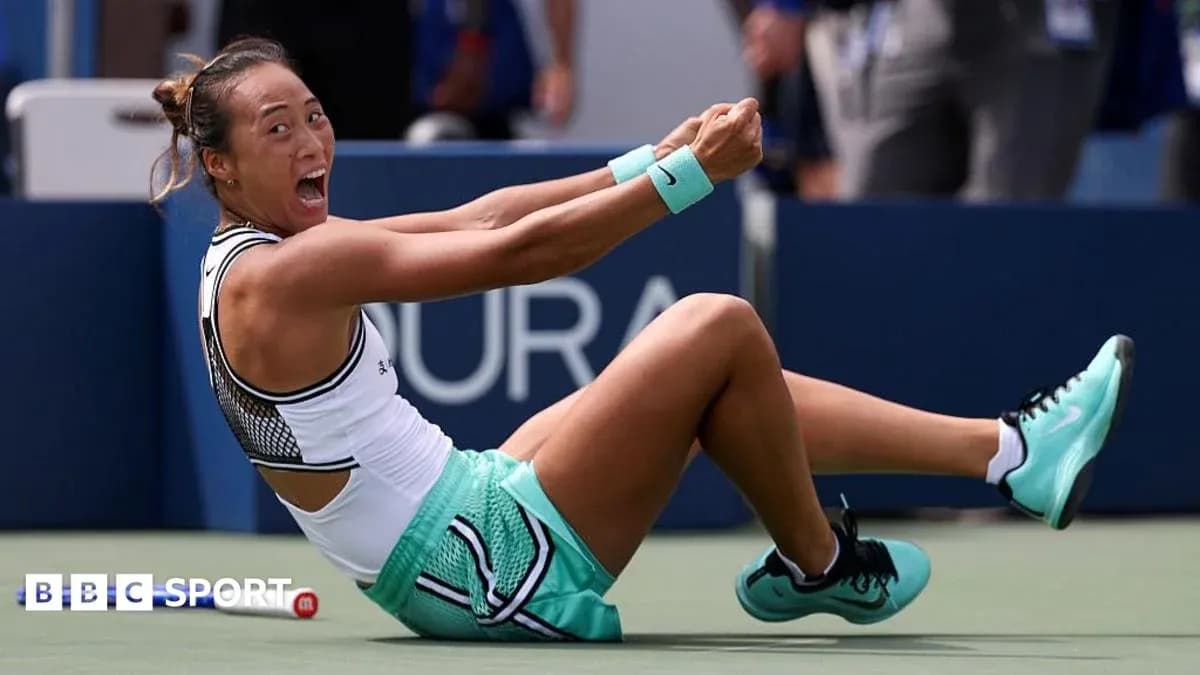
By now, Zheng was the one dictating, her body language transformed. Keys fought to stem the tide, but the momentum had swung violently across the net. At 6-5, Zheng completed the heist, sealing a 7-5 third set and one of the most audacious comebacks the US Open has seen in recent years.
She threw herself to the court in disbelief and release, the last 12 months crashing over her at once.
“Finally, a bit of luck is on my side,” the 23-year-old said afterwards. “I am just telling myself ever give up. Somehow, little by little, it’s just happened. Tennis sometimes feels like rollercoaster. You see many times people have a match point, but at the end we made a comeback.”
A year in the dark
To understand the weight of this win, you have to rewind.
Three months ago, Zheng sat in a press room in Paris and cried after a first-round exit at Roland Garros. It was her first Grand Slam since elbow surgery in July 2025, an operation to remove small pieces of bone floating in the joint. A chronic problem that had finally become unbearable.
That injury had cut short the best spell of her career. In 2024 she had reached the Australian Open final, won Olympic gold, and made the US Open quarter-finals. She opened 2025 in the same gear, pushing into the last eight at Roland Garros and climbing to No. 4 in the world.
Then the elbow gave way. Nine months gone. Momentum shattered.
When she returned, the ranking told its own story. From the top four to as low as 160. For the first time in four years, she had to grind through qualifying at a major just to earn a place in the main draw. The player who had moved with such certainty now questioned everything.
“After coming back from injury I felt I lost the energy and I forgot how to compete,” she admitted.
Those doubts were not abstract. They played out in real time, under lights, in front of cameras. The tears in Paris. The early exits. The unfamiliar feeling of being the hunter again, not the hunted.
Echoes of Raducanu
That is what makes this New York run so striking. Zheng is the first qualifier to reach the women’s fourth round at the US Open since Emma Raducanu in 2021, a name that carries its own weight in this city. Raducanu rode that wave all the way to the title.
No one inside Zheng’s camp will be rushing to draw that parallel too loudly. The road back from surgery rarely runs in straight lines, and one wild comeback does not guarantee a clean ascent. But nights like this do something numbers cannot capture: they restore belief.
From 5-0 down and match point against a Grand Slam champion, she found the competitor she feared she had lost. She trusted her shots again. She trusted her fight.
For a player rebuilding a career, that might be the most valuable win of all.
Now the qualifier who once wondered if she would ever feel like herself again walks into the second week of the US Open, not as a curiosity, but as a threat. The question is no longer whether Zheng Qinwen can compete at this level.
It’s how far this rollercoaster is about to run.