.svg&w=384&q=75 "logo")
Venus Williams: A Legend's Return to the US Open
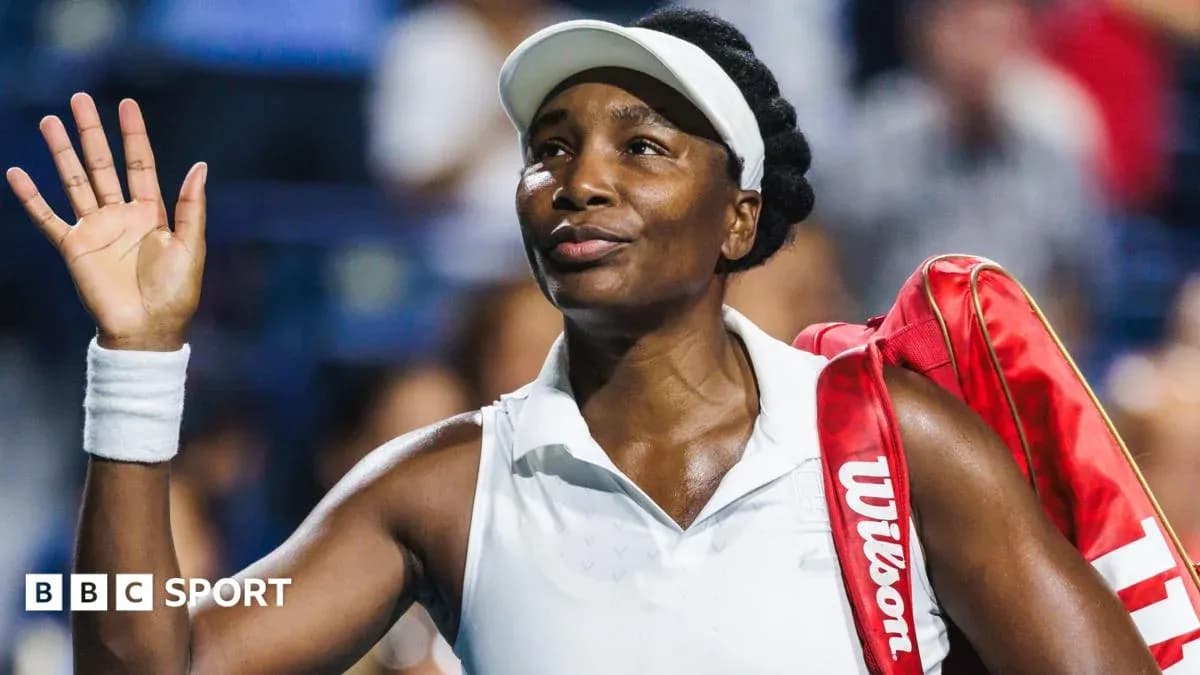
Venus Williams will walk back into Flushing Meadows next week the way she always has – head high, shoulders back, as if time is something that happens to other people.
She is 46 now, nearly three decades into a professional career that has reshaped the sport, claimed five Wimbledon singles titles and two at the US Open, and inspired a generation. Yet the numbers she carries into New York this time are stark.
Fourteen straight singles defeats. Eighteen losses in her past 19 matches. A world ranking of 611. And still, another wildcard.
A legend on borrowed time – and borrowed entries
The United States Tennis Association has handed Venus a 12th wildcard of the season so she can play in the US Open main draw, where she will face fellow Grand Slam champion Sofia Kenin in the first round.
On paper, it is a decision that divides opinion. She has not qualified for a major on ranking since Wimbledon 2021. That same tournament remains the site of her last singles win at a Grand Slam. Since then, every appearance in a main draw has depended on an invitation.
There is a school of thought that says enough is enough. That wildcards should reward form, not memory. That 11, now 12, main-draw gifts in a single season is simply too many for a player without a tour-level win in more than a year.
But that argument runs into a hard reality: there is no formal limit on how many wildcards a Grand Slam champion can receive. And when the champion in question is named Williams, sentiment is only part of the story. The rest is business.
Tournament directors still want her. They still call.
This year alone, events in New Zealand, Australia, Spain, Germany, Canada and the United States have all opened doors for her. Eight of the 128 spots in a Slam singles draw are reserved for wildcards. At WTA and ATP events, four to eight more sit in the gift of organisers. Those spots carry value – commercial, promotional, emotional. Venus, even in decline, ticks every box.
‘Generational icons’ and the price of a seat
Karl Hale, tournament director in Toronto, did not hesitate when the chance came to offer her a wildcard for this month’s WTA 1000 event.
“I think it's good for tennis to have these generational icons,” he said. “That they are still allocating wildcards for them says something to their intrinsic value to the tournaments.”
Hale’s calculation was simple. Venus Williams still moves the needle.
“She’s done so much for the sport and is really popular here in Toronto and our markets specifically – so we thought it was really good to announce it early that we have a Williams sister coming.”
The impact was immediate. Media interest spiked. Opening-day ticket sales followed.
“The wildcards always play first-round matches, and with the bigger draw now, it adds more notable names and stars for the beginning of the tournament,” Hale said. “Venus played opening day. She kicked off our tournament, so it added a lot of value.”
This is the trade-off at the heart of the wildcard debate. Most events will first look after their own, handing chances to national players trying to break through. But slots also go to names that sell – the stars who can fill stands on a Monday afternoon, not just a Saturday night.
Sometimes those decisions are literally trades. Federations and agencies cut deals. Hale talks about “trades” with other national bodies or with player management groups like IMG, which until recently owned the Miami and Madrid Opens. The most obvious example sits at the top of the sport: the reciprocal wildcard agreements between the USTA, Tennis Australia and the French Tennis Federation. Each offers a men’s and a women’s wildcard to the others, knowing the favour will be returned when their own Slam comes around.
In that marketplace, Venus remains premium stock.
Still swinging, still close – but not winning
Strip away the nostalgia and the marketing, and the numbers on court are unforgiving.
Her last 14 singles matches have all ended in defeat. The only win in her past 19 came against Peyton Stearns in Washington last July. This month in Cincinnati, she fell to qualifier Emiliana Arango. Another early exit. Another reminder of how far the results have slipped.
Yet it has not been a story of one-sided beatdowns. At the Slams, the old competitive fire keeps flickering.
At last year’s US Open, she stretched 11th seed Karolina Muchova to three sets. In January, at the Australian Open, she again went the distance before losing narrowly to Olga Danilovic. Hale points to her 6-4 6-1 defeat to Kamilla Rakhimova in Toronto as another example.
“Venus lost 6-4 6-1 to Kamilla Rakhimova, and the first set was really competitive,” he said. “She's still competitive, but just not winning these matches.”
That distinction matters to the people handing out wildcards. No tournament director wants to send out a great champion to be humiliated.
“You never want to put a player out there that you are unsure about,” Hale said. He believes she can still win matches. The evidence is thin, but not non-existent.
Doubles has offered a softer landing. At last year’s US Open, Venus reached the quarter-finals in that format, showing there is still enough feel, enough instinct, to trouble opponents when she shares the court.
When does legacy meet its limit?
So where is the line? When does a wildcard for a legend become a wildcard denied to a younger player trying to climb?
Golf has already wrestled with that question. The Open Championship used to allow any past champion under 65 to tee it up. Two decades ago, that was cut off at 55, freeing places for those higher in the rankings and closer to their peak. Golfers can stay competitive well into their fifties. Tennis is far less forgiving on the body, but the rules remain wide open.
Martina Navratilova received wildcards for the 2004 French Open and Wimbledon at the age of 47. On the grass of SW19, she even won a round. There is precedent for legends stretching their careers with the help of invitations.
So should tennis impose its own age or wildcard cap? Or should the game let its icons decide when the curtain finally falls?
Hale thinks the answer still rests with Venus.
“When the time comes that Venus is not competitive in sets, then I think she will make that call,” he said.
From his perspective, the Williams sisters have earned the right to take that decision on their own terms.
“Venus and Serena have done so much for women's tennis and the sport that they should be able to play as long as they want. I'm very happy they are continuing and they make their decision when they are ready, or each tournament makes their decision when they are ready.”
Players feel it too. British number one Katie Boulter, who partnered Venus in doubles in Madrid in April, did not hesitate when asked what the American still means.
“Venus has given so much to our sport that she deserves to get what she needs back,” she said. “We have to be grateful that she is still out there, doing the best she can.”
One more walk into the noise
And so the cycle continues. Another wildcard. Another first-round match on a big court. Another chance, however slim, that the old timing clicks and the crowd sees something that looks like the Venus of old.
For the young hopefuls hovering outside the main draw, her name on the list means one less open door. For the USTA and the US Open, it means an opening day built around a global icon.
At some point, the results may make the decision for her. For now, the sport keeps holding the door open, and Venus Williams keeps walking through it.