.svg&w=384&q=75 "logo")
Venus Williams' Late Night US Open Match Sparks Controversy
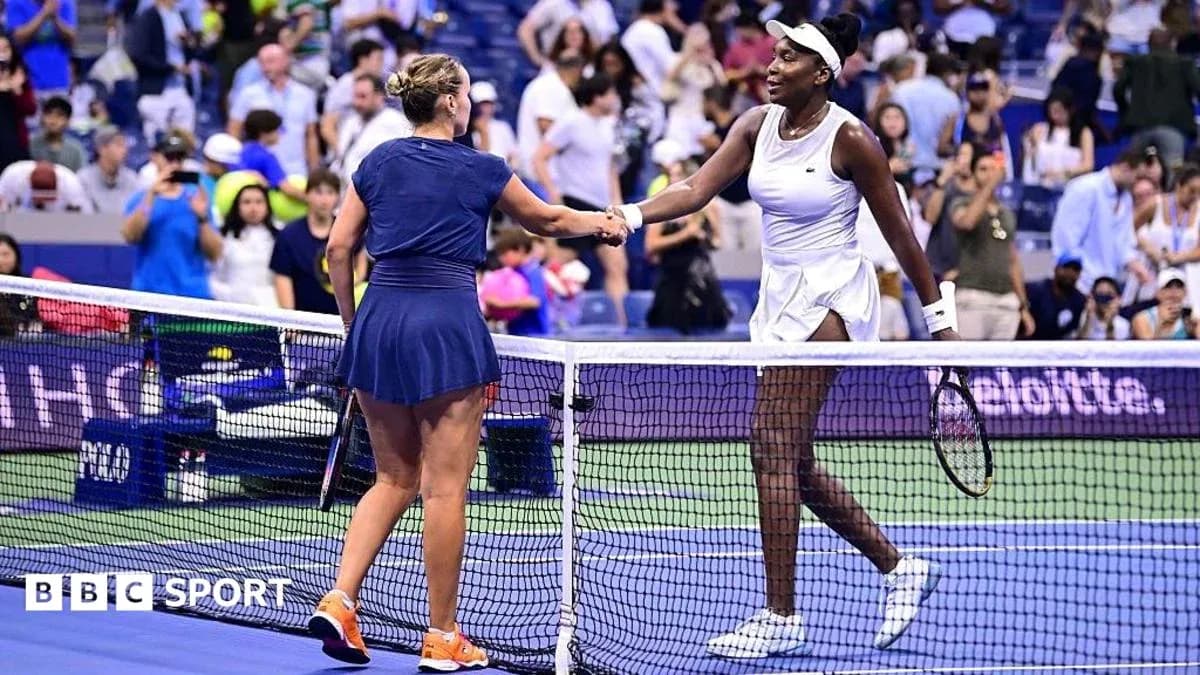
Venus Williams walked into Arthur Ashe Stadium with the lights blazing and the clock already flirting with Monday. This was supposed to be a Sunday night showcase, a primetime salute to a great champion on home soil. Instead, she and Sofia Kenin were sent out just after midnight, starting a first-round match at an hour when most of New York had long since gone to bed.
By the time Kenin closed out a straight-sets win, it was past 2am. The stadium, built for 23,933 people, felt cavernous and half-asleep.
Williams, 46 years old and on a 15-match losing streak in singles, did not hide her frustration. She called the scheduling “not ideal” and said it “wasn't great” for either player’s conditioning. She will play doubles with Serena later in the tournament, but if this is her last US Open as a singles player, it arrived in the dead of night, in front of a thinning crowd and a tired sport.
Her complaint is not new. It sits at the heart of a long-running argument between players and Grand Slam organisers: who pays, who plays, and how late is too late?
Why tennis keeps pushing into the night
Three of the four majors – the Australian Open, Roland Garros and the US Open – have embraced split days: one ticket for the daytime grind, another for the night-session glamour.
In New York, that means two marquee matches from 7pm: one men’s, one women’s. The logic is blunt and unapologetic. Two sessions mean two sets of tickets for the same seats. Day fans file out, night fans file in. The second group pays more for the privilege.
Those night tickets are marketed as an event. After work. Under the lights. Big names, big atmosphere. The price tag reflects it.
Then there is television. The US Open’s domestic broadcaster, ESPN, signed a deal in 2024 worth $2.04bn to show every match until 2037 – roughly $170m a year. Primetime tennis in the US sits in a lucrative window, with late-night talk shows only kicking off around 11pm. Advertisers pay more for those slots, and broadcasters know it.
The tournament has built its modern identity around that evening spectacle. The roar, the skyline, the late finishes. It sells.
Wimbledon, by contrast, has drawn a clear line. Play starts at 11am and stops at 11pm, roof or no roof. If a match is still going, players return the next day. Fans know they will not be stranded on Centre Court at 2.30am, scrambling for a way home. The BBC, which broadcasts Wimbledon, is not driven by the same advertising pressures, and the tournament has never embraced a formal night session.
Players sometimes grumble when a match is halted just a few games from the finish. But they know the rules. There is certainty, even if it occasionally cuts across drama.
In New York, certainty is the first thing sacrificed.
When the clock beats the players
Organisers can never truly predict how long a tennis match will last. They know the range. They also know the extremes.
A five-set men’s match can easily sprawl past four hours, even five. A three-set women’s match can push beyond three. Put them back-to-back in a night session, and the second match is at the mercy of the first.
That is exactly what happened to Williams and Kenin. Novak Djokovic’s defeat by Mariano Navone stretched to five sets and over four hours. The delay rolled downhill. By the time the women walked on court, Sunday night had become Monday morning. By the time they walked off, most of the crowd had gone.
Tournament director Stacey Allaster defended the model last year after reviewing the 2022 event. She argued that starting earlier than 7pm was unrealistic for New Yorkers trying to get to Queens after work. She also pushed back against the idea of cutting the night session to a single match, saying it would short-change fans who expect a full evening of tennis.
Tennis, she pointed out, does not have a fixed runtime. A night ticket might buy you a 70-minute demolition or a five-hour epic. That unpredictability is part of its charm – and part of its problem.
Everyone in the sport understands the risk. When a schedule leans on long matches for drama and revenue, it also invites chaos. The second match on Ashe is always one long fifth set away from finishing in the middle of the night.
Money, power and a growing revolt
The late nights are not an isolated grievance. They sit inside a broader clash between players and Grand Slam organisers over money, workload and basic working conditions.
Players have pushed for a larger share of Grand Slam revenue, pointing to rising demands on their time and bodies: late starts, short turnarounds, expanding media duties, questions over pensions and long-term security. Many see the night sessions as a symbol of where the balance lies – with broadcasters and ticket sales, not with athletes’ recovery.
At Roland Garros and Wimbledon, leading names such as Coco Gauff, Aryna Sabalenka and Jannik Sinner have scaled back media commitments in protest at what they view as unfair conditions. It was a quiet but pointed form of resistance.
The pressure has had some impact. Wimbledon and the US Open have agreed to increase prize money from 2026. A new Grand Slam players advisory council, due to launch after this US Open, will give players a more formal voice in how the majors are run.
What that council does with late-night finishes is an open question. The majority of players dislike them. Many see them as unnecessary, unhealthy and avoidable. Yet any move to bring matches back into earlier windows will come at a cost.
If night sessions are trimmed or reshaped, broadcasters may not pay as much for rights. With a smaller pot, prize money could fall. The same players pushing for better conditions might find themselves fighting over less money.
That is the tension at the heart of this era of tennis. The sport wants the spectacle and the cheques that come with it. The players want a career that does not ask them to compete at 1.45am in front of empty seats.
For now, the numbers are winning. Venus Williams, a seven-time major champion and one of the defining figures of the Open era, walked out for a US Open singles match in the small hours and called it “not ideal.” The match ended. The stadium emptied. The arguments did not.
How long tennis keeps chasing the money into the night will say plenty about who really runs the biggest stages in the game.