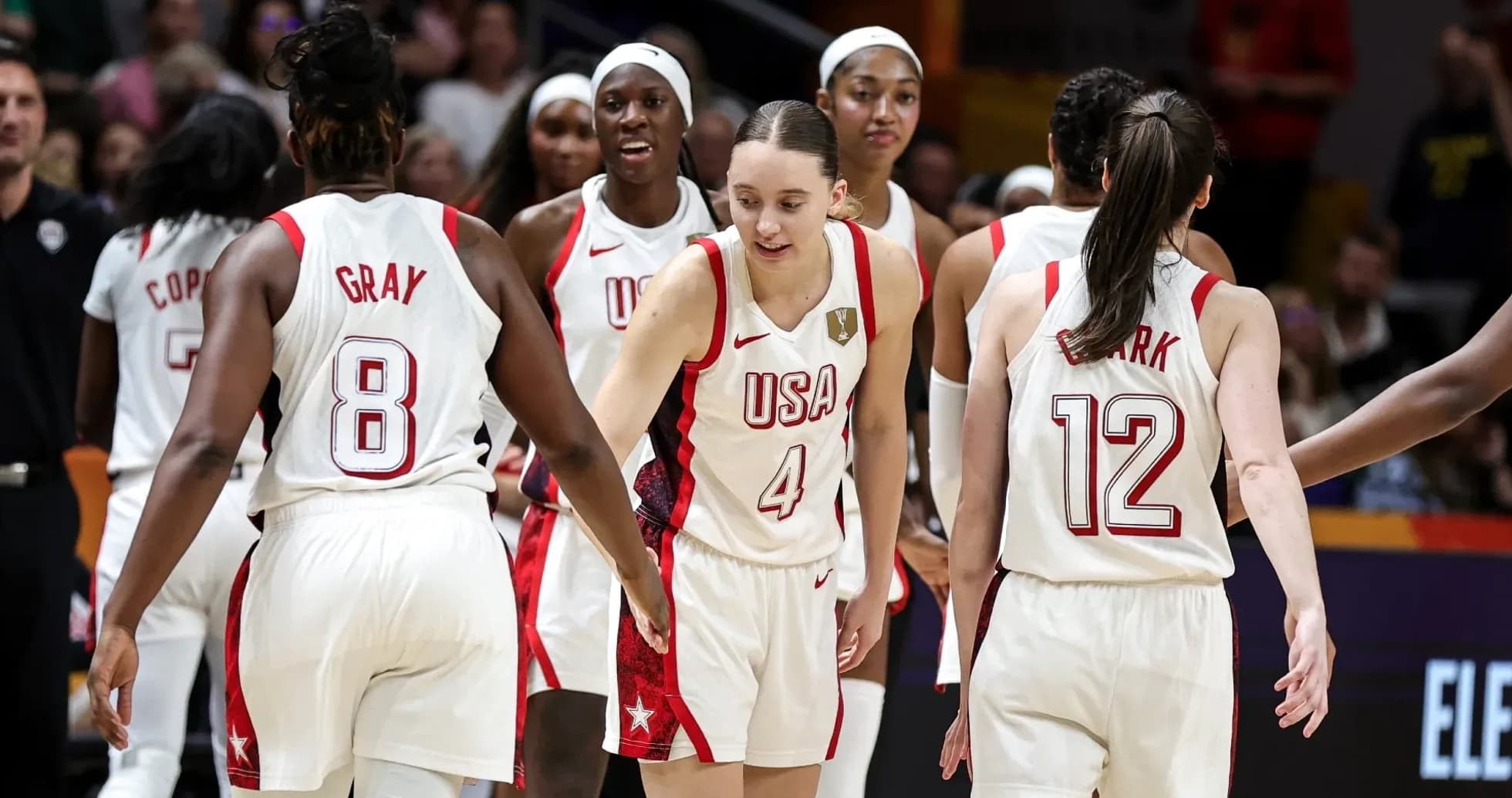
U.S. Women’s Basketball Dominates Hungary in FIBA World Cup Quarterfinals
BERLIN — The U.S. didn’t just advance. It steamrolled its way into the women’s FIBA World Cup semifinals.
Napheesa Collier poured in 19 points as the Americans crushed Hungary 108-56 on Thursday, a statement win wrapped inside a record-breaking performance.
Next up: the winner of Spain vs. Australia on Saturday in the medal round. France–China and Belgium–Germany completed the quarterfinal slate, but this was the night the defending champions reminded everyone why the road to gold still runs through them.
Records fall as U.S. turns on the style
The numbers told one story. The way the U.S. played told an even louder one.
The 108 points were the most ever scored by any team in a World Cup quarterfinal. The 31 assists? Also a record for this stage. The ball zipped, swung, skipped an extra pass. Hungary chased shadows.
“When that ball is moving, we want to get the best possible shot,” said Kahleah Copper, who added 10 points. “We want to make sure everybody gets involved. Everyone here on this roster, we know what they’re doing on their respective (WNBA) teams. But you come here, you sacrifice a little bit of that.”
They didn’t just talk about sacrifice. They played it. Good shots became great ones. Open looks became layups. The box score turned into a showcase of collective dominance.
This is now 34 consecutive World Cup wins for the U.S., a run stretching back to a semifinal loss to Russia in 2006. Since medal rounds were introduced in 1983, the Americans have never missed one. The streak lives, and it doesn’t look tired.
A blitz from the opening tip
Hungary barely had time to settle in before the game was gone.
The U.S. ripped off a 36-12 first quarter, running at every opportunity, hammering the paint, and turning turnovers into fast-break layups. Every miss by Hungary felt like the start of another American sprint.
Caitlin Clark and Angel Reese, still early in their international careers, looked like they’d been running pick and rolls together for years. On the final possession of the first quarter, they executed a slick two-player game, Clark threading the pass, Reese finishing just before the buzzer. It was a small moment in a big win, but a telling one: the chemistry is growing, and quickly.
Collier set the tone with 10 points in the opening 10 minutes, attacking inside, cutting hard, and punishing every defensive lapse.
The offensive onslaught only intensified. The U.S. hit 20 of its first 26 shots — a scorching 77% — and knocked down five of its first six 3-point attempts. With six minutes left in the half, the lead had ballooned to 50-18. The contest felt less like a quarterfinal and more like a training tape.
By halftime it was 59-30, the highest-scoring first half in U.S. history in a World Cup knockout game, according to FIBA. The scoreboard in Berlin was working overtime.
Clark orchestrates, defense suffocates
Clark finished with 10 points and nine assists, flirting with her second double-double of the tournament. She controlled tempo, stretched the floor, and repeatedly found teammates in stride. One more made basket here or there, and it would have been another statistical milestone. The performance didn’t need it.
The defense matched the offense.
Hungary’s centerpiece, Dorka Juhasz of the Minnesota Lynx, walked into the arena as one of the tournament’s standout performers, averaging 15.3 points and 11 rebounds. She left frustrated and smothered.
The U.S. crowded her catches, bodied her on the block, and contested everything. Juhasz missed her first seven shots and did not see the ball drop through the net until 2:26 remained in the second quarter. She ended with just two points on 1-of-12 shooting, a stark contrast to her earlier form in the competition.
Hungary tried to adjust, but every adjustment met another American wave.
A brief scare, then back to business
There was a moment of concern in the third quarter when Sonia Citron took an accidental hand to the nose from a Hungary player and had to leave the floor. The U.S. bench looked on with unease.
Citron returned to start the fourth quarter, easing any fears and allowing the Americans to settle back into their rhythm.
By then, the result was beyond doubt. The only remaining questions were about margins, minutes, and records. The U.S. rotated freely, spread the scoring, and kept the pressure high without losing its edge.
Hungary’s historic run, America’s familiar standard
For Hungary, the night ended in a heavy defeat, but the tournament still marks a historic step. Reaching the quarterfinals for the first time in this format delivered their best World Cup finish in the medal-round era. The nation’s previous high, fifth place in 1957, came in a round-robin competition with no knockout stage.
This version of Hungary ran into a juggernaut.
The Americans, meanwhile, look exactly like what their record says they are: the benchmark. The team everyone else measures themselves against. The side that can turn a World Cup quarterfinal into a showcase of how ruthless, unselfish basketball is supposed to look.
Spain or Australia awaits on Saturday.
The bracket tightens now. The margin for error shrinks. But if the ball keeps flying like this and the defensive screws stay this tight, who is really ready to stop them?