.svg&w=384&q=75 "logo")
U.S. Open 2024: When Influencers Disrupt Tennis Etiquette
The Arthur Ashe court has seen its share of distractions over the years. Drunken shouts in the cheap seats. Celebrity cutaways on the big screen. A restless New York crowd that never quite behaves like Wimbledon.
But on Monday night, as Naomi Osaka faced Anastasia Zakharova, the noise wasn’t coming from the usual places. It was coming from a glowing rectangle of light and a suite full of people more focused on content than on tennis.
A TikTok Set on Center Court
Midway through the match, the umpire’s patience snapped. Over and over, he turned toward a particularly loud suite and asked them to quiet down as they filmed what looked like a TikTok dance, illuminated by a bright, handheld light. The scene unfolded in the middle of points, not during breaks, with Osaka on serve.
In the stands, Katherine — a lifelong tennis fan — pulled out her phone and started recording. Her video, showing influencers posing and taking selfies while play continued, rocketed around social media, drawing more than 1,500 comments and a wave of anger from fans who feel the U.S. Open has slipped into something closer to a social-media festival than a Grand Slam.
“All around the stadium, there were people — in the middle of serves and in the middle of points — getting up, walking through the crowd down to the closest they could get to the court in their section, and taking pictures, taking videos, using ring lights,” Katherine said. For traditional tennis fans, that’s a cardinal sin. You sit still for the point. You move at the changeover. That’s the deal.
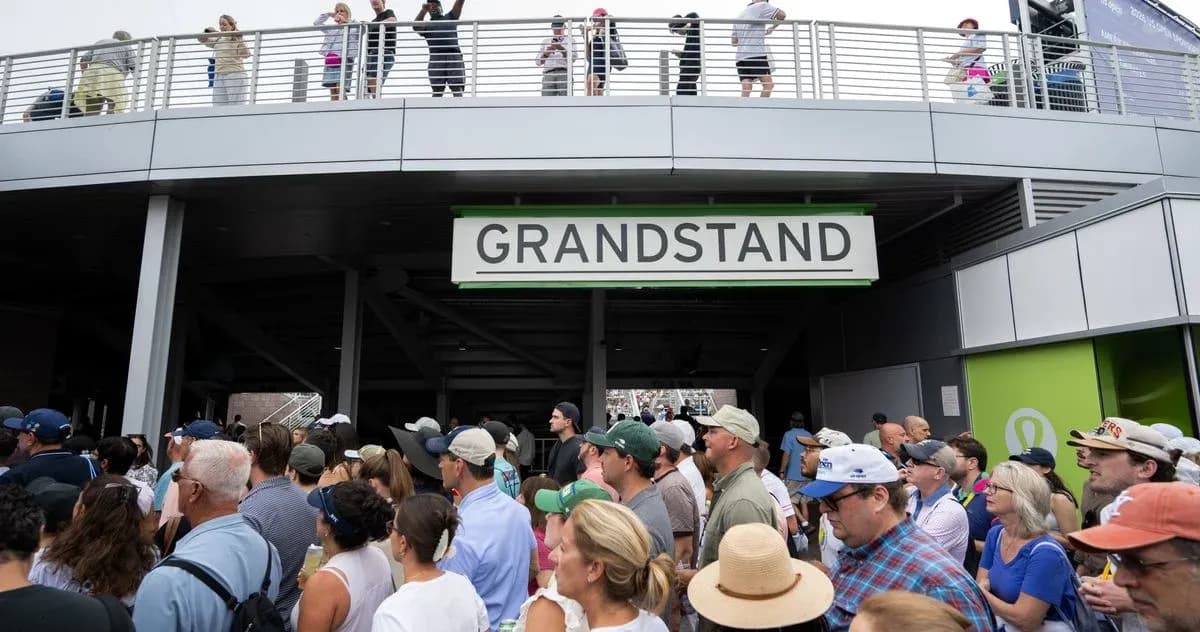
Not this year. In 2024, the U.S. Open relaxed its rules on walking around during matches. The result: a steady stream of fans and influencers drifting through the aisles while players tried to lock in on second serves and break points.
“I Just Wanted One Cute Photo”
One of the faces caught in Katherine’s video was Mriganka Chawla, a fashion and lifestyle influencer who suddenly found herself at the center of the storm.
Chawla wasn’t in the rowdy suite that drew the umpire’s ire, but she did step into a quieter section to get a photo while Osaka played. It was her first time at the Open, attending with her fiancé’s tennis-obsessed family. She wasn’t on a paid assignment. She just wanted a picture.
She says she left her seat to grab an ice-cream sandwich, then spotted a relatively empty part of the stands and asked an usher to take her photo — under a bright selfie light. “Because my man can’t take a photo to save his life,” she explained.
“I was seriously so far away,” Chawla said. “I’m really sorry if I disrupted any playing.”
At first, she pushed back in the comments under Katherine’s video, insisting her flash wasn’t disturbing anyone. Once she identified herself, the reaction turned ugly. She says she’s now getting a mix of “death threats” and questions about which selfie light she used — the same one popularized by Alix Earle.
“This is such an influencer thing, and I understand that now, but everybody has really cute photos [from the Open]. I just wanted one cute photo,” she said. “I wish somebody had told me, ‘You can’t do that.’ This is also on me. I should have researched it. I wish there were some guidelines or something.”
The punchline? The photo that caused all the trouble, she says, “looks like I’m mid-sneeze.”
“Tennis Disneyland” Meets Tennis Etiquette
This clash didn’t come out of nowhere. It’s the product of a deliberate strategy.
The United States Tennis Association has spent the past few years turning the U.S. Open into what its CEO recently called “tennis Disneyland” — a sprawling, sponsor-heavy, family-friendly spectacle built as much for Instagram as for the scoreboard. Branded cocktails. Pop-up activations. Photo walls. A-listers in suites. And now, a growing army of influencers.
According to Sportico, the USTA handed out media credentials to 100 influencers and podcasters this year, double last year’s figure. That number doesn’t even include the creators invited by sponsors to their corporate suites, the very spaces now drawing the loudest complaints.
For many long-time fans, the balance has tipped. They’ve watched ticket prices climb, crowds swell, and an increasing number of newcomers treat the night session like a backdrop for content rather than a world-class sporting event.
A recent piece in culture magazine the Mercer Edition called it bluntly: the U.S. Open has an “influencer problem.” The article argued that tennis depends on a level of concentration that only really makes sense when you’ve seen it up close — and that brands should remember that before they chase “vanity metrics and corporate satisfaction.”
Katherine feels the same fatigue. She’s seen the Open evolve from a loud, raucous, but locked-in crowd into something else entirely. The Honey Deuce became a social-media prop. Tennis WAGs turned into Instagram fixtures. The selfies multiplied. Then came the ring lights.
“The tournament has always been known for its loud and rowdy crowds,” she said. “Once it’s impacting the play of the game, that’s a breaking point.”
When the Flash Becomes the Story
The irony is hard to miss. A tournament desperate to be seen — to be shared, clipped, and posted — now finds itself under fire for exactly that.
The U.S. Open wanted reach. It got a viral video of an umpire pleading for silence while a suite full of guests filmed content under a glaring light, seemingly oblivious to the match they’d come to watch. It got a debate about etiquette, entitlement, and what kind of fan the sport actually wants.
It also got a reminder of a simple truth: in tennis, distraction is not just an annoyance. It can decide points, games, even matches. A flash at the toss, a figure moving in the corner of a player’s eye, a burst of noise during a second serve — the margins are that thin.
For now, the influencers will keep coming. The brands will keep filling suites. The Honey Deuces will keep flowing. The question is whether the U.S. Open can keep selling the spectacle without losing the sport at its core.
Because if the brightest light in Arthur Ashe is a selfie lamp and not the scoreboard, tennis has a bigger problem than a bad photo that looks like a sneeze.