.svg&w=384&q=75 "logo")
Untold Raygun: Breaking Badly - A Love Story and Olympic Downfall
On Netflix, the story of Rachael Gunn doesn’t open with a scandal. It opens with a love story.
In Untold Raygun: Breaking Badly, the cameras first find Gunn not under the glare of Olympic lights, but in the softer orbit of her husband, Samuel Free. “Sammy (Sex)” in the film’s telling, he’s the partner who shared her obsession with dance long before the rest of the world knew her name, the man who ended up coaching her in breaking as Paris 2024 loomed into view.
Their wedding footage drops into the documentary like a home video spliced into a global news report: vows, smiles, and of course, dancing. The couple move like two people who never expected their private passion to become public property.
That innocence doesn’t last long.
From lecture theatre to lightning rod
Gunn, better known by her breaking name Raygun, arrived in Paris as an academic-turned-Olympian. She left as a meme.
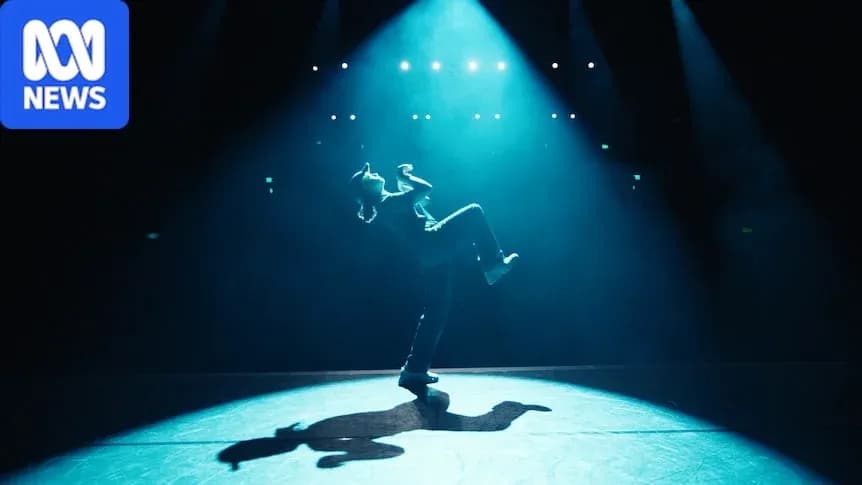
Her routine on the Olympic stage detonated online. Within hours, social feeds filled with clips of her now-infamous moves — the kangaroo, the sprinkler — looped, remixed, ridiculed, defended. Comedy skits followed. So did conspiracy theories. Opinion piled on opinion, praise clashed with derision, and a previously obscure B-Girl from Australia found herself at the centre of a culture war she never asked for.
When Snoop Dogg and Adele start weighing in on your footwork, you’re no longer just an athlete. You’re pop culture.
The documentary doesn’t shy away from that explosion, but it spends just as much time on the slow, uneasy countdown that came before it. In those weeks leading into the Games, Raygun looks startlingly unready for what’s coming — not only competitively, but emotionally. She is portrayed as an Olympian without an Olympic-sized support team, a breaker stepping into a brand-new Olympic discipline with very few people around her who truly know that world.
What she does have is a sharp sense of looming disaster.
“What’s the worst that could happen?”
In one of the film’s most telling moments, Gunn recounts a session with her therapist right before Paris.
“Right before the Olympics, I went to my therapist and panicked,” she says.
The therapist’s question is the classic one: What’s the worst that could happen?
Raygun’s answer lands like a prophecy. The worst, she says, is that the whole world could laugh at her.
Days later, that nightmare plays out in real time.
Her parents, Russell and Beverly, bring a different texture to the story. They remember a “normal suburban girl,” not a future Olympian. Her mother recalls the early years — ballet, tap, jazz — before breaking entered the picture. Her father, half-joking, admits he thought his trip to Paris might end with him consoling his daughter rather than celebrating her.
He wasn’t the only one bracing for impact.
Breaking’s big stage, brutal reception
Paris was not just Raygun’s debut at an Olympic Games; it was breaking’s debut as an Olympic sport. The stakes were enormous for everyone involved. For some in the breaking community, that made her performance feel unforgivable.
B-Girl Tinylocks, a fellow breaker who chose not to pursue an Olympic berth, emerges as one of the film’s harshest critics. She speaks as someone who sees breaking first as an art form, and she is appalled by what she watched in Paris.
“Who could have imagined it would have gone so wrong?” she says.
Her absence from the Olympic qualifiers hangs over her comments. She didn’t try out, perhaps because she feared exactly this: the world’s first real look at Olympic breaking framed by a routine that, in her eyes, misrepresented the culture she loves.
B-Girl Flix, a friend of Raygun’s for 15 years, offers a different kind of sting. Friendship doesn’t blunt her words. She describes feeling “offended” and “embarrassed” by the performance, a reaction that cuts deeper precisely because it comes from inside Gunn’s own circle.
The documentary rewinds to show Raygun’s Olympic qualifier against B-Girl Molly. The footage is awkward. Both dancers look stiff, both short of the swagger and polish expected at that level. Neither appears especially professional in that moment, a reminder that breaking’s Olympic era began with athletes and a system still finding their feet.
When the real thing arrives in Paris, the judges are ruthless. Raygun doesn’t receive a single vote in any of her rounds. On paper, it’s a wipeout. On screen, it’s the start of something far messier.
Living inside the storm
Untold Raygun: Breaking Badly gives Gunn space to narrate her own downfall and its aftermath. Her voiceover threads through the film, pulling viewers inside the surreal experience of waking up as a global punchline.
“Sometimes this all feels like a really wild dream,” she says early on. “It’s like I’ve been charged with some crime.”
That line hangs over every frame of online mockery that follows. For the millions who only saw a 30-second clip, she was a joke. For her, it felt like a trial.
The documentary tracks the days before, during, and after Paris, letting Raygun unpack what happened in real time rather than in neat hindsight. There are no grand excuses, no last-minute revelations of secret injuries or sabotage. Just an athlete who stepped onto the biggest stage of her life, misjudged it badly, and then watched as the internet turned her misstep into a global spectacle.
By the end, the cost is clear. Raygun reveals she has walked away from her academic career, leaving her future deliberately unresolved. No new path, no triumphant pivot, no tidy redemption arc. Just open space.
The love story that opened the film is still there. The memes are still out there. Breaking has had its chaotic Olympic baptism. And Raygun, caught between them all, is left to decide what comes next.