.svg&w=384&q=75 "logo")
Taylor Fritz's Heartbreaking Defeat at the 2024 US Open
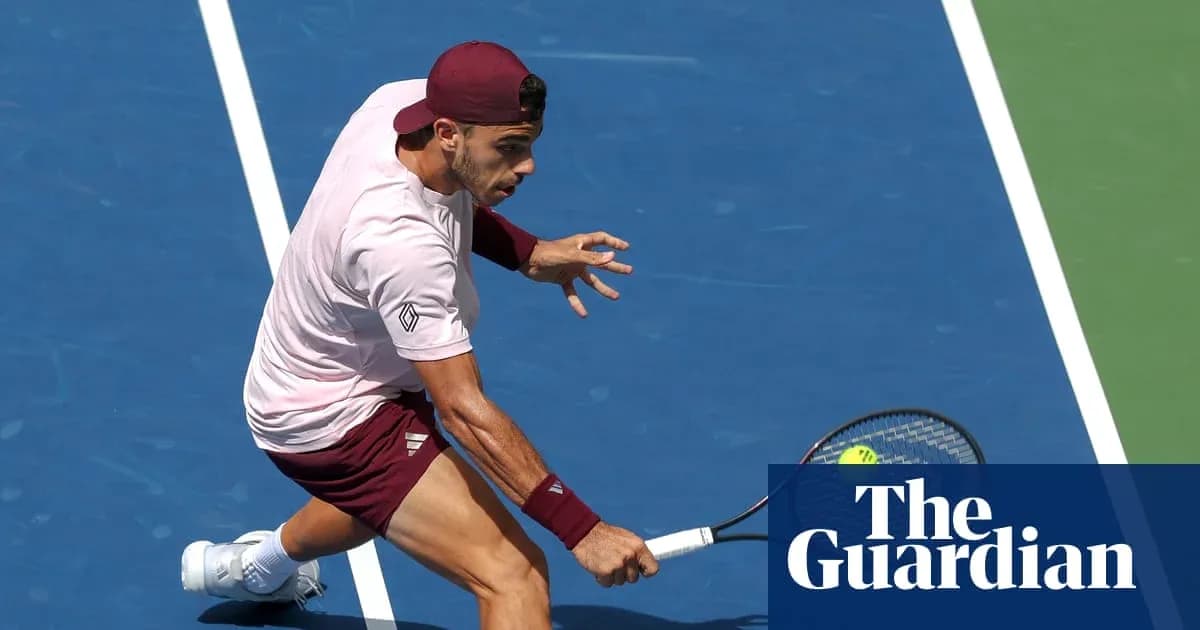
Taylor Fritz dropped his racket, then his head. As his last, frantic backhand sailed long under the Arthur Ashe lights, the American covered his face with both hands, frozen in the realisation of what he had just thrown away.
For two sets, this was the match he has spent a career waiting for. Control. Clarity. A draw blown wide open. A home slam there for the taking.
Then it slipped, point by point, game by game, until a golden chance at the 2024 US Open dissolved into a 3-6, 4-6, 6-3, 6-4, 6-4 third‑round defeat to a relentless Francisco Cerundolo.
A door swings open – and Fritz walks past it
Fritz did almost everything right for an hour and a half. He bullied Cerundolo from the baseline, took a two-sets-to-love lead, then broke in the opening game of the third. Arthur Ashe felt calm, almost routine. The No 1 American was cruising towards the second week.
One loose service game changed everything.
Cerundolo, who had looked outclassed early on, seized on that flicker of doubt. Fritz never quite found the same rhythm again. From the moment the Argentine stole back the break in the third, the match turned into a long, grinding test of nerve. Fritz failed it.
Across the last three sets, the 28-year-old spent more than two hours chasing the momentum he had casually tossed away. It never truly returned. In the deciding set, he still carved out three break points for a 5-3 lead and a chance to serve for the match. He missed them all. Cerundolo did not miss his opportunity.
“I don’t even know what to say,” Fritz admitted afterwards. “I don’t really want to talk to anybody, see anybody. I kind of just need to get out for a couple days and then just get back to work. I don’t know how I let that happen today.”
The words were flat. The look on his face said more.
The best of his generation, stuck in the same place
For years, Fritz has been the standard-bearer for American men. He climbed as high as No 4 last season. He is the one with the deep runs, the one who finally cracked the code in New York in 2024 by reaching the US Open final – the first American man to do so since Andy Roddick in 2006.
Either side of that breakthrough, he ran into Novak Djokovic in the quarter-finals in 2023 and 2025. An all‑time great, standing in the doorway. The story of his career so far.
Fritz is not the most natural athlete in the top tier, and he knows it. He has dragged every ounce out of his game through work, discipline and stubbornness. Usually, the explanation for his defeats is simple: someone better, often one of the sport’s giants, stood across the net.
This fortnight felt different. The giants are mostly gone.
Jannik Sinner, world No 1 and already a four‑time grand slam champion, is out with injury. Djokovic, now 39, crashed out in the first round in a shock that still hangs over the tournament. Carlos Alcaraz, a seven‑time major winner and the defending champion, is playing his first event after four months out.
No dominant force. No clear favourite in peak form. For once, the draw looked like a wide-open street fight. For once, Fritz did not have to stare down a legend to dream of a trophy.
That is why this one hurts more. This was the window.
A warning for the American pack
At the start of the day, seven American men were still alive in singles: Ben Shelton, Fritz, Frances Tiafoe, Learner Tien, Tommy Paul, Alex Michelsen and Michael Zheng. In the bottom half of the draw, where Friday’s play locked in the last‑16, every fourth‑round match features an American.
On paper, it is a dream scenario for a nation that has waited since Roddick’s 2003 US Open triumph for another men’s major champion.
In reality, Fritz’s collapse is a flashing red light for all of them. More opportunity means more weight on the shoulders. The absence of Sinner and an early Djokovic exit do not just open doors; they expose nerves.
The next week will strip away reputations. It will show which of these players can handle not just the opponent, but the expectation.
Keys’ nightmare to match Fritz’s
It was not just Fritz who walked off Ashe with that hollow, stunned look. Two days after one of the grittiest wins of her career, Madison Keys suffered one of her most brutal defeats.
On Thursday, she had saved five match points in a wild three‑set escape against Anna Bondar. On Saturday, she led Zheng Qinwen 5-0 in the final set of their third‑round match and still lost 1-6, 7-6 (3), 7-5.
From total command to total collapse.
“I think she started playing better; I started playing poorly,” Keys said. “Then I felt like I couldn’t play tennis any more, and it just was – it just felt like it was a much bigger deal than just playing a tennis match all of a sudden.”
The 2025 Australian Open champion did not sugarcoat it. She suggested this kind of result had been looming, the product of issues she has tried to push through.
“I just feel like I’ve been struggling for a while now and I feel like I was able to kind of play through it for a bit,” she said. “I’m sure everyone could kind of see that I was struggling a little bit, but inside it felt probably even bigger than that. Some weeks are easier than others, and this week is obviously one of the harder ones just because you care so much. Yeah, I’m going to have to make some changes.”
On a day meant to showcase American strength in depth, Keys’ unraveling matched Fritz’s in raw shock value. Both will linger.
Zheng’s rise from the shadows
For Zheng Qinwen, the same match was a lifeline.
The 23‑year‑old Chinese star came into New York as a former Olympic gold medallist and top‑10 player whose ranking had plunged after elbow surgery. She had to grind through qualifying just to reach the main draw.
Now she has the kind of win that can reset a season.
“Tennis sometimes feels like a rollercoaster,” she said. “You see many times that people have a match point, but at the end [their opponent] makes a comeback. Like today was just happening. So this also gives me a lesson that in a tennis match you always have to be there. It doesn’t matter if you are winning or losing, you have a match point or you don’t have a match point – you just need to be concentrated for every single point as long as you can.”
Her reward is a fourth‑round showdown with Iga Swiatek, who had to dig deep of her own.
The world No 1 saved three set points in the second set against Marie Bouzkova, then edged through 7-6 (3), 7-6 (3) in a match that asked serious questions of her resilience. Swiatek answered them, point by point, tie-break by tie-break.
On the same day, Amanda Anisimova’s resurgence stalled badly. The 2025 Wimbledon and US Open finalist, who rose to a career‑high No 3 during that blazing summer, went out with barely a murmur, losing 6-2, 7-5 to 24th seed Anastasia Potapova. With that, Anisimova will slide out of the top 10, another American story bending away from the script.
So the pattern emerges: opportunity on the table, pressure in the air, and players either rising or shrinking under it.
Fritz and Keys walked off Ashe knowing they had the match, the moment, the stage – and let it go. Others, like Cerundolo and Zheng, grabbed their chance with both hands.
In a US Open stripped of its usual giants, that may be the only question that matters now: when the draw opens and the noise swells, who still wants the ball in their hand?