Serena Williams Advocates for Women's Health After Birth Trauma
Serena Williams has spent a career spotting danger early — a drifting backhand, a hanging second serve, the slightest shift in an opponent’s body language. When her own body sounded the alarm after the birth of her first child, she read it just as clearly. This time, the stakes were far higher than a Grand Slam final.
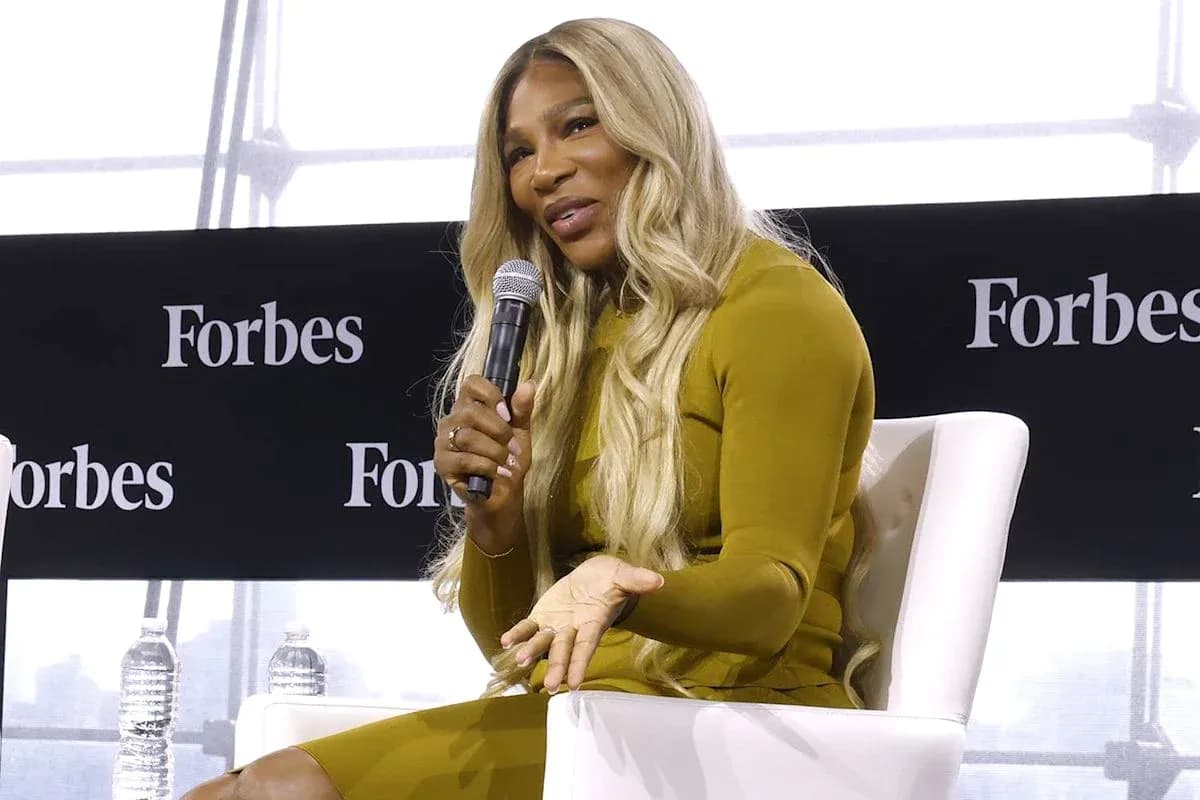
Speaking at the Forbes Power Women's Summit 2026 in New York on Thursday, the 44-year-old detailed again how the life-threatening complications that followed the birth of her daughter, Alexis Olympia, in 2017 forced her to confront a brutal truth about women’s health care.
"When I told my story, I didn't realize how many people could relate," Williams said on stage. At first, she thought it was mainly a “minority problem.” Then the stories poured in. Different countries, different incomes, different backgrounds — the same fear. "Then I realized it's a women's problem."
The room listened as one of the most decorated athletes in history described a side of her life that had nothing to do with trophies. Williams was rushed into an emergency C-section to deliver Olympia. Afterward, a coughing fit reopened her wound. That led doctors to find a large hematoma in her abdomen — a dangerous swelling of clotted blood.
The crisis didn’t stop there. She then fought through a six-day battle with a pulmonary embolism, a blood clot in the lungs that can be fatal. Multiple surgeries followed. Her body, pushed to the limit for decades on court, suddenly teetered on the edge for a very different reason.
"I knew something was wrong with me and it was super important that I was heard," she told the summit. “Thankfully, my doctor listened to me. The nurses did, but I was so fortunate enough to have a doctor that did and literally saved my life."
That insistence — the same stubborn will that drove her through five-set marathons and comeback wins — became her lifeline. It also became the foundation of her advocacy.
As she heard more women share what she called “nightmare's tale” birth stories, her anger sharpened into a wider critique. If men were the ones giving birth, she joked, the experience would look very different: “They would have sweets [and] like all kinds of medicines. So it wouldn't be the same problem at all."
The line drew laughs, but the point landed. The system is built without women at the center of it.
Williams has spent the years since trying to change that. Her own ordeal pushed her into health equity work, particularly for women and underrepresented communities. She became the first entrepreneur-in-residence for the Reckitt Catalyst program, a global social impact and innovation initiative backing female and underrepresented founders working on health, hygiene, water and sanitation solutions.
"What these women are doing is they're really letting us know that women's healthcare is so important, and healthcare in general," she said, noting that women are often the ones holding families together day to day. "Because also we're talking about women who take care of the kids, you know, I take care of my kids mostly."
Through the program, she said, the goal is not abstract. It’s practical. Build connections. Fund solutions. Remove barriers. "With the program, we're able to actually solve a lot of issues, make, like I said, make those connections that are really vital, that are really important to open so many doors," Williams explained. "Because every time we open a door, we're solving another problem that's closer to helping us all in this room and helping our kids."
Her stance is not new, but it has hardened with time. In a 2018 opinion piece for CNN, Williams spelled out how preventable so many maternal health tragedies are. She pointed to “simple solutions” that already exist: access to midwives, functioning health facilities, clean water, basic drugs, breastfeeding support, skin-to-skin contact, good nutrition.
“Yet we are not doing our part,” she wrote then. “We are not rising to the challenge to help the women of the world.” The call ended with a line she still leans on: “Together, we can make this change. Together, we can be the change.”
Her own life has moved forward since those harrowing days in 2017. In August 2023, she and her husband, Alexis Ohanian, welcomed their second daughter, Adira River Ohanian. Ohanian marked the moment with a family photo and a message of gratitude, calling Serena the “GMOAT” — the greatest mother of all time — and noting that both baby and mother were healthy.
The contrast is striking. A first birth that nearly killed her. A second that unfolded with the kind of care and attention she wants every woman to receive, whether or not the world knows her name or her record of 23 Grand Slam singles titles.
On court, Williams spent two decades forcing tennis to raise its standards. Now she’s asking a tougher question of the world beyond the baseline: if we know how to keep mothers alive and healthy, how long until that becomes the rule, not the exception?