.svg&w=384&q=75 "logo")
Sabalenka and Alcaraz Shine Under New York Lights
Arthur Ashe Stadium bathed in floodlights. Two defending champions, two very different nights, one message: they are not ready to hand over New York just yet.
Sabalenka’s 53-Minute Statement
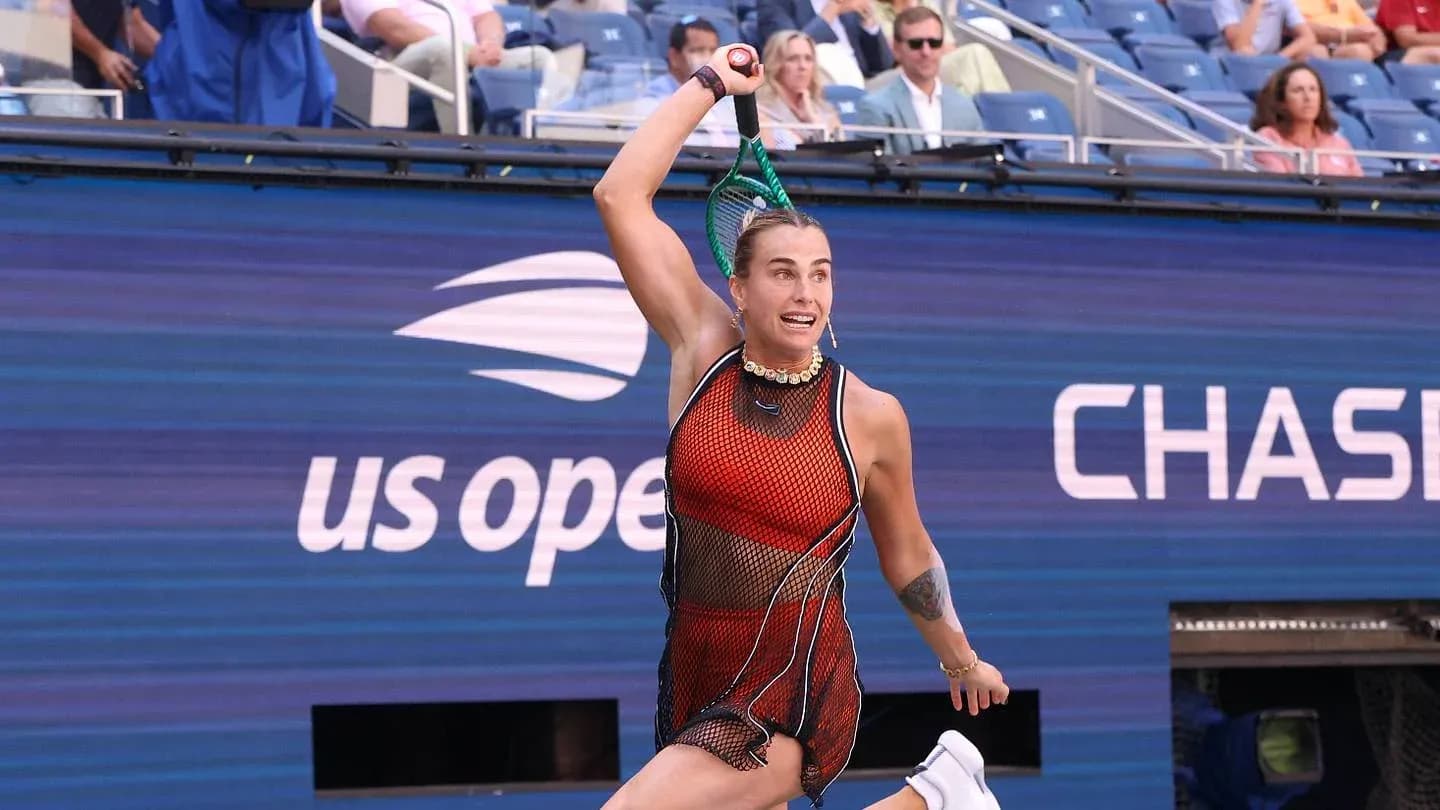
Aryna Sabalenka walked into the night session with the weight of a ranking, a title, and a season on her shoulders. She left it having barely broken a sweat.
The World No. 1 tore through Polina Iatcenko 6-1, 6-1 in just 53 minutes, a demolition that felt less like a second-round match and more like a warning shot to the rest of the field. The New York crowd, usually loud and restless, never really got the chance to work up a roar. There was no drama to feed on. Just power, precision, and a debutant swept away by the occasion and the opponent in front of her.
Sabalenka broke Iatcenko three times in each set. The only interruption to the rout came early in the second, when the Russian qualifier finally snatched a break of her own in the fourth game. It barely registered. Sabalenka simply reset, reloaded, and resumed the onslaught.
For Iatcenko, it was a harsh introduction to tennis’ biggest stadium. A first main-draw appearance at a major, a run through qualifying, and then suddenly the defending champion staring her down under the Ashe lights. The scoreline stung, but the experience will linger longer than the bruises.
For Sabalenka, the win did its job on paper. Two matches, two straight-sets victories, barely any time spent on court. Yet the stakes for her in New York run far beyond a smooth early week. She must win the title to have any chance of clinging to the No. 1 ranking she has held for 99 consecutive weeks. Even then, she needs Elena Rybakina to fall before the semi-finals. The once vast 3000-point cushion she enjoyed in March has shrunk to a fragile 434.
That erosion has mirrored her year. After a blistering start to the season, three titles, and a narrow defeat in the Australian Open final, her form sagged. Early exits at majors, surprising losses to lower-ranked opponents, questions about focus and confidence. The aura of invincibility around her ranking began to crack.
Some of that strain surfaced again once the match was over.
A Frosty Exchange Off the Court
In her post-match press conference, Sabalenka’s tension spilled into a terse exchange with a journalist. When she was perceived to have been questioned about a lack of focus before the tournament, with reference to off-court promotional work and brand activities in the days leading up to the US Open, she bristled.
“What kind of question is that?” she snapped. “Just because I posted some activities with brands, you think that I've been partying and not training?”
The follow-up – asking if she was “getting serious” now that the tournament had started – only sharpened her tone.
“Oh yeah, I wasn't serious before that. Next question,” came the sarcastic reply.
It was a flash of irritation from a player who knows exactly what is at stake here. The outside noise is growing louder, the ranking pressure is real, and her margin for error in New York is almost non-existent.
On court, though, she remains ruthless. Sabalenka’s title defence is rolling, and the draw has already tilted in her favour. Instead of facing two-time Grand Slam champion Barbora Krejcikova in the third round, she will meet Kamilla Rakhimova, the Czech’s conqueror, on Friday. A tricky hurdle, but not the one many had pencilled in.
The champion is still tight, still under siege from the rankings race, but her tennis on Wednesday night left no doubt: she is here to fight for every last point at the summit.
Alcaraz Shakes Off the Rust
If Sabalenka’s win felt inevitable from the first game, Carlos Alcaraz took the scenic route.
For a set, Arthur Ashe felt the tremor of a potential shock. Jaime Faria, ranked No. 72 in the world, stepped into the biggest match of his life and saw a defending champion who hadn’t played much singles tennis in over four months. Alcaraz looked rusty, late on balls he usually devours, searching for rhythm and timing.
Faria sensed it. He broke in the seventh game of the opening set and held his nerve to pocket it 6-4. The upset whispers started to ripple through the stadium.
They didn’t last long.
Alcaraz opened the second set under real pressure, facing a pivotal cluster of break points in the very first game. He survived. The match flipped. What followed was a brutal 6-0 response that reminded everyone exactly who was standing on the other side of the net.
The defending champion accelerated. The forehand, that vicious, whipping strike that had been protected through months of rehab after a delicate wrist injury, suddenly looked free again. He had insisted after his first-round win over Roman Safiullin that he wasn’t holding back on the shot. Against Faria, he proved it.
“I know once I step on the court, I've just got to go for it every time. I've got to feel normal,” he said afterwards. “I have to hit like I was hitting before the injury. I'm feeling great. There is no reason to be afraid and not hitting normal.”
The third set brought a brief tug of war. They traded breaks early, Faria clawing back before Alcaraz struck again to reclaim control. From there, the Spaniard settled into a familiar groove, closing out a 4-6, 6-0, 6-3, 6-2 win that looked comfortable on the scoreboard but carried real significance for his comeback.
“It was a tough match for me. I felt great in the first set, but I didn't take time and that cost me,” he admitted. “After that I tried to be focused, stay calm and think the good things will happen.”
He finished with no apparent physical issues, no visible hesitation on the wrist, and two rounds navigated without needing to touch his highest gear. For a player returning from a long lay-off, that is gold dust.
But the real questions are still ahead.
The Road Only Gets Steeper
So far, Alcaraz has avoided the teeth of the draw. Faria pushed him early, but sterner tests loom. A dangerous third-round encounter with Wu Yibing awaits, and beyond that, a possible fourth-round clash with 20th seed Tommy Paul – a man with the weapons and belief to drag him deep into a five-set trench.
No one yet knows how Alcaraz’s body, and especially that wrist, will respond if he is forced into back-to-back marathons in the second week. Five more matches stand between him and a defence that would rank among his most impressive achievements.
Sabalenka faces her own gauntlet. Every round is a double test: survive the match, and survive the ranking math. She cannot slip. She cannot coast. Her tennis has to hold, and so does her nerve, as the Rybakina threat looms in the background.
On Wednesday night, under the New York lights, both champions did what they had to do. One crushed everything in front of her. The other absorbed an early shock and roared back.
The crowns are still on their heads. The question now is how long they can keep them there.