.svg&w=384&q=75 "logo")
Roger Federer: A Life Beyond Numbers in Tennis
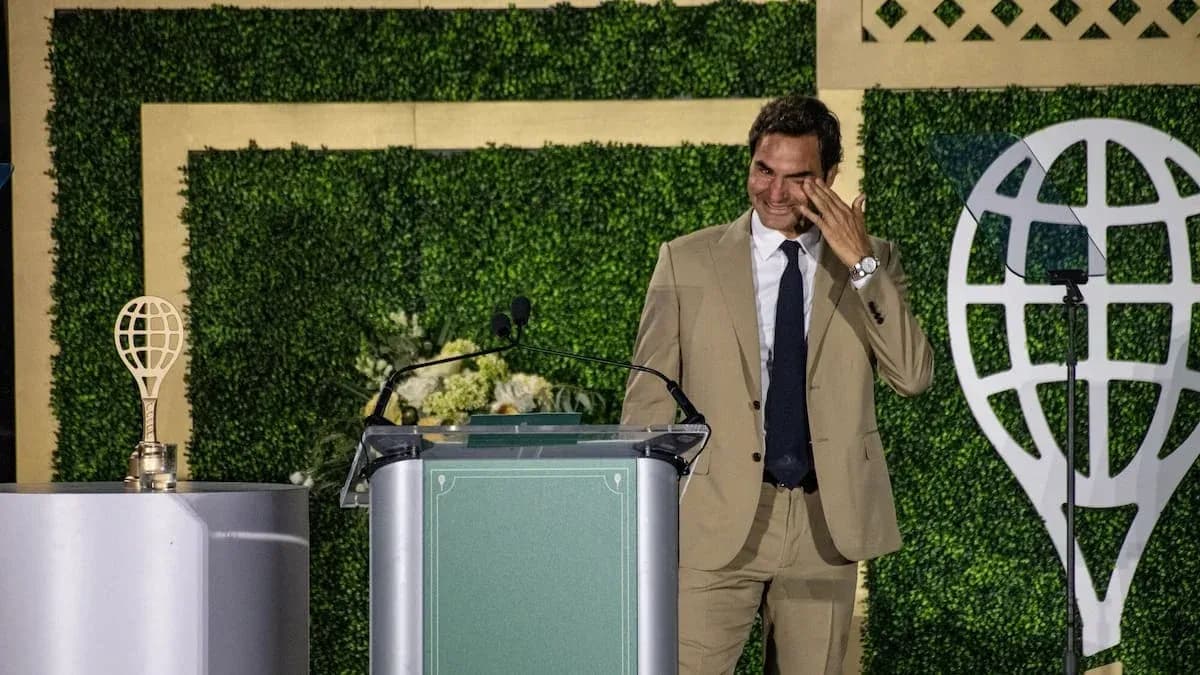
Roger Federer has spent a lifetime turning numbers into art. On this night, as he stood in the glow of the International Tennis Hall of Fame, he chose the strangest numbers of all.
Not 20 majors. Not 310 weeks at No. 1.
Headbands. Socks.
“Not the obvious stats like the number of majors or number of weeks at number one,” Federer said, setting the tone with a wry smile. “I’m talking about the numbers that really paint a picture.”
He had done the maths. Across a career stretching from his first steps on tour in 1998 to his farewell in 2022, Federer reckoned he wore more than 5,000 headbands.
“That’s more than [Bjorn] Borg and [John] McEnroe combined,” he added, the showman’s timing still intact.
The crowd laughed. He kept going.
If the headbands sounded excessive, the socks took it up a level. Federer estimated he went through over 7,000 pairs.
“That’s probably twice as many as most of my opponents, because I doubled them up,” he said.
The numbers were absurd, of course, but that was the point. They painted the life behind the legend: the rituals, the repetitions, the tiny details that stitched together 24 years at the top of the sport.
Then the tone shifted.
“But really, there’s no way to measure what it means to be here. It’s hard to put it into words,” Federer said, the humour giving way to something rawer as he reflected on the journey from a 13-year-old ballboy in Basel to one of the defining figures in tennis history.
He turned back to where it started for him – on the side of the court, not the centre of it.
“I really want to thank every ball kid who ever stood through my matches or all our matches, for that matter, for hours on end,” he said. “I see you. I thank you. I was you.”
It hit him. The eight-time Wimbledon champion, so often the picture of composure, had to stop and gather himself. Tears came as he began to name those who had shaped his path: his idol Stefan Edberg, fellow players, family, coaches, the support staff who travelled the world with him.
“I need tissues and sunglasses and everything to protect me right now,” he joked through the emotion. “This is such a mess.”
The room laughed with him, not at him. This was Federer as the sport has rarely seen him: unguarded, overwhelmed, still trying to control the moment but happily losing that battle.
“It’s been an incredible journey,” he said, the phrase sounding almost too small for what it tried to contain.
For Federer, the Hall of Fame was not a museum for his achievements but a vantage point.
“For me, the International Tennis Hall of Fame provides a great opportunity to look back, but also to look ahead,” he said.
He made it clear that retirement from competition had not closed the book.
“As you can tell, I’m still writing my love letter to tennis. My time as a player is done, but tennis will always stand at the intersection of everything I care most about: my family, our friendships, the past 40 years, the future we’re building. Tennis for me is responsible for it all.”
No trophy count can capture that. No ranking can rank it.
In the end, the numbers he chose – 5,000 headbands, 7,000 pairs of socks – were less about statistics and more about a life spent inside the lines, obsessing over every detail, loving every minute. The records are already etched in history.
The love letter, by his own admission, is still being written.