.svg&w=384&q=75 "logo")
Roger Federer Reflects on His Legacy and Future in Tennis
Roger Federer spent two decades sprinting through history. On Saturday in Newport, he finally gets to stand still for a moment and look at what he built.
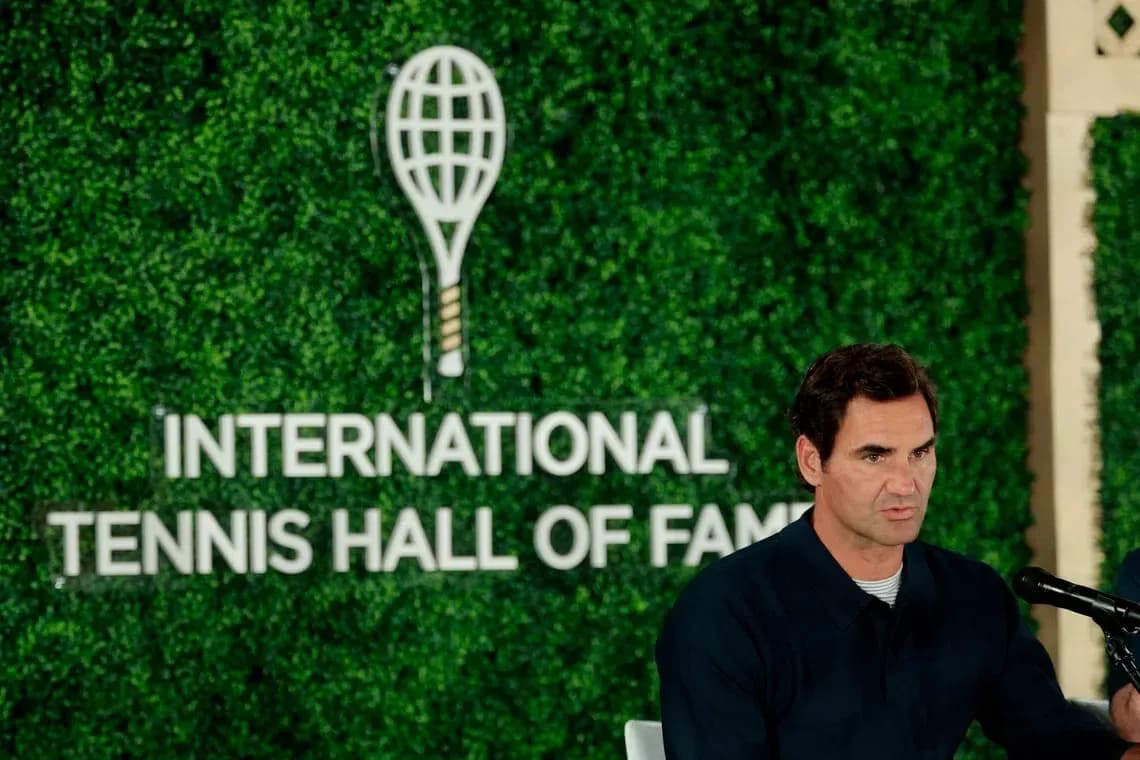
His induction into the International Tennis Hall of Fame is not another trophy, not another ranking, not another number to tack onto an already absurd résumé. For Federer, it is something rarer: permission to reflect.
"It's a huge, huge honour, one of the greatest we can achieve in this sport," he said on Friday, speaking at a news conference moderated by Hall of Fame president Patrick McEnroe. At 45, the 20-time Grand Slam champion sounded less like a man chasing records and more like a curator of his own legacy.
On Saturday, he will go in alongside broadcaster and journalist Mary Carillo, another figure who helped shape how the sport is seen and understood. Fitting company for a player who has long cared about tennis beyond the lines of the court.
A career that rewrote the record book
The numbers still hit hard, even now.
- Eight Wimbledon titles, more than any other man.
- Six Australian Opens.
- Five U.S. Opens in a row at his peak.
- The 2009 French Open to complete the career Grand Slam.
- Olympic doubles gold with Stan Wawrinka in Beijing in 2008.
- A Davis Cup crown with Switzerland in 2014.
He walked away in 2022 with 103 ATP Tour titles and 310 weeks as world number one. For years, those statistics defined him. They were the shorthand for his greatness.
But Federer no longer wants the story to stop there.
He spoke not about the elegance of his one-handed backhand or the aura he carried onto Centre Court, but about the quieter work—meetings, negotiations, long conversations in boardrooms and player lounges—that he hopes will endure just as strongly.
"I hope I represented the sport well," he said. "But more so that maybe I helped drive the sport in the right direction through all the conversations we had together with the leaders of the sport — on the ATP side, with the Slams, the players and councils where I donated my time."
The pressure finally told in a different way. Not in a fifth-set tiebreak, but in the push to change how the sport treats its own.
Legacy beyond the trophies
Federer pointed to the growth in prize money across the board, not only at the top. First and second rounds now pay more. Life on tour, he believes, has become more sustainable for players who never come close to lifting a major.
"I feel like way more players can make a living. And I hope that I have helped with that as well," he said.
He also highlighted better conditions for those who make the sport run: players, media, medical staff, and the infrastructure around them—improved stadiums, improved standards, a more professional environment.
It is the kind of legacy that rarely gets a highlight reel. No slow-motion montage captures a players’ council debate or a late-night call with tournament directors. Yet Federer clearly takes pride in that work. The Hall of Fame, with its plaques and its permanence, offers a place for that side of the story too.
Embracing the spotlight, surviving the storm
Federer’s ease on the biggest stages always seemed effortless. On Friday, he admitted it was a choice as much as a gift.
"I felt like I was a winner early. I liked being on Centre Court. I preferred Centre Court to Court Five or Court 18. I wanted to be that person, so I think I embraced the pressure."
He chased the spotlight rather than ducking it. But that appetite came with a cost.
At the highest level, tennis can become a referendum on a single result. Win, and the narrative soars. Lose, and the questions multiply.
"You get affected by so many outside comments that it's like one big storm sometimes in your brain," he said. "Sometimes you lose the fun in it."
The key, he believes, was holding on to joy amid the scrutiny and the grind.
"For the most part, I've really done a good job of staying really happy on the road," he added, a simple line that hints at a discipline as demanding as any practice session.
Staying close to the game
Retirement has not pulled Federer away from tennis. It has simply changed his seat.
Earlier this week, he stepped back onto Arthur Ashe Stadium for an exhibition ahead of the U.S. Open, rolling back the years for a night and reminding a packed crowd what they had missed. The roar sounded familiar. The stakes did not.
Now, he is weighing how best to give back.
He floated the idea of one day serving as a Laver Cup captain, mentoring younger players, or even moving into commentary. None of it is fixed yet. The options are open, and he seems in no rush to close them.
"I would like to give back to the sport," he said. "I try to attend three, four or five events during the year, so I stay connected."
Those trips are not just nostalgic tours. They are fuel.
"It rejuvenates me mentally to see what I could be doing in the sport that would be meaningful down the road."
On Saturday in Newport, the Hall of Fame will etch his name into its walls. The record books already did that long ago. The more intriguing question now is not what Federer has done for tennis, but what, in this next chapter, he decides to do with it.