.svg&w=384&q=75 "logo")
Roger Federer Inducted into International Tennis Hall of Fame
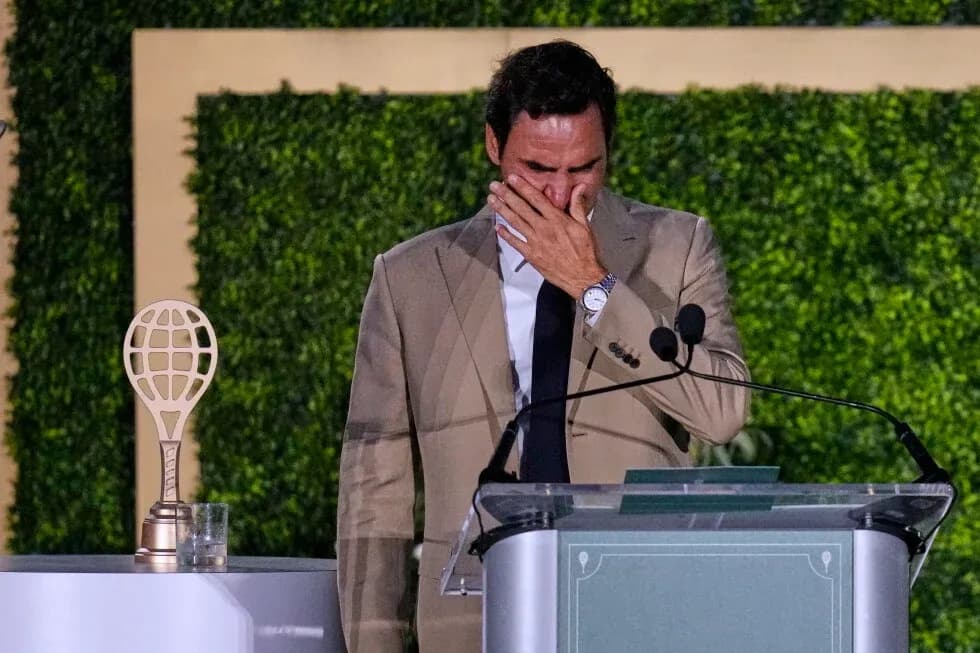
NEWPORT, R.I. — The sun was sliding behind the stands at the International Tennis Hall of Fame when Roger Federer, tan suit sharp against the Newport grass, stepped toward the podium and promptly surrendered to the moment.
“Oh man,” he exhaled, the first man to win 20 Grand Slam singles titles suddenly sounding like someone trying to steady himself, not a legend used to center courts and closing stages. “This is very high level and a tough act to follow.”
A few minutes earlier, his wife Mirka had introduced him. He kissed her, hugged her, and then realized what lay ahead: not a final to be won, but a career to be unpacked in front of the sport that had defined his life.
He tried to defuse it with humor. “I don’t know if you have been practicing secretly,” he joked, praising her presentation as he officially became the 272nd Hall of Famer. The line drew laughs. It didn’t slow the emotion.
On a night when the Hall of Fame rolled out its first red carpet on the grass horseshoe court, the “Swiss Maestro” walked it as both icon and vulnerable man. Introduced with that familiar nickname during the pre-ceremony show, Federer admitted to the crowd he “was a little stressed to be honest.”
The nerves showed. So did everything else.
Across nearly 30 minutes, the player whose movement once seemed effortless and whose one-handed backhand carried him to a record 237 consecutive weeks as world No. 1 found himself repeatedly stopping, swallowing, regrouping. The tears came in waves.
They hit hardest midway through, when he turned to the figures who shaped him.
Talking about his childhood hero Stefan Edberg, Federer called them “happy tears.” The phrase landed softly, a reminder of the boy who had grown up idolizing the Swede before surpassing records that once felt unreachable.
The emotion rose again when he spoke about longtime coach Severin Luthi. The partnership that had guided him through comebacks, reinventions, and the twilight of his career suddenly sat heavy on his shoulders.
Then came the part he had clearly been bracing for.
“Now the Mirka part,” he said, and stopped. The pause stretched. “Oh gosh, this such a mess.”
He tried to laugh it off. The tears didn’t cooperate. They rushed in like a flat return at his feet.
“I need tissues and sunglasses, everything to protect me right now,” he told the crowd, fighting to keep going as the evening turned from ceremony to something closer to confession.
Yet, as he did so many times in his prime — five straight U.S. Open titles from 2004 to 2008, 10 consecutive Slam finals, eight of them won — Federer found a way to close.
He steadied himself and turned outward, away from his own story and back to the sport. He thanked the ball boys, the often-unseen cogs in the machinery of elite tennis. Then he spoke directly to the players who will follow him, urging them to keep pushing the game to new heights.
This was not a night for statistics, but they hovered anyway. Federer turned 45 three weeks ago. His résumé remains a monument: eight Wimbledon titles, six Australian Opens, one French Open in 2009 to complete the career Grand Slam — a feat matched by only seven other men.
“I’m thrilled to have made the journey here,” he said. “It’s amazing to see yourself in a place like this. To immerse yourself in the history of the sport means a lot to me.”
He wasn’t alone on stage.
Mary Carillo, former player and one of the defining television voices of the sport, entered the Hall as a contributor. Already enshrined in the Sports Broadcasting Hall of Fame, she was presented by Billie Jean King, who captured the significance of the moment with the economy of someone who has seen it all.
“She has earned her spot in sports journalism and she has earned her spot in Newport,” King said.
Carillo, 69, looked out at a cluster of Hall of Famers and allowed herself a moment of awe.
“To walk through these gates here in the company of you people, that was beyond my dreams,” she said.
On this Newport evening, the Hall of Fame did what it does best: it turned careers into chapters of a longer story. For Carillo, it was recognition of a voice that has narrated the sport for generations. For Federer, it was something more intimate — a final, formal welcome into the game’s eternal club, and a reminder that even the most graceful careers end with a lump in the throat.
The trophies are already in the cabinet. The records are already written. Now his name is carved into history’s wall, exactly where the sport always seemed to be steering him.