.svg&w=384&q=75 "logo")
Roger Federer Inducted into Hall of Fame: A Night of Emotion and Legacy
NEWPORT, R.I. — The tears arrived early for Roger Federer, and they never really left.
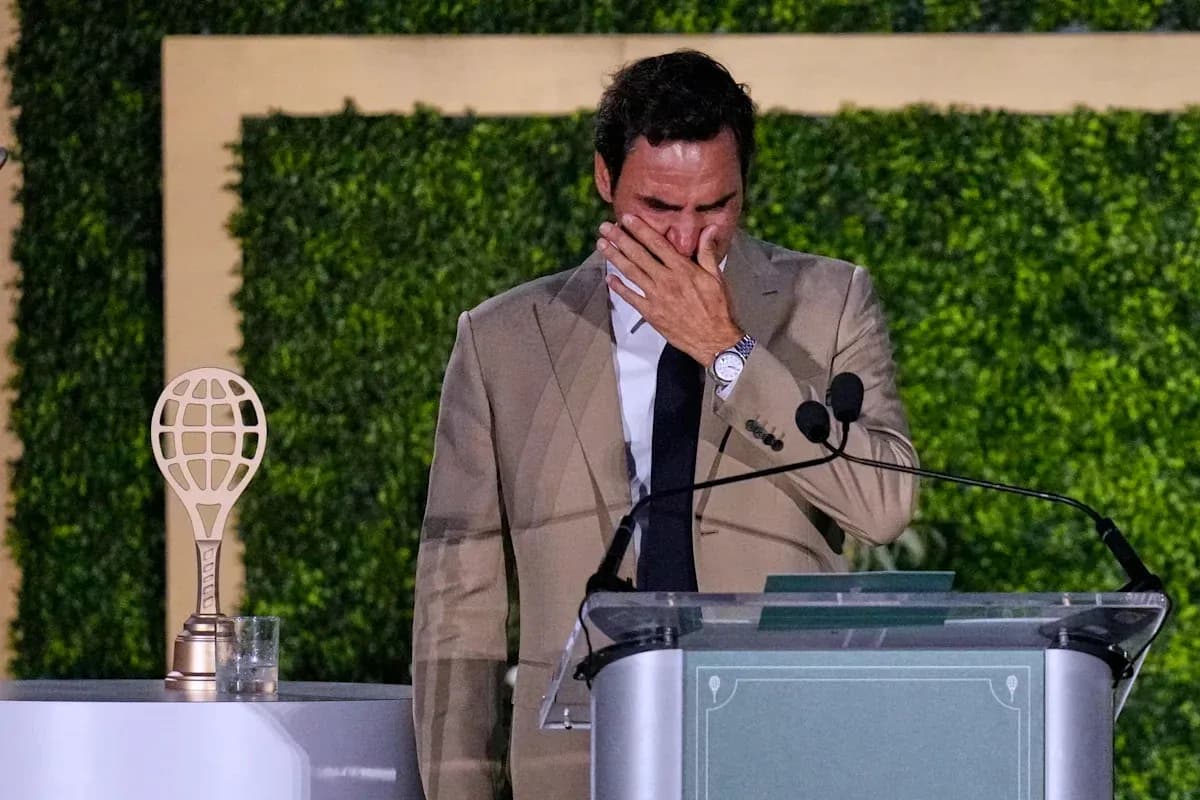
As the sun dipped behind the historic horseshoe grass court at the International Tennis Hall of Fame, the 45-year-old walked to the stage in a tan suit, kissed and hugged his wife Mirka, and instantly felt the weight of the moment.
"Oh man," he began, the first man ever to win 20 Grand Slam singles titles suddenly sounding less like the “Swiss Maestro” and more like someone overwhelmed by his own story. "This is very high level and a tough act to follow."
Mirka had just introduced him, and Federer tried to steady himself with a joke.
"I don't know if you have been practicing secretly," he said, praising her poise as she presented the Hall’s 272nd inductee — her husband.
It didn’t get easier from there.
A Maestro in Tears
Federer, inducted alongside broadcaster and former player Mary Carillo, stepped into a place reserved for the sport’s immortals and promptly showed something fans rarely saw during those 237 consecutive weeks as world No. 1: emotional vulnerability he couldn’t disguise.
He admitted he "was a little stressed to be honest," speaking on center court after walking the Hall’s first-ever red carpet earlier in the evening. The man whose movement once seemed effortless, whose one-handed backhand glided through eras and opponents, now had to navigate something far trickier — his own memories.
Across nearly 30 minutes, he choked up repeatedly. The timing was almost poetic. About halfway through, when he turned to the subject of his childhood hero, Stefan Edberg, the voice began to waver. The tears followed.
These, he insisted, were "happy tears."
They kept coming. When he spoke about longtime coach Severin Luthi, the partnership that anchored so much of his dominance, the emotion surged again. Then came the section he knew would test him most.
"Now the Mirka part," he said, stopping as the words caught in his throat. "Oh gosh, this such a mess."
He tried to laugh it off. The tears won.
"I need tissues and sunglasses, everything to protect me right now," he told the crowd, still fighting the emotion that had finally rushed past his usually calm exterior.
A Career That Redefined Greatness
For two decades, Federer built a résumé that looked almost unreal: eight Wimbledon titles, six Australian Opens, five straight U.S. Opens from 2004–08, and a French Open in 2009 to complete the career Grand Slam — a feat only eight men have achieved.
He reached 10 consecutive Grand Slam finals and won eight of them, imposing a level of consistency and artistry rarely seen in the sport. His footwork, his quick dart to the net, that elegant one-handed backhand — all of it combined to keep him atop the ATP rankings for a record 237 straight weeks.
In Newport, those numbers hung in the air, but they weren’t what broke him. It was the people.
He thanked the ball kids, the often-forgotten heartbeat of every match he played. He urged today’s players to keep pushing tennis to "new levels," a challenge from a man who spent his career raising the bar.
"I'm thrilled to have made the journey here," Federer said. "It's amazing to see yourself in a place like this. To immerse yourself in the history of the sport means a lot to me."
Carillo’s Moment in Newport
Federer did not stand alone on this stage. Mary Carillo, inducted as a contributor, entered the Hall not with a racket in hand, but with the voice and insight that helped shape how generations watched the sport.
Already a member of the Sports Broadcasting Hall of Fame, Carillo received her highest tennis honor from another icon, Billie Jean King.
"She has earned her spot in sports journalism and she has earned her spot in Newport," King said, a simple, emphatic endorsement of a career spent telling other people’s stories.
Carillo, 69, looked out at a small group of Hall of Famers and let the moment sink in.
"To walk through these gates here in the company of you people, that was beyond my dreams," she said.
On a quiet Newport evening, with the light fading and the grass court glowing under ceremony, the sport celebrated two very different careers. One played out under the brightest lights in tennis history, the other narrated so many of those nights.
Federer left the game two years ago. Now his name and legacy are etched permanently into its shrine. The question no longer is where he stands in the sport’s history.
It’s how long it will take anyone to touch the standard he set.