.svg&w=384&q=75 "logo")
Roger Federer: A Journey of Emotions and Excellence
Roger Federer has cried on tennis courts all over the world. The first time, he didn’t even understand why.
It was Wimbledon, 2001. Centre Court. His debut on the sport’s most sacred patch of grass. Across the net stood Pete Sampras, the four-time defending champion, the king of that lawn and Federer’s childhood idol. Federer won, dropped to his knees, then walked to the net to shake hands with the man whose posters had once been on his wall.
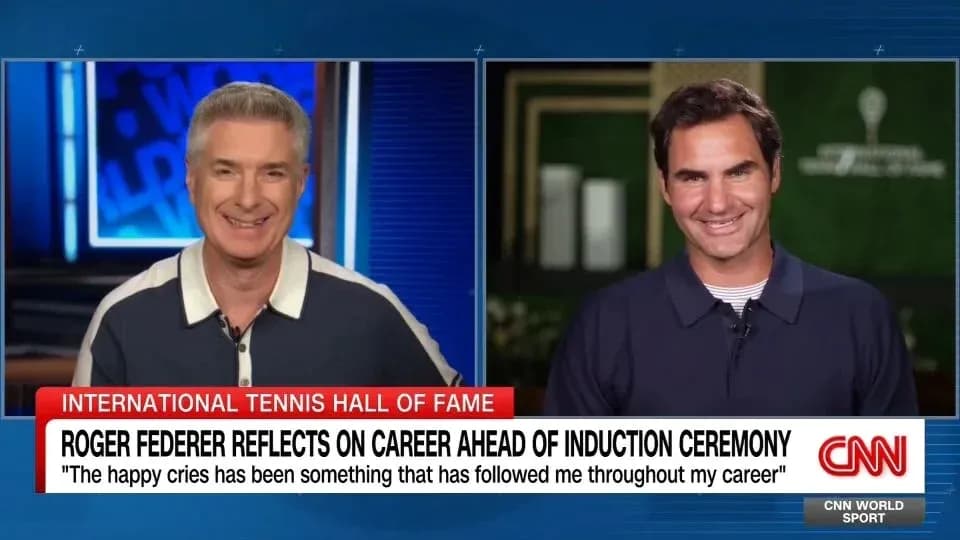
“I go to my knees, (then) I shake hands with Pete and he's my hero … and these emotions came all over me,” he told CNN Sports. “And I was like, ‘What is going on?’ This is not who I am normally.”
From that afternoon in London to his tear-streaked farewell in 2022, those emotions never really left. They became part of the Federer myth. The greatest crier in sport, and the owner of one of its greatest careers.
This weekend in Newport, Rhode Island, the tears might return again. Federer is being inducted into the International Tennis Hall of Fame, a destination that has felt inevitable for two decades but no less significant for its certainty.
“If I'm speaking about the game and all the gratitude that I have, and having my entire family there – from my parents to my wife to my four children and my whole team from coaching staff and physios, etc. I think it could hit home very hard,” he said in the hours before his big moment.
He knows himself too well now to pretend otherwise.
“If it happens, it will be more memorable for me personally, but I hope I get through the speech without too many hiccups. We'll see.”
A career that bent the sport
For Federer’s army of admirers, this Hall of Fame call has felt overdue in spirit, if not in calendar years. His path to immortality crystallised in 2004, a season that reshaped the sport’s landscape. He won three of the four grand slam singles titles and climbed to No. 1 in the world rankings, then simply refused to move. He stayed there for 237 consecutive weeks – a record that still stands and still sounds almost unreal.
The dominance did not ease. In 2005, he won more than 95% of his matches. Then came 2006, the year many point to as his true peak: three more majors, 12 titles in total, and a 92–5 record that translated to a 94.8% win rate. Week after week, surface after surface, he turned tournaments into processions.
Sampras’ 14 grand slam titles once looked untouchable. Federer blew past that mark at Wimbledon in 2009 and never glanced over his shoulder. The number eventually stopped at 20, but by then he had already altered expectations of what greatness could look like in tennis.
He did it with a kind of grace that made brutality look beautiful. The footwork, the timing, the liquid one-handed backhand – it all fed into an illusion that this came easily to him. He floated where others ground, glided where others scrambled. Off court, the image only hardened: relaxed, charming, accessible, a superstar who somehow never seemed to be straining.
He knows that perception, and he knows the price behind it.
The cost behind the elegance
Federer says he carries no real regrets. If anything, he bristles slightly at the idea that his talent made everything simple.
“It looked like I wasn't actually hitting the ball so hard,” he recalled of how people saw his game when he was young. “But it was kind of flying off of my racket with a lot of power. People always thought, like, ‘It's so simple for you,’ because it looked like elastic. But it wasn't the case. There was a lot of work and effort put into it.
“When I would lose, they say, ‘Why don't you try harder?’ And when you win, they would say, ‘Oh my God, it's so easy for you!’”
Hidden in that contradiction is the explanation for many of those post-match tears.
“The sacrifice was massive and I was holding a lot of pressure in.”
The pressure is gone now. The sacrifice, at least in its sporting form, is over. What remains is a man at ease with what he’s done and what he no longer needs to do.
“It doesn't sound like he misses it all that much” is an understatement. By his own account, there is no void, no itch to recreate the intensity of centre court or the emotional spikes that came with it.
“I'm actually really happy going through everyday life at a lower pace,” he said.
Life after the last forehand
Retirement has not exactly meant stillness. Federer is a father of four, a philanthropist, an investor, a businessman. The schedule looks different, but it is hardly empty. He remains what he always was: a man on the move.
“I've always been a guy who loves being on the road,” he said.
Newport offers him something else: a chance to look back, to share a stage – if only in imagination – with the legends whose names once felt distant and now sit alongside his in the Hall of Fame.
“I would have a little list,” he said, before reeling off the names with the ease of a fan: Rod Laver, Bjorn Borg, John McEnroe, Stefan Edberg, Boris Becker, and Sampras again. “I think these would be my favorite players to play against. I've always admired their personalities, what they have achieved, and what they represent in the game.”
That is the company he now officially keeps. His 20 majors have been surpassed by Rafael Nadal and Novak Djokovic, the two men who helped define an era that may never be matched. The numbers say one thing. His followers insist on another. For them, Federer remains the greatest of all time, not just for what he won, but for how he made the sport feel.
A different kind of mastery
So what does a man who once mastered tennis do next?
“I'm trying to get better at golf,” he said with a hint of curiosity about a fresh challenge.
There is also a pull back to an old discipline. “I would love to start with an instrument again. I used to play the piano, so when I have more time, I'd like to dive into that because my four children and my wife play the piano.”
The ambitions now are quieter, more personal, but no less revealing. He is chasing qualities that never show up on a scoreboard.
“I hope I'm a good listener and a good decision-maker. Hopefully I'm a guy who people enjoy being around. I'm a big family guy. I love being surrounded by my friends – that's really the priority in my life.”
In Newport, as he steps onto another stage with a microphone instead of a racket, the old emotions may come flooding back one more time. The tears, if they arrive, will not be for a trophy or a ranking or another record.
They will be for a life in the game that he no longer needs to defend, only to remember.