.svg&w=384&q=75 "logo")
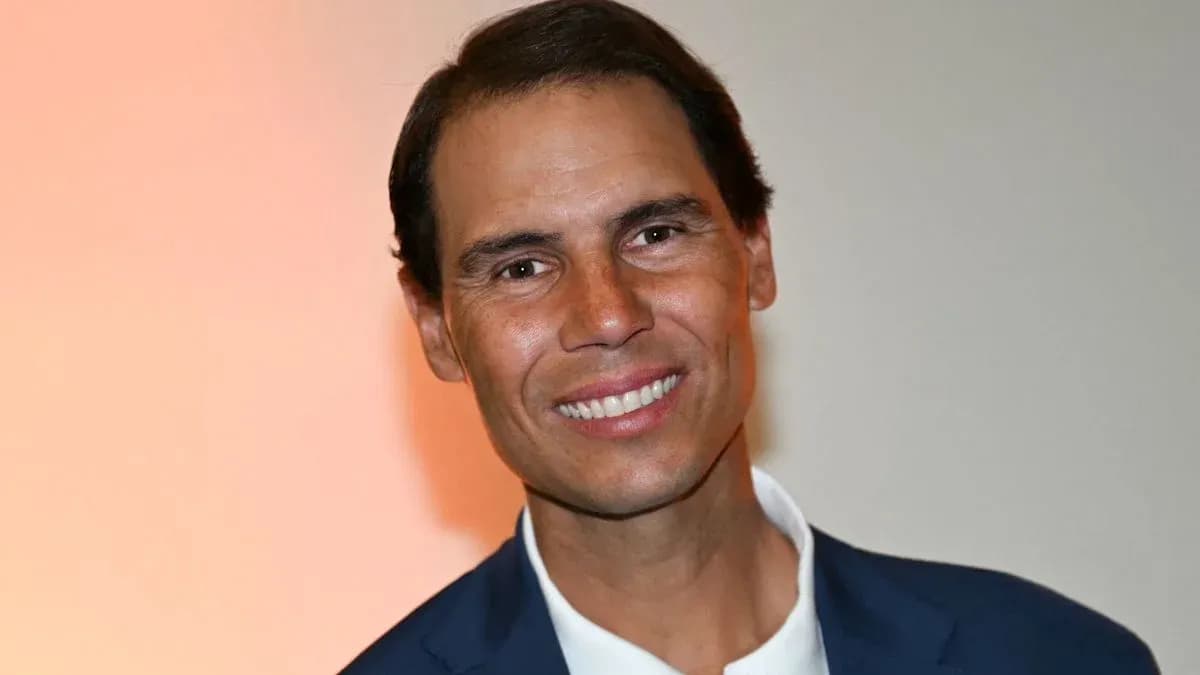
Rafael Nadal Shares Family Moments: A Summer Away from the Court
Rafael Nadal has spent a lifetime under stadium lights. This summer, he chose something softer.
The 22-time Grand Slam champion opened a rare window into his private world, sharing a series of photos from his family holiday that trace a very different kind of journey: beaches instead of baseline duels, waterfalls instead of centre courts, toy cars instead of trophy lifts.
The first image sets the tone. Nadal, his wife Mery Perelló, and their eldest son, Rafa, beam at the camera, a toy Jeep and a dinosaur looming in the background, likely at Dinopark Funtana in Croatia. No sweatbands, no racket. Just a young family framed by plastic prehistory and summer light.
From there, the gallery turns into a roll call of the people who have shaped his life far beyond the lines of a tennis court. Nadal appears with his children, Rafael and Miquel, with Mery, with his mother Ana Maria, his father Sebastian, his sister Maribel, and his uncle Miguel Ángel. They move through classic holiday backdrops – beaches, waterfalls, busy tourist spots – but the real focus is the constellation of faces around him.
“Summer 2026 in family,” he wrote alongside the photos, punctuating the caption with a smiley emoji. Four words, one symbol, and a clear message: this is where his energy is going now.
For those who have followed his career closely, none of this feels accidental. Nadal has long spoken about how central his family has been to his success and his sanity, how their presence anchored him through the grind of the tour. His uncle Toni, who does not appear in this particular set of photos but looms over any account of Nadal’s career, spent years at his side as coach and mentor, helping build the competitive edge that defined an era.
This summer, that sense of family stretched beyond his own household.
When Lionel Messi lost his father, Jorge, Nadal stepped forward not as a global icon addressing another, but as a son speaking to another son. He posted a simple, heartfelt message on social media, one that cut through the usual polished condolences.
“Dear Leo Messi, I can't imagine the pain you're going through. I'm sending you all my love and all of my condolences to you and your family in these challenging times. Rest in peace, Jorge,” Nadal wrote.
No grand statements. No public performance. Just direct empathy from one man whose life has been built around family to another whose career has been intertwined with his father from the beginning.
Messi has never hidden how deeply Jorge shaped his path. His father was not only a parent but also his agent, standing beside him through the turbulence of a career that started with a bold move from Rosario to Barcelona. In a 2007 radio interview, Messi described the toll of those early years and the quiet burden they shared.
“My old man was always by my side. We went through a lot of ugly things together,” he said in Spanish at the time. “Sometimes, I would shut myself in my room to cry alone, or he'd do the same, without me seeing him. We'd pretend we were both OK, but we weren't. My old man asked me, 'What do you want to do? Do you want to keep going or should we go back home?' I wanted to keep going, and he stayed with me.”
Those words land differently now. Nadal’s message acknowledges exactly that kind of bond – not the public partnership of superstar and agent, but the private alliance of father and son trying to navigate a world that rarely forgives weakness.
Two of the greatest athletes of their generation, from different sports and different cultures, have built their empires on similar foundations. Nadal’s academy, his business ventures, his support team – family threads run through all of it. Messi’s career, from contract battles to career-defining moves, has carried his father’s fingerprints.
So when Nadal shares sunlit photos of his children and parents at waterfalls and theme parks, then reaches out to Messi in his darkest days, the through line is unmistakable. This is not a champion discovering family late in life. This is a man doubling down on what has always mattered most, now that the roar of the crowd has softened.
The trophies are already in the cabinets. The records are already in the books. What remains, for both Nadal and Messi, is the question that lingers long after the last ovation: when the games fade, who is still standing next to you?