.svg&w=384&q=75 "logo")
Novak Djokovic's Struggle at the US Open: A Turning Point
Novak Djokovic has stared down match points, hostile crowds and the weight of history. On Sunday night in New York, it was his own body that finally broke him.
Tears welled in his eyes as he fought to hold serve late in the fifth set of his US Open first-round match. Once, that moment would have signalled the familiar Djokovic surge: shoulders back, eyes narrowed, the court shrinking around a suffocating champion who simply refused to lose.
This time, the tears told a different story.
Djokovic, a 24-time Grand Slam champion, fell 7-6 (5), 5-7, 4-6, 6-2, 6-1 to Mariano Navone, suffering his first opening-round exit at a major since 2006. At 39, he will now slide out of the world’s Top 10, and for the first time in nearly two decades the question is no longer who can stop him.
It’s how much longer he can stop time.
A Night When the Body Said No
Conditions should have helped him. The brutal New York heat had softened into a more forgiving Sunday evening. Djokovic raced out to a 3-0 lead, the script looking familiar enough.
Then, abruptly, it flipped.
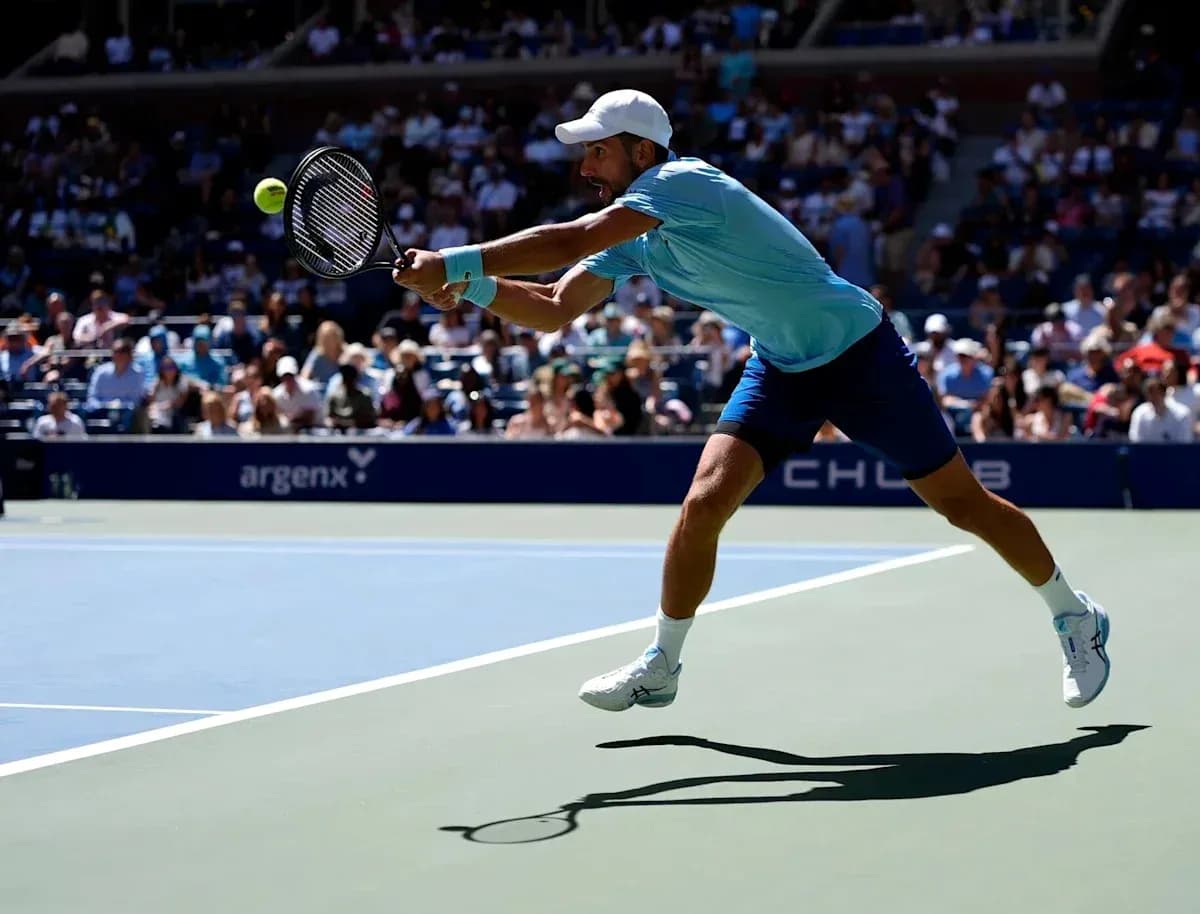
Less than an hour into the match he began to feel sick. The lead vanished. The timing went. The legs dulled. Nausea crept in and never really left. In the third set he vomited. In the fourth and fifth, the cramps took over, his back and shoulder seizing to the point that he could no longer swing freely or hit his serve with anything close to full power.
Four hours and 36 minutes drained him of everything. The early flashes of brilliance — the clean winners, the sharp changes of direction — gave way to a stream of errors. By the end, he had sprayed 70 unforced mistakes, a number unthinkable in his prime, yet brutally in line with what the eyes were seeing: a great player wrestling not with Navone’s game so much as with his own failing engine.
“I think it was obvious that it was an awful feeling on the court for me,” he said afterwards, speaking to a small group of reporters rather than holding a full press conference. “This is something that, unfortunately, I’ve been dragging along in practically every match this year.”
Then came the blunt admission. Once the sickness set in, he said, “my whole body starts to collapse, basically cramping and pain,” noting that his back and shoulder “gave up.”
Navone’s Moment, Djokovic’s Warning Sign
Navone did more than just hang around and wait for a legend to crumble. The 25-year-old, who claimed his first ATP Tour title in 2026, played with conviction and patience. He drove his groundstrokes deep, refused to offer cheap points, and backed his first serve, winning over 70% of those points. When break chances appeared, he took them.
He earned this.
Yet the night revolved around Djokovic. It always does in these arenas, and especially here, where he had reached the semifinals just a year ago before a straight-sets defeat to eventual champion Carlos Alcaraz. That 2025 run had felt like proof that he could still muscle his way into the business end of majors, even if the clock was ticking a little louder.
Now the alarm is blaring.
Djokovic is not accustomed to physically unraveling in the first round of a Slam. The warning signs, though, have been there. In August, he wilted in harsh conditions at the Cincinnati ATP 1000, losing his opener 2-6, 6-4, 6-4 to Thiago Agustin Tirante. In New York he tried to frame that defeat as a blessing in disguise, a chance to rest, reset and prepare for best-of-five.
Grand Slams remain his declared priority. They always have. But at 39, skipping events to save himself for the majors is no longer a simple equation. Players need matches to sharpen their instincts and stretch their lungs before a two-week grind. Four hours on court is a brutal test at 19. At 39, with a long history of mileage, it becomes a negotiation with every muscle.
On Sunday, that negotiation broke down after barely half an hour.
The Edge That Might Not Be Enough
Djokovic has built a career on solving impossible problems with his mind as much as his racket. When others tightened, he cleared his head. When others panicked, he locked in. For years, that mental steel turned five-set marathons into his personal playground.
This loss hinted at a new reality: no amount of mental fortitude can fully override a body that refuses to cooperate.
He has played just seven tournaments in 2026. On paper, that sounds like a light schedule, a veteran managing his workload. On court, it has looked more like a man trying to outrun accumulated wear and tear and finding the gaps closing fast.
The questions now will swirl around Flushing Meadows for the rest of the fortnight. Will he be back here next year? Will he accept life as a world No. 20, grinding on tour for the love of the game rather than the expectation of lifting trophies? Or will he decide that if he is no longer a genuine Grand Slam contender, the fight has changed too much?
Only he knows where his line is.
For now, the only concrete signpost is that he remains on the ATP 500 Beijing entry list, confirmed on Monday. He is not done yet, at least not officially. Not in his own mind.
His loss to Navone, though, underlined a harsh truth: at this stage, his Grand Slam prospects rest less on his famed resolve than on whether his body can still handle the load. The mental edge that once separated him from everyone else may no longer be enough to drag him through nights like this.
“Forever grateful, New York,” he wrote on social media after the defeat.
Grateful, yes. But as he walked off into the Queens night, the more pressing question hung in the air: how many more times will he get to say goodbye here with a racket in his hand?