.svg&w=384&q=75 "logo")
Novak Djokovic's Reckoning at the US Open: A Shift in Legacy
By the end, he could barely stand.
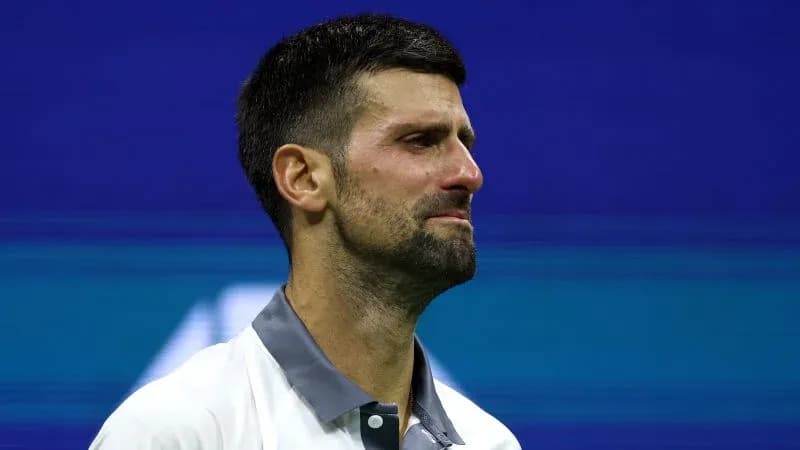
Novak Djokovic, so often the immovable force of men’s tennis, was bent over in the New York heat, his body rebelling, his eyes wet. A first‑round exit at the US Open to Mariano Navone – his worst grand slam result in two decades – felt less like an upset and more like a reckoning.
This was not the familiar image of Djokovic snarling at the crowd, flexing at his box, turning five-set marathons into exhibitions of willpower. His footwork, usually so precise it borders on mechanical, looked heavy. His movement, once elastic, seemed rigid. For the first time in a long time, the aura cracked.
This defeat felt different. It felt close to final.
Only seven months ago, Djokovic was contesting the Australian Open final, still trading blows with the new order led by Carlos Alcaraz and Jannik Sinner. At 39, he was still the man the younger generation had to go through, the outlier who refused to obey tennis’ age curve. A Wimbledon semifinal in July kept the dream alive of that record 25th major singles title, the number that would separate him from every player in history.
Now that dream looks distant, almost abstract.
Djokovic is no longer a week‑in, week‑out presence on tour. He has long since reshaped his calendar around the four majors, dropping in on other events mainly to tune up. It has been a clever, calculated strategy, preserving a body that has carried him through more than a thousand matches. But this time, even the careful planning seemed powerless.
Earlier this month, he revealed he has been managing an underlying health issue for some time, one that flares in hot, humid conditions. In New York, it roared back. Between points he was seen vomiting. As the match dragged on, he could barely move, his legs seizing, his back and shoulder screaming.
The tears in that final set told their own story. They looked like the tears of a man who knows that, for all his discipline and defiance, time is no longer a theoretical opponent. It is on the other side of the net now.
“I didn’t enjoy myself,” he said afterward. “I think it was obvious that it was an awful feeling on the court for me.”
“It’s something that I’ve been carrying, unfortunately, pretty much every match this year: vomiting, throwing up, a serious issue there.
“Then my whole body starts to collapse, basically cramping and pain. Yeah, the back just gave up in the end and shoulder.”
When Djokovic left Flushing Meadows, he did so talking about reflection, not revenge. He spoke of needing time to consider his future, to decide whether he can keep subjecting his body to this level of punishment. After what the world watched on Sunday, how could retirement not be on his mind?
Yet this is Djokovic. The same player who has repeatedly dragged himself back from the brink. In 2017, an elbow injury derailed him so badly that some wondered if his reign was over for good. By the end of 2018, he had two more grand slam titles and the No. 1 ranking again.
The retirement narrative has stalked him for years. Every January brings another round of predictions: this season will be his last at the top, this loss will be the one that signals the end. Each time, he has found a way to stretch his prime a little further, to rewrite his own script.
Even this season, he produced flashes of the old ferocity – none more striking than that five‑set epic against Sinner in Melbourne, when he clawed his way back into a match that seemed to have slipped beyond him. He has adapted his game, shortened points, sharpened his returns, leaned even more on his unrivaled competitive instincts.
But the scoreboard is blunt. Djokovic has not lifted a grand slam trophy since 2023. That, in truth, should surprise no one. Roger Federer and Rafa Nadal both collected their final majors at 36. The physical demands of the modern game are unforgiving, the rallies longer, the movement more brutal, the margins thinner. To win seven best‑of‑five matches against younger, fresher bodies, he now needs not only brilliance, but luck.
His stated ambition has been to keep going until the Los Angeles Olympics in 2028, to close his career on the ultimate stage while wearing his country’s colors. After the scenes in New York, that target feels almost impossibly far away. Yet history warns against writing him off too quickly. Doubting Djokovic has never been a safe bet.
Still, Sunday carried a different weight. The look on his face as he tried, and failed, to summon one last surge was telling. This was not the master conductor orchestrating every point, dictating every rally. This was a champion staring at limits he has spent a career pretending did not exist.
Whatever he decides in the coming months, his legacy is secure. Twenty‑four majors, years spent at No. 1, a body of work that places him, by almost any metric, at the very summit of the sport’s history. Like so many greats before him, he may choose to cling to the game a little longer than his body would like.
Perhaps the answer lies in redefining what success looks like: fewer titles, more moments; fewer seasons built around domination, more around presence. But is Novak Djokovic, the ultimate collector of trophies and records, willing to live with that version of himself?