.svg&w=384&q=75 "logo")
Novak Djokovic's Brutal US Open Defeat: A Night of Vomiting and Tears
Novak Djokovic has spent two decades turning Arthur Ashe Stadium into his stage. On Monday night, it became his cage.
Barely three hours into the first night session of this year’s US Open, the 24-time grand slam champion strode to the corner of the court, bent over the towel bin and vomited. Not once. Not for the last time. Under the lights of the biggest tennis arena in the world, the sport’s great survivor was reduced to a man simply trying to get through the next point.
Four hours and 36 minutes after it began, the ordeal ended. Around midnight, Djokovic walked off Ashe in tears, beaten 7-6 (5), 5-7, 4-6, 6-2, 6-1 by Argentina’s Mariano Navone in the first round. A scoreline that will live in the record books. A night that will live in the memory for very different reasons.
A giant brought to his knees
This was Djokovic’s record-extending 84th appearance at a grand slam. It produced one of his most brutal defeats. He is 39 now, with a career full of five-set epics and miraculous escapes, but this was only the third time he has lost in the opening round of a major. The last time it happened was at the 2006 Australian Open, when he was an 18-year-old still learning the tour.
Here, the shock lay not just in the result but in how quickly the body started to fail him.
He broke early and led 2-0 in the first set, barely 15 minutes played, and already looked drained by the New York humidity. This was the supposedly kinder slot of a late-night match under the Ashe roof, not a sweltering afternoon furnace. It didn’t matter. Djokovic’s chest heaved. He coughed and spluttered between points. The eyes that have so often burned with defiance seemed glassy and distant.
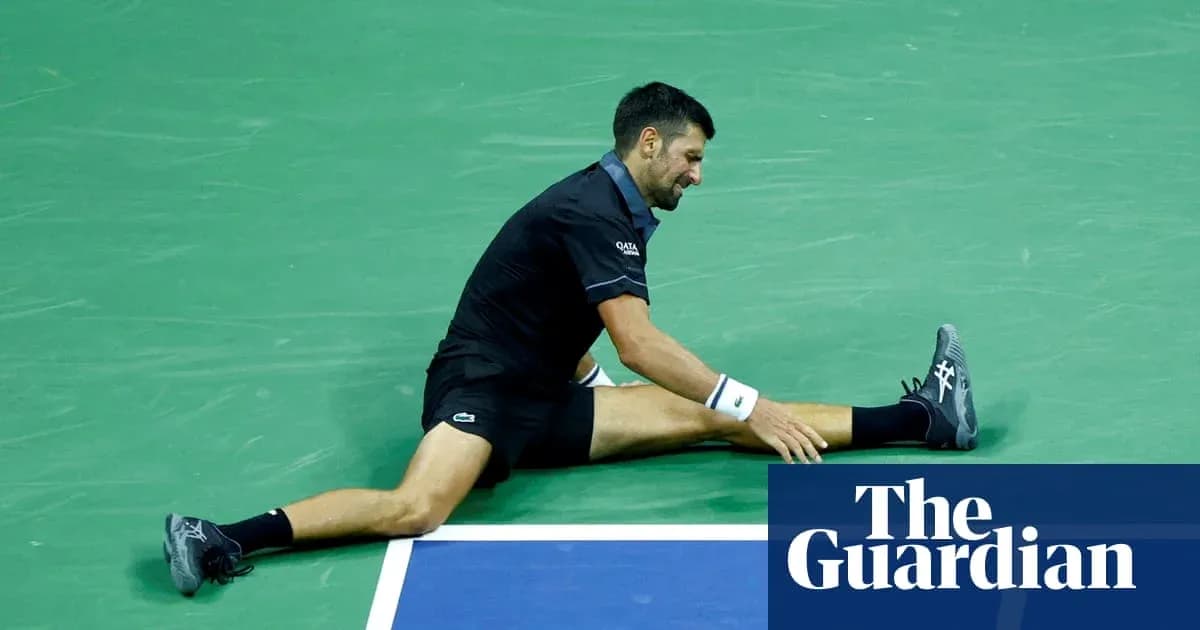
From there, the match turned into a grim watch. Across five sets, Djokovic veered between panting at the back of the court, vomiting, fighting for balance and fending off cramps. At times he looked dazed, as if his body and brain were out of sync. By the end, there was simply nothing left.
This was not a one-off sickness. Just weeks ago in Cincinnati, he had laboured in similar evening humidity against another Argentinian, Thiago Agustín Tirante, and lost in three sets. Then too, he looked physically overwhelmed while his opponent handled the conditions without fuss.
After that defeat, Djokovic pointed to a specific health condition aggravated by heat and humidity. He returned to the same theme in New York.
“I think it was obvious that [it was] an awful feeling on the court for me,” he said. “It is something that I’ve been carrying, unfortunately, pretty much every match this year. You know, vomiting, throwing up, serious issue there, and then my whole body starts to collapse, basically cramping and pain, and the back just gave up in the end, and shoulder, and I couldn’t close it out, break up in the fourth, but just struggled all the way since the fourth game of the match. And again, don’t want to take too much out of his win. Congrats to him; he’s a nice guy, fighter, but you know, I didn’t enjoy myself.”
The words were as stark as the images. This was not a champion out of rhythm. This was a champion trapped in a body that would not cooperate.
Navone’s dream, Djokovic’s ordeal
On paper, this looked like a gentle start. Navone, 25, is a rugged competitor who has climbed back inside the top 50 after flirting with a slide out of the top 100 last year, but almost all of his best work has come on clay. For Djokovic, this appeared to be a manageable first-round draw, a chance to settle and save energy for the weeks ahead.
Tennis rarely sticks to the script.
The drama began inside 20 minutes. Djokovic’s breathing grew laboured. He bent over between points. At 4-3 in the first set, rain forced organisers to close the Ashe roof, locking in the heavy air. From then on, the contrast between the two men was jarring.
Navone moved freely, unbothered by the conditions. Djokovic wrapped himself in ice towels, trying to cool a body that wouldn’t respond. At 5-4 in the opening set, the doctor appeared with pills. The serve, that familiar weapon, kept him afloat for long stretches, allowing him to cling to the match even as everything else frayed.
Across the net, a childhood dream was unfolding. Navone has long idolised Djokovic. When the draw came out, fans quickly unearthed old posts from his X account, showing a 13-year-old Navone flooding his feed with messages of support for the Serb. His parents had not planned to be at Flushing Meadows this year; the prospect of their son facing his hero sent them rushing from a Caribbean holiday to New York.
On the biggest night of his career, Navone did more than just show up. He chased every ball, refused to yield an inch of court and kept a relentless depth off both wings. He dragged Djokovic into the sort of long, bruising rallies that once suited the Serb better than anyone. This time, Djokovic’s body could not live there.
Still, the old instincts flickered. Djokovic vomited repeatedly through the night, yet somehow found a way to serve big, to fight, to steal the second set and then the third. He led by two sets to one and broke early in the fourth. For a few minutes, the script felt familiar. The great escape looked on.
Then the legs went.
The first serve deserted him. The movement dulled. Cramps crept in. Navone sensed the shift and tightened his grip, running harder, hitting deeper, forcing Djokovic to pay for every short ball. The fourth set raced away from the Serb. The fifth was a procession.
When the final point ended, there was no roar, no defiant stare, just a 39-year-old walking slowly to his chair, then to the exit, tears in his eyes. The man who has pushed the limits of longevity in tennis had just absorbed another harsh reminder of what it costs to live at the sport’s summit for so long.
Navone celebrated the greatest win of his life. Djokovic left Arthur Ashe with questions that, for once, have nothing to do with forehands or tactics, and everything to do with whether his body will still let his mind chase the biggest stages of all.