.svg&w=384&q=75 "logo")
Novak Djokovic's Streak Ends in Stunning First-Round Upset
NEW YORK — Novak Djokovic has spent two decades turning opening rounds at Grand Slams into formalities. Sunday night on Arthur Ashe, the formality ended.
A 77-match first‑round streak at majors snapped. A 39-year-old body finally refused to cooperate. And an unheralded Argentine grinder, Mariano Navone, walked into the chaos and walked out with the win of his life.
Navone beat Djokovic 7-6(5), 5-7, 4-6, 6-2, 6-1 in four hours and 36 minutes, handing the Serb his first opening‑round defeat at a Grand Slam since the 2006 Australian Open, when Djokovic was ranked No. 76 in the world.
This time, he arrived as a 24-time major champion and the greatest hard‑court player of his era. He left limping, cramping, and in tears.
A night that never added up
For more than four hours, almost nothing about this match made sense except the number next to Djokovic’s age.
He burst out of the blocks, cracking three aces in his first two service games and racing to a 3-0 lead. On a humid but not oppressive New York night, with the roof eventually closed and the air conditioning humming, this looked like one of those routine Djokovic night shifts on Ashe. The kind he has owned for 15 years.
Then the rallies lengthened. Navone dug in.
The Argentine, a top‑50 clay‑court specialist with one ATP title to his name, started forcing Djokovic to hit one, two, three extra balls. Points that used to be Djokovic’s territory — long, grinding exchanges — became a slow bleed. On rallies of four shots or fewer, Djokovic held the edge. Anything longer, Navone took over, chipping away at the favorite’s reserves.
By the middle of the first set, Djokovic had already surrendered his early break and was bending over between points, hands on knees. The roof closed as rain fell seven games in. The conditions stabilized. Djokovic did not.
Navone stole the opening set in a tiebreak, something that used to feel almost impossible against Djokovic in this stadium. The Serb’s legs grew heavier. The match stretched. The clock ticked.
Body in revolt
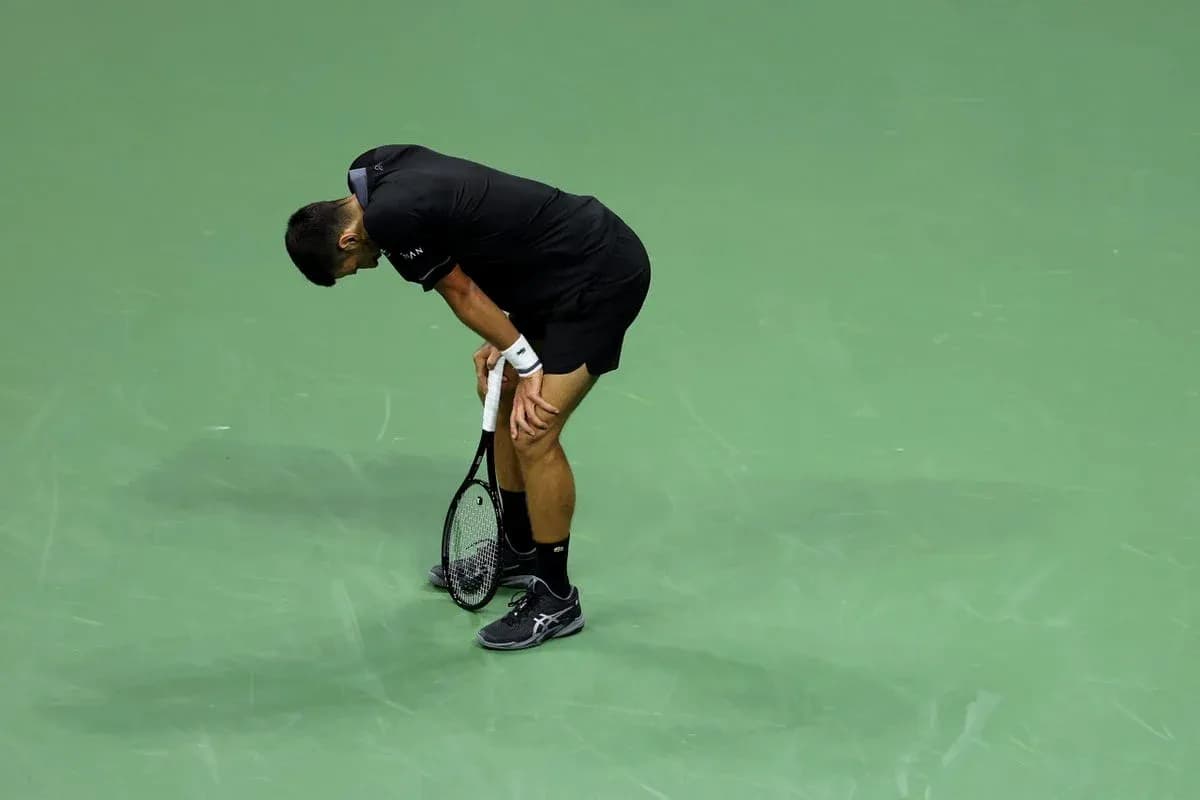
In the seventh game of the third set, Djokovic walked to the side of the court and vomited into a courtside bin mid‑game. It was a jarring sight: the man who has outlasted generation after generation suddenly unable to keep his body under control.
“The back just gave up in the end, and the shoulder, and I couldn’t close it out,” he said afterward, standing drained outside the locker room. “An awful feeling on the court for me. It’s something that I’ve been carrying unfortunately pretty much every match this year. Vomiting, throwing up, a serious issue there. And then my whole body, you know, starts to collapse. Cramping, pain.”
He said the struggle began as early as the fourth game of the match. From there, it became a battle not just with Navone, but with a body he no longer trusts.
“I’m trying, man, I’m trying,” he said of the lingering medical problem he has referenced but never detailed. “Let’s, let’s see.”
Djokovic’s wife, Jelena, and his children, Stefan and Tara, sat courtside and watched the unraveling unfold point by point. Their faces darkened with each grimace, each stretch of his lower back, each labored walk to the towel.
The fight that wouldn’t go away
For all of Djokovic’s torment, Navone refused to become a footnote.
This was only his third U.S. Open main draw. He had won just one match at this tournament in his career. He had never set foot on Arthur Ashe Stadium before Sunday, while Djokovic has built a career’s worth of memories — and four titles — on this court.
He arrived as a clay‑court worker, not a hard‑court threat. On paper, he was the kind of opponent Djokovic might have quietly welcomed for a first round, a chance to feel his way into the event.
On court, he turned into something else entirely: relentless, patient, implacable.
He took the first‑set tiebreak. When Djokovic clawed back to win the second and third sets, Navone didn’t fade. Early in the third, he saved two break points and held, prompting Djokovic to sit on the changeover rolling ice bags over his head. Later, when Djokovic appeared to seize control again by breaking early in the fourth set, Navone struck straight back. He broke Djokovic twice in a row as the Serb’s body finally buckled.
Navone “is a nice guy, a fighter,” Djokovic said. The label felt understated by the time the fifth set began.
The dagger in the fifth
Djokovic took a medical timeout before the decider. A trainer worked on his lower back, kneading and pressing, trying to coax one last stand out of a champion who has spent his career living for these moments.
It didn’t come.
In the second game of the fifth set, Navone delivered the shot that seemed to age Djokovic in real time. He dragged him corner to corner, then drew him forward. As Djokovic moved in, Navone ripped a backhand down the line. Djokovic lunged for a half‑volley and couldn’t lift it over the net.
He staggered on his next steps. The limp grew more pronounced. The winces sharper. The atmosphere inside Ashe shifted from tense to funereal.
By the fifth game of the set, tears began to roll down Djokovic’s face. The match — and something larger — was slipping away.
He has spoken often in recent seasons about the toll of best‑of‑five tennis, about how the extended format now feels like a finite resource. If he spends too much energy in the first week, there is nothing left when the real heavyweights await in the second.
On this night, even that calculation felt optimistic. Even had he survived Navone, the tournament already looked doomed from the middle of the third set.
A long shadow from Wimbledon
The signs were there.
At Wimbledon, Djokovic pushed himself to a vintage five‑set win over Félix Auger-Aliassime in the quarterfinals, only to fall in straight sets in the semifinals to Jannik Sinner, the one‑time protégé who has become the sport’s new standard.
That loss cut deeper than most. Late in that match, when a fan tried to tell him he could still hang with Sinner, now the world No. 1, Djokovic muttered, “Maybe 10 years ago.”
He disappeared after Wimbledon, choosing family and quiet over the tour. He played tennis with his wife and children, went on vacation, and delayed any serious preparation for the U.S. hard‑court swing.
When he finally returned in Cincinnati, he looked miles from his ruthless best, losing his opening match to Thiago Tirante and laboring in the heat. He hinted then at a medical issue he had been managing for a couple of years but declined to say more.
Arriving in New York, he insisted he had used his early exit in Ohio to train properly.
“Two weeks, to really train and get my body and mind into the right state, prepared for what’s coming up,” he said before the tournament. “If you ask me if I’m prepared, I feel like I am, you know, as best as I can be, but it’s different training and then getting out on the Arthur Ashe Stadium and playing best of five.”
He acknowledged that opening rounds had become trickier. “Hopefully I can overcome, you know, the first hurdle and build from there,” he said.
On Sunday, that first hurdle turned into a wall.
A champion meets the unknown
Djokovic has won 101 titles, trailing only Jimmy Connors and Roger Federer. He has ruled hard courts like no one else in the modern game. He has turned Arthur Ashe Stadium, especially at night, into a personal stage.
Yet his last two visits here have ended with him in tears.
Five years ago, chasing a calendar‑year Grand Slam, he played one of his worst matches of the season in the final. The New York crowd, long ambivalent about him, roared for him as he wept on his chair.
On Sunday night, as Navone completed the upset and Djokovic’s 2026 U.S. Open ended before it had truly begun, the scene echoed that moment. The crowd stood and cheered. Djokovic turned to every side of the stadium and formed a heart with his fingers, a small gesture of thanks from a man who has spent so long fighting this city and this sport’s expectations.
Earlier this summer, he released a documentary titled “The Wolf in Winter,” a portrait of an athlete refusing to bow to the end. On Ashe, under the closed roof and the harsh light, winter felt closer than ever.
He walked off into a tunnel filled not with answers, but with the one opponent he has never solved: time.