.svg&w=384&q=75 "logo")
Novak Djokovic's Stunning First-Round Exit at US Open
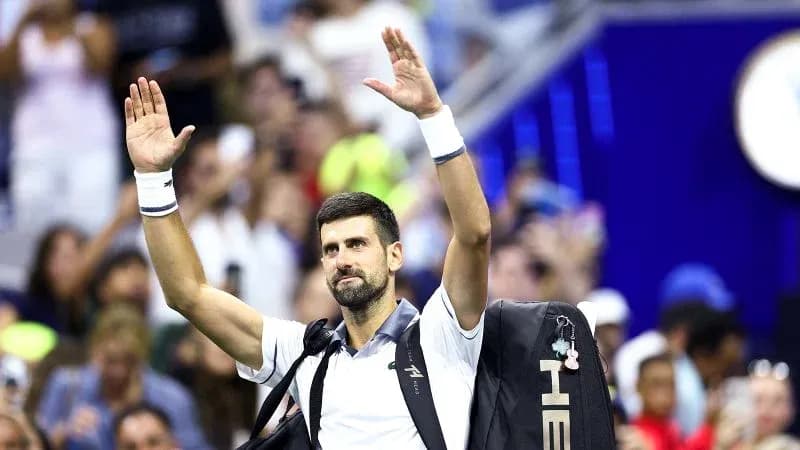
Novak Djokovic walked into Arthur Ashe Stadium on Sunday night as the sport’s great constant. He walked out beaten, emptied, and facing a question he has managed to outrun for two decades.
Was this the last time he plays a match at a Grand Slam?
The 39-year-old, the owner of 24 major titles and a career built on defiance of time and logic, fell in the first round of the US Open to Mariano Navone, 7-6 (5), 5-7, 4-6, 6-2, 6-1, in a four-hour, 36-minute epic that felt less like an upset and more like a turning of the page.
It was the longest opening match of a major in Djokovic’s career. It was also his earliest Grand Slam exit since the 2006 Australian Open and his first-ever first-round defeat in New York, coming 21 years to the day after his US Open debut.
On this night, history did not protect him.
A giant looks human
From the start, something was off. Djokovic jumped to 3-0 and 4-1 in the opening set, the kind of early stranglehold that usually signals a routine night. Then the errors arrived, in waves. By the end, he had sprayed 70 unforced mistakes, a number as jarring as the scoreline.
His body betrayed him as much as his timing. He threw up at least once. He grabbed at his left foot, clearly bothered. He swallowed pills handed over by the doctor. He lay on the court for treatment to his lower back during a medical timeout between the fourth and fifth sets. Between points, he grimaced. Between games, he searched for answers.
The aura never fully left, but it flickered.
Across the net, Navone, a 25-year-old Argentine who grew up idolizing Djokovic and only this year won his first ATP singles title, refused to shrink from the moment or the name on the other side of the net.
“(It) was very tough for me because you are playing with the ‘GOAT’ on this court,” Navone said on court, almost overwhelmed by the scale of what he had done. “For sure it’s the best thing I’ve had on court. This is an amazing court and the biggest stage. It’s amazing, the way we play. I mean, five sets. … I’m very happy. I don’t know. What can I say?”
He didn’t need to say much. The scoreline spoke loudly enough.
Momentum swings and a fading force
Djokovic’s night became a tug-of-war between muscle memory and a body that no longer obeyed as it once did.
He coughed up that first-set lead and lost the tiebreak, something that hadn’t happened to him in a US Open first round since 2006. Yet even as his wife, Jelena, watched with a worried gaze from the stands, the old champion surfaced in flashes.
He clawed through the second set, finally sealing it and allowing himself a small fist pump, a hint of the familiar steel. In the third, he cupped his hand to his ear, calling for more from the crowd, and they responded, sensing one more escape act brewing under the lights.
For a while, it looked like the script might hold. Djokovic took the third set and, with it, the lead. Navone, though, did not retreat. He absorbed the surge, held his nerve, and waited.
The pressure finally told — not on Navone, but on Djokovic’s body. After missing wide in the fourth set, Djokovic landed awkwardly, dropped his racket, and with it, much of his resistance. He effectively let the set go, conserving whatever was left for one last five-set push.
It never came.
Navone, chasing his first five-set win, grew stronger as Djokovic shrank. The rallies that once bent to Djokovic’s will now drained him. The fifth set raced away from the No. 4 seed, his legs heavy, his timing frayed, his usual impenetrable resolve reduced to gestures of frustration and pain.
Navone closed it out with the composure of a man who understood the magnitude of the moment but refused to be swallowed by it.
“It’s unbelievable,” he said. “This means a lot. It’s a dream come true.”
A nightmare stretch and an uncertain horizon
For Djokovic, the dream has tilted toward something darker in recent weeks. This loss follows a first-round exit at the Cincinnati hardcourt event earlier this month, his first match since falling to world No. 1 Jannik Sinner in the Wimbledon semifinals.
He had hoped that early Cincinnati defeat might buy him time — a chance to reset, to prepare for New York, to make sure the first match at a tournament, which he admitted has become more difficult in recent years, would not trip him again.
Instead, that opening hurdle became the whole story.
This was not a young contender outlasting a fading legend in peak form. This was one of the greatest players the sport has ever known fighting his own body, his own limits, and for long stretches, losing that battle before he finally lost the match.
The numbers will say this was a first-round defeat to a rising 25-year-old from Argentina. The images — the heaving chest, the labored movement, the 70 unforced errors under the Ashe lights — will say something else.
They will ask whether this was just a brutal night in a long career, or the moment when Novak Djokovic’s era at the Grand Slams quietly began to close.