.svg&w=384&q=75 "logo")
Nikita Tszyu vs Ben Mahoney: Danny Green's Controversial Verdict
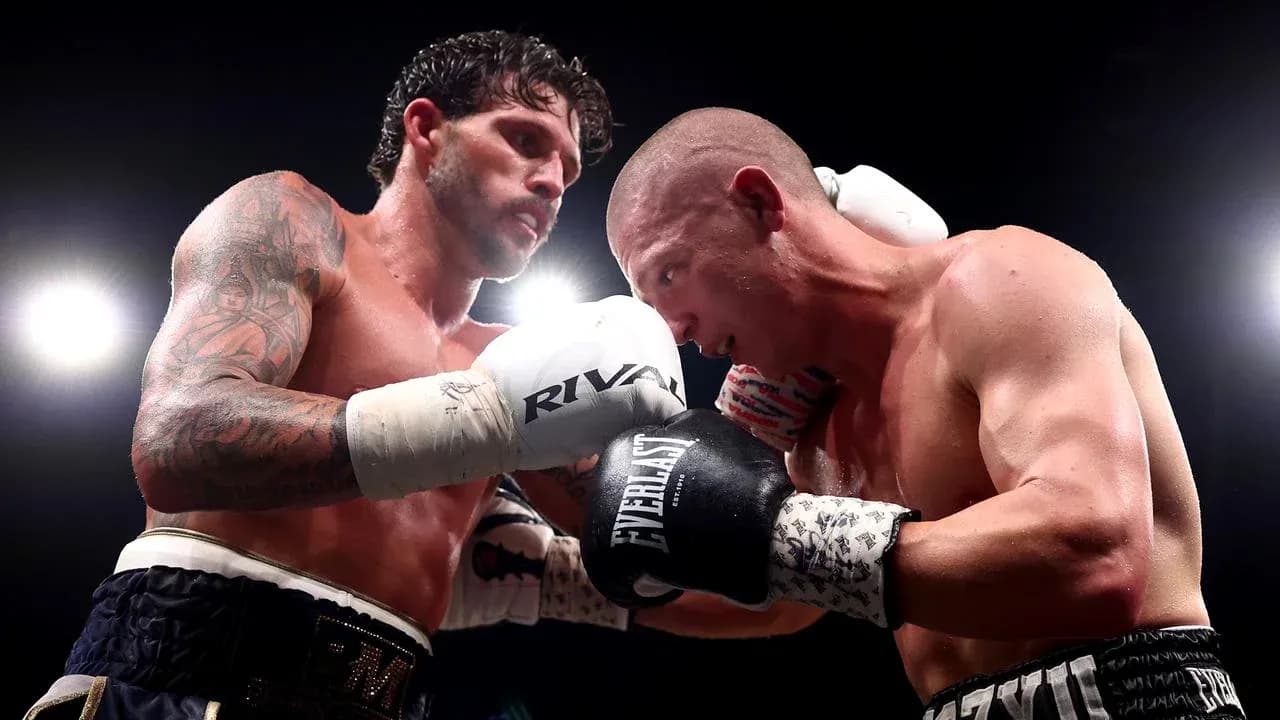
Danny Green has watched it again. No crowd, no commentary, no chaos. Just 12 rounds of Nikita Tszyu and Ben Mahoney on a screen in his Perth home — and one of Australia’s most respected boxing minds is adamant: “The Butcher” did enough.
A week after calling the action from ringside on the Gold Coast, Green has rescored the controversial IBF super welterweight eliminator for Fox Sports Australia and still has Tszyu edging it, 116-114.
Tight. Messy. Emotional. But a win.
And for Green, that verdict clears the way for Tszyu to do what ambitious young punchers are supposed to do: pack a bag, head to America and test himself under the bright lights before Christmas.
Green’s card: early Mahoney, then the tide turns
On the night, three judges produced three different readings of the same brutal story.
- Phillip Holliday went wide for Tszyu, 117-111.
- Sabrina Kerr saw it 115-113 for Mahoney.
- Carl Zappia split the difference at 114-114.
Then Tszyu himself, still breathing hard and stung by his failure to close the show, told Ben Damon in the ring that he thought he’d lost. The confusion only deepened.
By the time the post-fight press conference rolled around, the Sydneysider had walked that back, blaming the raw disappointment of not stopping his rival. The tape, as it always does, offered something colder.
Green, who had already leant towards Tszyu in commentary, sat down midweek and scored every round in silence. He gave Mahoney the first two, and then only rounds six and twelve after that. Tszyu, in Green’s book, banked four, five, seven, eight, ten and eleven. Rounds three and nine were too close to split.
His final card: Tszyu 116-114.
“It was a tight fight,” Green said. “But after rewatching all 12 rounds without commentary, I’ve again scored it in Nikita Tszyu’s favour. And by two rounds.”
The key, in his eyes, was weight of shot.
Mahoney’s jab kept him alive, his volume kept him visible. He worked, he bustled, he “shoe shined” — those quick, flashy bursts on the arms and gloves. But when Green stripped it back, he saw Tszyu landing the heavier, more telling punches.
Nikita’s left hand, thudding home over and over. The body work that judges are supposed to reward, even when it doesn’t send sweat flying for the cameras. The momentum through the middle and late rounds, where Green felt Tszyu simply chugged past a gallant opponent.
“Mahoney was throwing a lot of punches, and his jab certainly kept him in the game,” Green said. “But it was Nikita landing the harder, heavier shots.”
Not ready for the “top dogs” — yet
Green’s respect for Tszyu’s performance doesn’t spill over into wild predictions. He’s seen enough careers rushed and wrecked to know what premature looks like.
He likes the left hand. He loves the right hook that barely made an appearance.
“I would’ve liked to see Nikita throw his right hook more,” he admitted. “He’s got a beautiful right hook but just didn’t let it go as much as he could have. And Mahoney had his hands high, so wasn’t really allowing it.”
That, for Green, is where the conversation about world titles stops for now.
Tszyu’s split draw with Mahoney came in just his 14th professional outing — including the aborted night with Michael Zerafa that barely qualified as a fight. Green’s view is blunt: this is not yet a man ready for the likes of IBF champion Josh Kelly, Sebastian Fundora or Jaron “Boots” Ennis.
“Overall though, Nikita still needs more experience before he steps up to that world title level,” Green said. “It’s absolutely measured and intelligent of a young fighter to say, ‘no, I need more time before taking on these top dogs … because I’m not quite there yet’.”
In other words, there’s no shame in waiting. Especially when the learning curve can run straight through the United States.
Why America still makes sense
The Mahoney fight, with all its noise and split opinions, might tempt some into demanding an immediate rematch. Green understands that instinct. But he doesn’t share it.
For him, a December US debut — likely on the undercard of American star David Benavidez — remains exactly the right move.
“I don’t see why not,” Green said. “As long as Nikita keeps improving, keeps testing himself and growing, there is no downside to that.”
The Gold Coast scrap has already given Tszyu something more valuable than a clean scorecard: a hard 12 rounds against a stubborn opponent who refused to fold. It exposed gaps, highlighted strengths and forced him to adjust under pressure.
That’s the kind of education you take overseas, not run back on loop.
Tim Tszyu’s next move: Lara, not Charlo
While Nikita wrestles with the super welterweight climb, his older brother Tim stands at a very different crossroads.
Fresh from a gutsy win over American Errol Spence Jnr, the former world champion has options — big names, big money, big risk. Jermell Charlo’s name always lurks around any Tszyu conversation. But Green, never one to chase shadows, sees a cleaner path.
“I think Erislandy Lara could be the perfect opponent for Tim,” he said.
Lara, the WBA middleweight champion, is 41 and, as Green put it, “well and truly on the back nine”. Yet he still holds a belt and a reputation. For Tim Tszyu, that’s the sort of target that turns a strong résumé into a legacy.
Green believes the styles mesh in Tim’s favour, and he hasn’t forgotten how close the Australian came to forcing the stoppage against Spence.
“If Tim Tszyu had stepped on the gas against Spence, I really believe he could have put him away,” Green said. “Maybe he could’ve stepped on the gas and finished. But a win is a win, and it was a great victory.”
So why not Charlo?
“Because what does Jermell Charlo do for you? What does he bring?” Green asked, underlining the calculation every fighter must make. Belts, leverage, timing. Lara, in his mind, ticks more of the right boxes — a winnable fight for a second-division world title.
“Whatever Tim does next though, that’s totally up to him,” he added. “But I’d be chasing another world title.”
A magic fight, an untidy ending
Back on the Gold Coast, the noise around the Mahoney draw hasn’t fully died. Controversial results rarely do.
On Main Event straight after the bout, Green summed up his live impression in simple terms: Nikita’s left hand landed too often, too clean, to ignore.
“I had Nikita Tszyu winning the fight,” he said. “Full respect to Ben Mahoney, who I said wouldn’t go past eight rounds. He proved me wrong. It was a magic fight. It’s not pleasant when it ends controversially. I’ll have to watch it again to then score it properly.”
He watched it again. He scored it properly. And he still came back to Tszyu by two.
The judges are locked in. The record shows a split draw. The debate will roll on in gyms and pubs and living rooms.
But for Nikita Tszyu, the more important question now isn’t about a number on a card in Queensland. It’s what he does with the lesson when he walks into an American ring, far from home, with no doubts left about how hard this climb is going to be.