.svg&w=384&q=75 "logo")
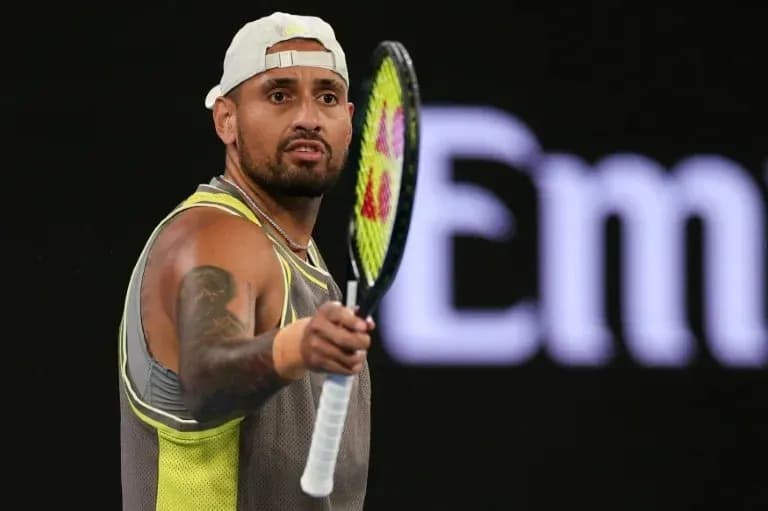
Nick Kyrgios Cleared to Return to Tennis After One-Month Ban
Nick Kyrgios has been cleared to return to tennis after accepting a one‑month ban for cocaine use and enrolling in a treatment programme, in the latest dramatic turn of a career that has rarely strayed far from the spotlight.
The 31-year-old Australian, a Wimbledon finalist in 2022, failed a doping test during an ATP event in Mallorca on June 22. He was provisionally suspended on August 4 by the International Tennis Integrity Agency (ITIA), and publicly admitted he had made “a huge mistake”.
On Friday, the ITIA confirmed that Kyrgios’ suspension had been reduced after he agreed to undergo treatment. The agency said Kyrgios explained that he had taken cocaine socially on a night out before he was due to play in Mallorca, not as a performance enhancer.
An independent scientific expert at a World Anti-Doping Agency (WADA)-accredited laboratory reviewed his case. According to the ITIA, the expert concluded that Kyrgios’ account matched the concentration of cocaine detected in his sample.
“As a result, the ITIA accepted that Kyrgios’ use of cocaine was outside of competition,” the agency said.
Under WADA rules, a violation of this kind typically carries a three-month ban. That sanction can be cut to one month if the athlete commits to a recognised treatment programme. Kyrgios has done so, and his suspension will now end on September 3, 2026, provided he completes the programme in full. His prize money and ranking points from the Mallorca event have been stripped.
It is another sharp twist in the story of one of tennis’ most mercurial talents. Armed with a huge serve and thunderous groundstrokes, Kyrgios once climbed to No. 13 in the world and has seven ATP singles titles to his name. Today, he sits at 918 in the rankings.
His peak remains that run on the lawns of Wimbledon two summers ago, when he surged into the final before losing in four sets to Novak Djokovic. It felt then like a breakthrough, a late flowering of a player long tipped for the very top.
The surge never became a sustained rise. Injuries bit hard. Operations mounted. The most serious came in 2024, when Kyrgios underwent a complete reconstruction of his right wrist, a brutal procedure for a player whose game depends so heavily on feel and racket speed.
His most recent appearance on tour came in July, as a wildcard in the men’s doubles at Wimbledon alongside Alexander Bublik. They went out in the first round, a low-key outing that did little to hint at the storm about to break.
When news of the failed test emerged last month, Kyrgios moved quickly to address it publicly.
“I recently failed a drug test in Mallorca after testing positive for cocaine,” he wrote on Instagram. “I made a huge mistake and I take full responsibility for it.
“I’m sorry to my fans, my family, my sponsors and everyone close to me. Above all, I’m sorry to the kids who follow me. I know the example this sets and I’m deeply disappointed in myself.”
The words carried a different weight than his usual social-media sparring. This was not a code violation or a courtside outburst. It was a doping case, however mitigated, and it now sits on his record.
For Kyrgios, the route back is clear but narrow: complete the treatment programme, serve the reduced ban, and try to rebuild a career that has already taken more hits than most. The question is no longer just whether his body can hold up.
It is whether, when the door finally opens again in 2026, he still has the will — and the game — to walk back through it.