.svg&w=384&q=75 "logo")
NBA Punishes LA Clippers with $30 Million Fine and Multiple Suspensions
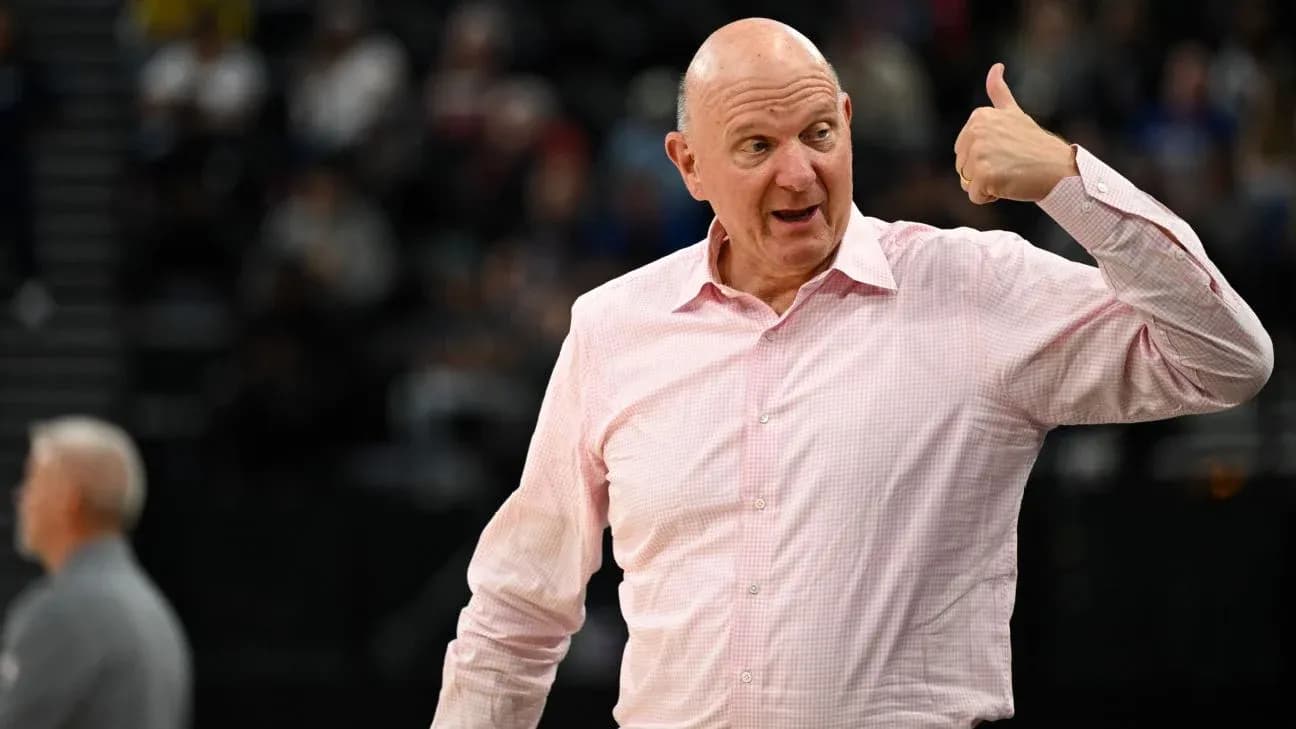
The NBA dropped the hammer on the LA Clippers on Wednesday, ending a nearly yearlong investigation into their 2021 extension with Kawhi Leonard with one of the most severe punishments the league has handed down in the salary cap era.
A $30 million fine. A one-year suspension for owner Steve Ballmer. A year without pay for team president of business operations Gillian Zucker. Six months without pay for president of basketball operations Lawrence Frank. And the loss of five first-round picks stretching from 2029 to 2033.
For a franchise that already emptied its draft chest to land Paul George and secure Leonard five years ago, the bill for this era just exploded.
How the case was built
At the heart of the investigation sits a dry-sounding but crucial debate: what counts as the Clippers merely “connecting” Leonard with sponsors, and what crosses the line into orchestrating off-court payments to dodge the salary cap?
The Clippers argued they were simply a middleman. Leonard is their star. Companies that sponsor the team wanted to be in business with him. The team, they said, made introductions, then stepped aside. That, under NBA rules, is allowed.
The league’s investigators saw something very different.
The report, commissioned from law firm Wachtell Lipton, concluded the Clippers “flagrantly and repeatedly” violated cap circumvention rules, and then tried to paper over those actions with emails designed to look compliant. The league said the connections weren’t “affirmative” in the way the team claimed; they were engineered.
The Daktronics deal became a centerpiece example. The company, which makes scoreboards, landed a massive contract for the Clippers’ new Intuit Dome. Investigators say the Clippers steered a kickback from that deal to Leonard in the form of an endorsement arrangement — and even helped set the terms.
In other instances, the report cites millions in “consulting” fees paid by the Clippers to companies shortly after they inked endorsement deals with Leonard. Those details came, the league says, from interviews with executives at the involved firms and contemporaneous documents.
The NBA compared the punishment to the infamous Joe Smith case in 2000, when David Stern stripped the Minnesota Timberwolves of five first-round picks and fined them $3.5 million for an under-the-table agreement. Here, the league hit the Clippers with what it describes as the maximum cap-circumvention fine — $7.5 million per company in four separate arrangements, totaling $30 million.
Why the league went so hard
On paper, the Wachtell report stops short of producing a smoking gun that directly implicates Ballmer personally in every detail. But the NBA clearly decided the pattern was enough.
The report says Ballmer failed to “create conditions under which his organization abided by the NBA’s circumvention rules” and that he “knowingly sought to help [Kawhi] Leonard obtain off-court income opportunities and, in at least one instance, engaged in a significant act of team facilitation.”
To connect Ballmer to the broader scheme, investigators leaned on internal notes from Lawrence Frank and communications around Leonard’s camp.
In those notes, according to the report, Leonard’s longtime adviser and uncle, Dennis Robertson, complained to Ballmer that Zucker was making “introductions” for “bulls--- deals” and that “I have to get paid.” The notes say Ballmer responded that Clippers staff were “collective workers to try and help [Leonard] achieve his financial goals.”
Frank’s cooperation appears to have helped him; he was suspended for six months, not longer. The league also leaned on interviews with executives from the involved companies, which, taken together, the NBA says created a compelling narrative of systemic circumvention.
The Clippers’ prior history didn’t help. They were fined $250,000 in 2015 over a separate cap-related accusation involving DeAndre Jordan. In 2019, the NBA investigated Leonard’s original signing and cleared the team, but issued a warning and ran them through a rules seminar.
This time, the league didn’t stop at a warning. It went to the edge of its authority — but not past it. Leonard’s contract stands. His Bird rights remain intact. He won’t be suspended, though he must pay a $700,000 fine.
The agreed blockbuster trade to send Leonard to the Toronto Raptors is still alive. A league source said both the Clippers and Raptors are allowed to proceed. If they do, LA will recoup two first-round picks in 2031 and 2033 — but won’t be able to flip them on, because of league rules on trading future firsts.
Clippers vow to fight
Publicly, the NBA called the penalties “final and binding” for all parties, noting that the league and the NBPA agreed on the punishment.
The Clippers immediately pushed back.
In a statement, the organization said it “intend[s] to vigorously challenge these findings and penalties through every avenue available to us and look forward to an ethical and impartial arbitration process.”
Ballmer’s attorney, David Kelley, went further in a separate statement, calling the ruling a “gross injustice” and promising to explore “every legal remedy.”
The franchise has been adamant, both publicly and privately, that it did not funnel money to Leonard through Aspiration, one of the companies cited in the report. A source close to the team previously said it would “fight that to the end,” including through arbitration.
The question now: what leverage do they really have against a punishment the league says is already locked in?
A draft future gutted
On the court and on the balance sheet, the most brutal piece of this penalty is simple: the Clippers’ first-round future has been shredded.
Before Wednesday’s announcement, LA had finally begun to climb out from under the mountain of draft capital it sent to Oklahoma City to acquire George in 2019, and to Philadelphia in the James Harden deal in 2023.
Trading Ivica Zubac to the Indiana Pacers last February was part of that slow rebuild. The Clippers picked up two firsts in that deal, one of which turned into Keaton Wagler at No. 5 in this year’s draft. Going into this week, they had seven first-round picks over the next seven years, with four tradable, though they didn’t control their own first outright until 2030 because of existing obligations and swap rights.
That thin margin is now gone.
The NBA’s penalty strips the Clippers of five first-round picks: the 2029 pick acquired from Indiana, and their own firsts in 2030, 2031, 2032 and 2033. What’s left is bleak: in 2027, they hold only the less favorable of their own, Oklahoma City’s and Denver’s (if it falls 6-30), and they still have a 2029 pick — but none of those can be traded under league rules.
The Leonard-to-Toronto framework offers a sliver of relief. As part of that trade, LA is set to receive unprotected first-rounders in 2031 and 2033. Those picks would give the Clippers at least some long-term draft presence. But because of the Stepien rule, which prevents teams from being without a first-round pick in any two consecutive future years, those new assets would be locked in place. They can draft with them. They can’t use them as trade ammo.
For a franchise that has built its identity on star-chasing and big-game hunting, the margin for error just shrank dramatically.
Ballmer on the sideline
The league’s decision to sideline Ballmer for a year jolts the ownership landscape, but it doesn’t threaten his grip on the franchise.
Ballmer, one of the NBA’s wealthiest and most visible owners, has vowed to fight the suspension, though it’s not yet clear whether he can delay or overturn it through the courts or arbitration. It’s also not yet public when the suspension officially starts.
When it does, the Clippers will technically fall under the stewardship of alternate governor Dennis Wong, Ballmer’s business associate and 1% owner of the team. Wong was an investor in Aspiration, but the NBA did not name him in its Wednesday release.
This is not a Donald Sterling situation. There’s no lifetime ban, no forced sale looming. When Sterling was ousted in 2014, his wife sold the team before the Board of Governors could vote to remove him.
Ballmer’s punishment is harsh, but it’s finite. The team will still be his when the suspension ends.
There is precedent. In the Joe Smith case, then-Timberwolves owner Glen Taylor and GM Kevin McHale both sat out a full season. Other owners have been banned for a year or more for different reasons: Donald Sterling, Mark Stevens in Golden State, Robert Sarver in Phoenix.
The Clippers now join that uncomfortable list.
Who runs basketball ops now?
The Clippers have not accepted the punishment, and they have not formally named an interim head of basketball operations. But the structure already in place points to a likely answer.
General manager Trent Redden, a respected front-office veteran, is expected to take the lead role while Frank serves his six-month suspension, if and when it begins.
The timing matters. A six-month ban would carry Frank past the 2027 trade deadline but still allow him to return for the 2027 draft, when the Clippers are finally projected to have a first-round pick again, and for free agency, when they could have up to $50 million in cap space.
Redden, then, would be the one navigating the team through the next crucial stretch of roster decisions without the benefit of tradable firsts.
Zucker at the center of the storm
If the league’s language toward Ballmer was stern, its treatment of Gillian Zucker was scathing.
Zucker, the Clippers’ president of business operations since Ballmer bought the team, was the point person on all four sponsor deals that overlapped with Leonard’s endorsements. The Wachtell report accuses her of making “misleading and false statements” to investigators.
In one detailed episode involving Aspiration co-founder Joseph Sanberg, the report says Sanberg approached Zucker about exploring an endorsement agreement with Leonard. Zucker, according to the findings, told him she would bring in a particular business agent to help structure the deal — an agent already under a retention agreement with the Clippers.
A day later, investigators say, she did exactly that.
The agent then emailed colleagues with proposed terms: $5 million per year plus $7 million in stock annually, for four years, tied to Leonard remaining with the Clippers. Investigators concluded that Zucker improperly relayed those financial terms to the agent.
Crucially, the agent told investigators neither he nor his team came up with the structure. Witnesses, including Zucker, agreed Sanberg lacked the experience to design such an endorsement package on his own.
That trail, the league believes, leads straight back to the team.
Dennis Robertson pushed out
The NBA’s ruling didn’t stop at the Clippers’ front office. It also landed on a figure who has hovered at the edges of league controversy for years: Dennis Robertson.
Robertson, Leonard’s uncle and longtime business adviser, received a five-year ban from “conducting business or otherwise engaging with NBA teams and their affiliates on behalf of or with respect to any player, employee, or other league or team personnel.”
His influence has loomed large since Leonard’s 2019 free agency, when, according to multiple reports, Robertson made sweeping demands of the Clippers, Lakers and Raptors. Among them: ownership stakes, access to a private plane, a house, and guaranteed endorsement money — requests that fall well outside the bounds of the collective bargaining agreement.
Those verbal asks triggered alarm around the league and helped prompt the NBA’s “rules enforcement initiative” on circumvention. One key rule from that initiative: teams must report any solicitation by a player, agent or representative for compensation or benefits not allowed under the CBA, even if they say no.
Robertson’s role in Leonard’s circle has already diminished. In July, Leonard hired Harrison Gaines of SLASH Sports as his new agent and business lead, replacing previous agent Mitch Frankel and effectively pushing Robertson out of his informal front-facing role.
On Wednesday, Leonard issued a statement that nodded to that inner-circle shake-up without naming Robertson directly.
“Integrity and respect for this game are fundamental to who I am,” Leonard said. “I accept full responsibility for lapses in judgment by people within my inner circle and regret the distraction this situation has caused the fans and my family.”
Leonard pays a price. His camp pays a bigger one.
Any hope of getting picks back?
History offers at least a faint lifeline.
In the Joe Smith case, Minnesota initially lost five first-round picks. Three years later, the NBA restored two of them, returning the Wolves’ 2003 and 2005 firsts while leaving them without picks in 2001, 2002 and 2004.
The Clippers now face a similar long game. Today, the punishment is total: five first-rounders gone, $30 million out the door, a suspended owner, and a front office in flux.
Years from now, if the league feels the message has been sent, could some of those picks be restored?
For a franchise that has wagered everything on this era of Kawhi Leonard and Paul George — and may soon be turning the page via a trade with Toronto — that question now hangs over everything.