.svg&w=384&q=75 "logo")
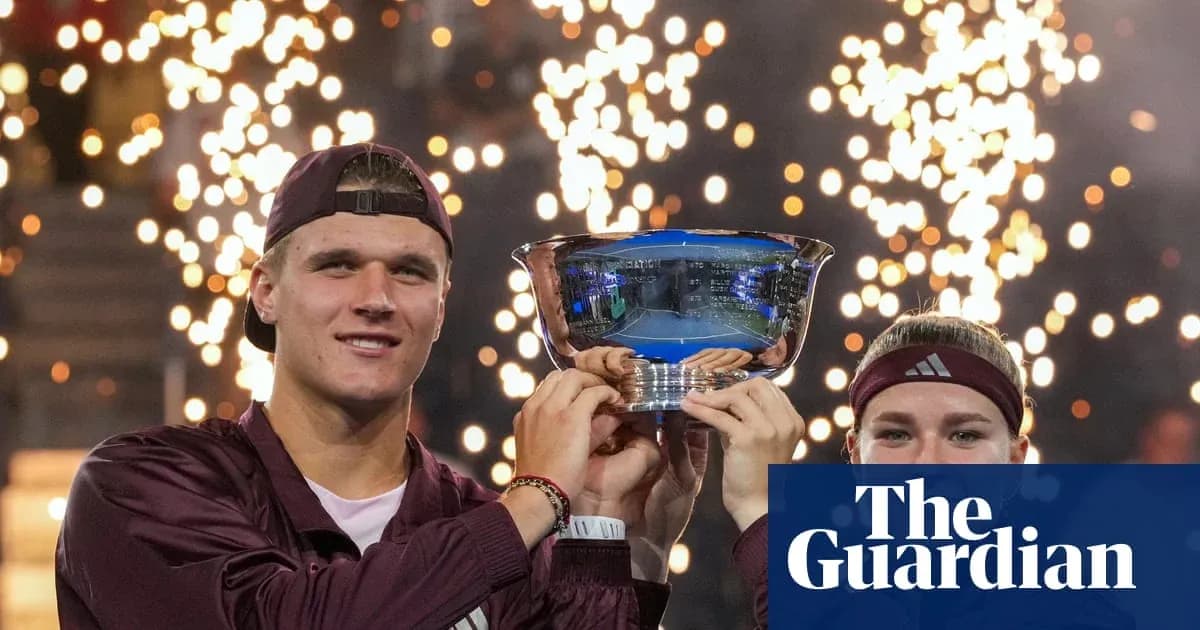
Karolína Muchová and Jakub Menšík Win US Open Mixed Doubles Title
Under the Arthur Ashe lights, with a million dollars on the line and the big names already gone, Karolína Muchová and Jakub Menšík turned a revamped mixed doubles experiment into their own late‑night showcase.
They walked out as singles players moonlighting in a discipline many specialists felt had been taken from them. They walked off as US Open champions.
The Czech pair beat Belinda Bencic and Flavio Cobolli 6-3, 1-6 (10-6) on Wednesday night, closing out a breathless final that ended just before midnight and capped a week in which mixed doubles finally felt like an event, not an afterthought.
A final built on fumes and nerve
Muchová and Menšík barely had time to sit down, let alone decompress. Seventeen minutes separated the end of their semi-final and the start of the final under Ashe’s bright glare. No proper warm-down. No long tactical reset. Just a quick reset and back into the fire.
At first, it didn’t matter. Menšík’s serve crackled, Muchová’s returns bit, and the Czechs jumped on Bencic and Cobolli to take the opening set 6-3, built on eight winners and four aces from the 6ft 5in Menšík. They looked sharp, loose, in control.
Then the match flipped.
Bencic and Cobolli, who had ridden a surge of momentum through their own semi-final, found the same wave again. They targeted a tiring Muchová, broke her to lead 4-1 in the second set and never really looked back in that stanza. Bencic’s cross-court forehand in the seventh game sealed the set 6-1 and dragged the final into a deciding 10-point tiebreak.
The tension ratcheted up. One point, one swing, could swing a million-dollar title.
In the breaker, the Czechs steadied first. Muchová and Menšík hit their spots on serve when it mattered most; Bencic and Cobolli flinched. Three of four crucial points from the Swiss-Italian pair died in the net. On triple championship point, Menšík uncorked his seventh ace of the night. Trophy secured. Title won. A sprint of a tournament finished with a heavyweight punch.
“It went really quickly,” Muchová said of the event, her first competitive outing since losing the Wimbledon final in June. “I’m obviously super happy that we managed to win. It was not my expectation.”
A controversial format finds its chaos
This was not the mixed doubles of old. Last year’s reimagining of the event – designed to lure the sport’s biggest singles names – shrank the draw to 16 teams, shifted it to the week before singles, and hiked the winners’ cheque from $200,000 to $1m. It also brought in four-game sets before the final, no-ad scoring and a 10-point tiebreak.
Doubles specialists were furious at being squeezed out. Purists questioned whether this should even count as a grand slam title.
Organizers tweaked the formula this year. An eight-team qualifying draw opened the door for more doubles experts to get in. The field gained depth, and the marquee names gave it shine: Serena Williams returning to New York for the first time since her 2022 farewell, Carlos Alcaraz back from a wrist injury, Novak Djokovic, Aryna Sabalenka, Felix Auger-Aliassime, Alex Eala.
On paper, it was star-studded. On court, the stars didn’t last.
By Tuesday, Williams and Alcaraz were gone in the quarter-finals. Djokovic, Sabalenka, Auger-Aliassime and Eala had already departed in the first round. All four specialist doubles teams were also out by the last eight.
What remained was not a gallery of doubles purists, but a quartet of pairings who embraced the format for what it was: fast, volatile, and fun.
Beer, maroon, and a married semi-final
The semi-finals on Ashe on Wednesday night didn’t have the aura of Williams or Alcaraz, but they had personality.
Asked how she would spend the time before the final if she advanced, Bencic answered simply: “Beer.” Cobolli’s face flashed a mix of amusement and alarm.
Muchová and Menšík, meanwhile, leaned into the show. They took the court in color-coordinated pink-and-maroon outfits, a detail that nearly never happened because Menšík had to ask what maroon was when Muchová first suggested it.
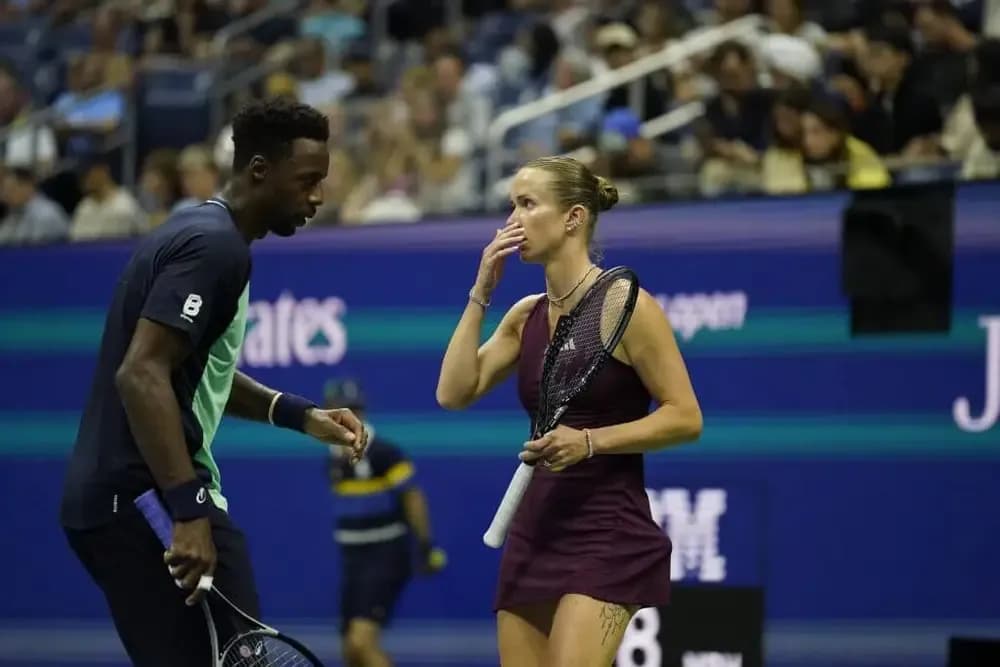
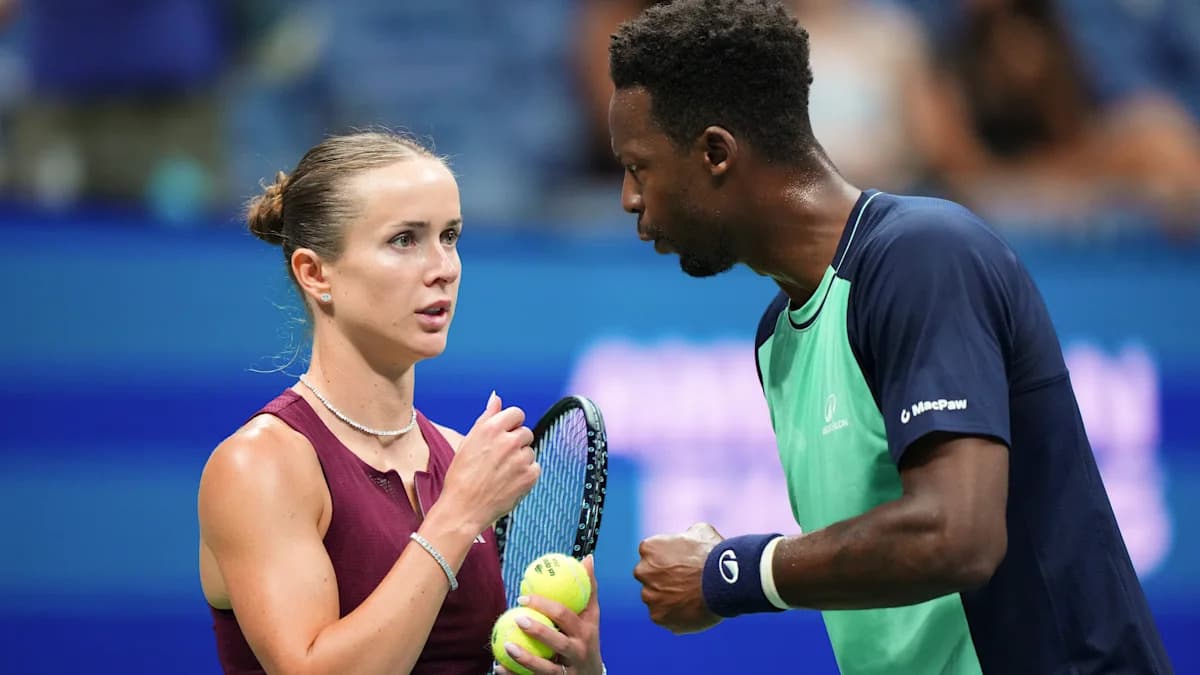
On the other side of the draw, Mirra Andreeva and Andrey Rublev brought their own quirks. Andreeva joked that she used to have a crush on Rublev, who is nine years older. On the opposite baseline stood Elina Svitolina and Gael Monfils, a couple the sport knows almost as well as any rivalry. Married since 2021, parents to a three-year-old daughter, and yet this was their first time playing doubles together at a tournament.
Svitolina is the world No 9, a hardened singles contender. Monfils, ranked 307 and set to retire at the end of the season, is in New York on a singles wild card. Neither has ever gone past a grand slam semi-final. Mixed doubles gave them a different kind of stage.
They started like they meant to stay on it.
Monfils and Svitolina’s run runs dry
In their semi-final against Bencic and Cobolli, Monfils and Svitolina rode the momentum of their first two wins. They took an even first set in a tiebreak by doing the simple things well: hold serve, extend rallies, ask questions.
At 7-7 in that tiebreak, chaos struck. Bencic’s backhand drilled her out-of-position partner, Cobolli, and on the next point the Italian double-faulted. Set to the married pair.
Cobolli’s frustration boiled over early in the second set. He double-faulted to start his first service game and looked rattled. But that wobble became the turning point. Facing triple break point, he dug in, saved all three, and held. From there, the Italian-Swiss duo caught fire.
They broke in the third game from 0-40 down, then broke Monfils again two games later without resistance. The crowd roared for Monfils and Svitolina, willing them to find one more surge, but the tank was empty. As the match crossed the hour mark, Bencic and Cobolli won 21 of the last 26 points to close it out 4-5 (7-9) 4-1 (10-5).
The fairytale pairing was out. The opportunists were through.
Czechs survive a thriller, then do it again
If that semi-final was a momentum swing, the second was a knife-edge.
Muchová and Menšík faced Andreeva and Rublev in a match that showcased exactly why this format can be addictive. Points were short, risks were high, and the margins were brutal.
Menšík attacked the net relentlessly, his frame and wingspan turning the forecourt into a wall. Muchová picked off returns with authority. The Czechs edged the first set in an 8-6 tiebreak, sealed by a delicate backhand volley from Muchová that floated past Andreeva.
The Russians hit back. Andreeva and Rublev went after the alleys, ripping winners and forcing the Czechs to grind for every point. They dragged the match into another tiebreak, and this time they had the finish line in sight.
Two match points came and went.
Menšík’s serve bailed the Czechs out, heavy and precise under pressure. From the brink, they reeled off the last four points to take the second-set breaker 11-9 and the match 5-4 (8-6) 3-5 (11-9). Their reward: 17 minutes, a quick reset, and a final under the Ashe lights.
A three-week US Open, and a springboard
By the time Muchová and Menšík finally lifted the trophy, Ashe had thinned out. The late hour caught up with New York. But the earlier scenes told a different story: the US Open has stretched itself into a three-week spectacle.
On Wednesday, Ashe was mostly full for the mixed doubles semi-finals. On Tuesday, it was packed for exhibition matches honoring Roger Federer, with Andy Roddick, John McEnroe, Andre Agassi and the 20-time major winner himself on court. The mixed event, once a sideshow, suddenly sat in the middle of a festival.
For Muchová and Menšík, the week was never just about this title. They said throughout that their main focus remained the singles draw. It shows in their résumés and ambitions.
Muchová, ranked No 6 in the world, has already played two major finals and reached the semi-finals in New York. Menšík is in the midst of a career-best season and will try to go beyond the third round at a slam for the first time here.
Singles begins Sunday. The stakes rise, the format stretches, the grind returns. The road to another trophy on Ashe will be longer, steeper, more unforgiving.
But they now walk into it with a fresh title, a shared memory of clutch points under the biggest roof in tennis, and the confidence that comes from winning when the margins are razor thin.
“We had really great matches to play,” Menšík said, after his first-ever week of mixed doubles. “It’s a pretty different discipline [from singles, but] at the same time it’s good that we tried a lot of things on the court. So, of course, it gives you a little bit of boost of confidence.”
The experiment worked for them. The question now is whether this wild, compressed, million-dollar gamble has permanently changed what mixed doubles means at a grand slam.