.svg&w=384&q=75 "logo")
Moses Itauma's Heavyweight Dream Ends in Defeat Against Filip Hrgovic
Moses Itauma’s dream of crashing the heavyweight history books at 21 ended not with a single punch, but with a slow, merciless unraveling under the remorseless will of Filip Hrgovic.
For eight rounds, it looked like a coronation. By the ninth, it had become a cautionary tale.
A prodigy in control
From the moment Itauma emerged from the dressing room, face set, shoulders loose, the arena felt like it belonged to him. The crowd bellowed his name long before the first bell. He didn’t play to them. He walked in as if this was all preordained.
Southpaw, sharp, and utterly sure of himself, he landed first with a sweeping right hand that set the tone. Hrgovic, taller, older, heavier, found himself being backed up by a 21-year-old who moved like a middleweight and punched like a fully grown heavyweight.
Itauma’s speed was jarring. He cuffed Hrgovic with fast, spiteful shots, then smashed him with a right cross that jolted the Croat and drew a murmur from ringside. The challenger, supposedly the green one, looked like the seasoned operator.
Then came the second round, and with it, the first major crack in Hrgovic’s night.
Itauma missed with a scything left, but when Hrgovic stepped in, he walked straight into a short, brutal right hook. The shot dumped him on the canvas, the first real eruption of noise tearing through the arena as the referee tolled an eight count. Hrgovic got up. He always does. He tried to respond late in the round, only for Itauma to rip through him again with another blistering combination.
By the third, sweat shone on both men under the lights, but it was Itauma who dictated. A sharp left snapped back Hrgovic’s head. The younger man dug cruelly to the body, thudding into the ribs. Hrgovic refused to fold, his supporters roaring him on as he finally enjoyed flickers of success, just enough to remind everyone that his ambition had not gone anywhere.
The turning of the tide
The fight’s first real warning sign for Itauma came not from a punch, but from his own body.
The pace had been fierce. In the fifth, Itauma still found moments of brilliance, threading a beautiful short left through Hrgovic’s guard. Yet the older man kept trudging forward, stoic, stubborn, unblinking. Itauma’s chest began to heave a little more. At one point, he had to use a gloved hand to push his black gum shield back into place. It was a small act, but it betrayed something his face had not yet shown: strain.
Still, he ended the round with menace. A spiteful uppercut snapped Hrgovic’s head back on that thick neck, and the crowd sensed the gap in class again. Above Hrgovic’s right eye, a cut began to leak, a thin line of blood trickling down. He answered with heavy shots of his own before the bell, and Itauma met fire with fire. The contest, once one-sided, had become a fight.
Then the unknown arrived. Itauma had never boxed beyond six rounds as a professional. The seventh took him into territory he had not yet explored.
He handled it well at first. He again forced Hrgovic back, stitching together deft combinations, still quicker, still sharper. But the pattern had shifted. Hrgovic no longer looked like a man being outclassed. He looked like a man waiting.
The eighth brought the storm.
Itauma continued to land, thudding in meaty blows that would have broken lesser men. Hrgovic absorbed them, almost swallowed them, and kept marching. Itauma’s legs began to betray him. His shoulders sagged. The brilliance that had lit up the early rounds dulled under the weight of exhaustion.
Hrgovic, incredibly, rallied again. The older fighter, written off by many as too slow for the prodigy in front of him, began to sense the truth: this wasn’t about hand speed anymore. It was about who had more left.
The collapse and the coronation
By the ninth, Itauma’s body language told its own story. The dazzling youngster who had danced around a world-level heavyweight now moved as if wading through treacle.
Hrgovic saw it. Smelled it. Went after it.
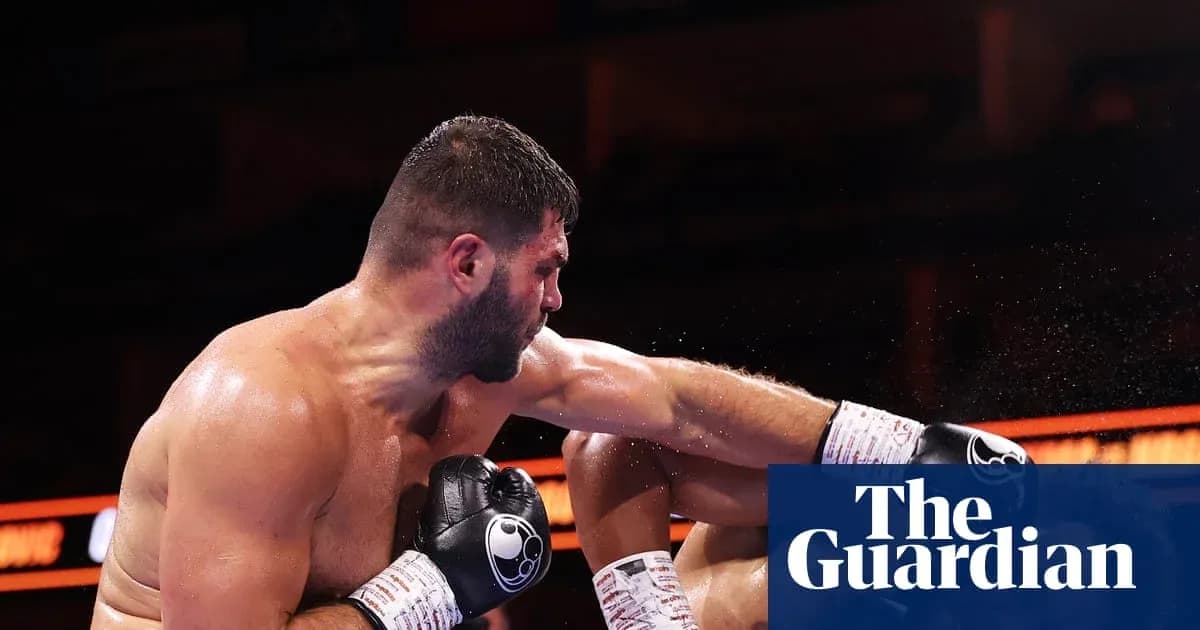
He pressed Itauma back to the ropes, unloading with renewed conviction, his punches no longer hopeful but authoritative. The Croat, who had been outboxed for long stretches, now fought like a man who knew the fight was his to take if he could simply keep punching.
Itauma, weaving under the onslaught, looked spent. His earlier swagger had gone, replaced by a desperate attempt to survive. The storm he had controlled for so long now crashed over him.
Pinned, exhausted, and unable to fire back with the same venom, Itauma sagged against the ropes as Hrgovic let his hands go. The referee moved in to intervene. At almost the same moment, from Itauma’s corner, Ben Davison launched the white towel over the ropes, a stark surrender to reality. The stoppage came not a second too soon.
The 21-year-old left the ring on a stretcher, apparently nursing a knee injury, his title bid in ruins. The physical damage, though, paled beside the psychological blow. He had dominated, dazzled, and still lost.
Across the ring, Hrgovic stood as Croatia’s first world heavyweight champion, a man who had carved out his own slice of history from the jaws of defeat.
A lesson in the hardest division
The result cut through the hype that had surrounded Itauma. His skill is obvious. His ceiling remains high. But heavyweight boxing does not forgive inexperience, especially when matched with a seasoned, unyielding opponent.
From the eighth round on, Itauma needed to be smart, to move, to spoil, to buy time. Instead, he allowed himself to be dragged into a slugfest with a fighter whose greatest weapon on the night was not speed or finesse, but stamina and a bludgeoning self-belief.
Hrgovic had been billed as the acid test of Itauma’s credentials. A 34-year-old with only one defeat in nine years as a professional, he was meant to struggle with the younger man’s footwork, hand speed, clear thinking, and power from odd angles. For long spells, that script held.
Then the intangible took over. Hrgovic simply refused to go away.
Afterwards, the new champion framed his comeback in spiritual terms. “Let me tell you something,” he said. “It was not me tonight. It was Jesus Christ in me. Holy Spirit. Father, Son and the Holy Spirit. It was not me. I was losing every round. I was outboxed. And I don’t know from where I got energy in that ninth round. And it was really not my strength. It was the Holy Spirit.”
He made a point of paying tribute to the man he had just broken. “He’s an amazing fighter,” Hrgovic said of Itauma. “I want to thank him for accepting this fight, to give me a chance to become a new superstar in the heavyweight division. I’m the present and he’s definitely the future.”
That future now comes with scars. Itauma has time, plenty of it, to rebuild from this crushing setback, to learn the brutal lessons that only nights like this can teach. But the belt, the glory, the history – those belong to Hrgovic.
On a night that was supposed to crown a prodigy, it instead underlined a harsher truth: in heavyweight boxing, talent can dazzle, but endurance and will still decide who walks out with the title.