.svg&w=384&q=75 "logo")
Manchester United's Left-Back Dilemma: A Risky Decision
As the clock nudged past 23:00 BST on 1 September and the transfer window slammed shut, the same thought flickered across Manchester United’s fanbase.
What about a left-back?
For months, as the post-2025-26 autopsy rolled into debates over Michael Carrick’s first full summer of squad shaping, one issue looked so obvious it barely needed stating. United had to strengthen on the left of their defence.
They didn’t.
A position left exposed
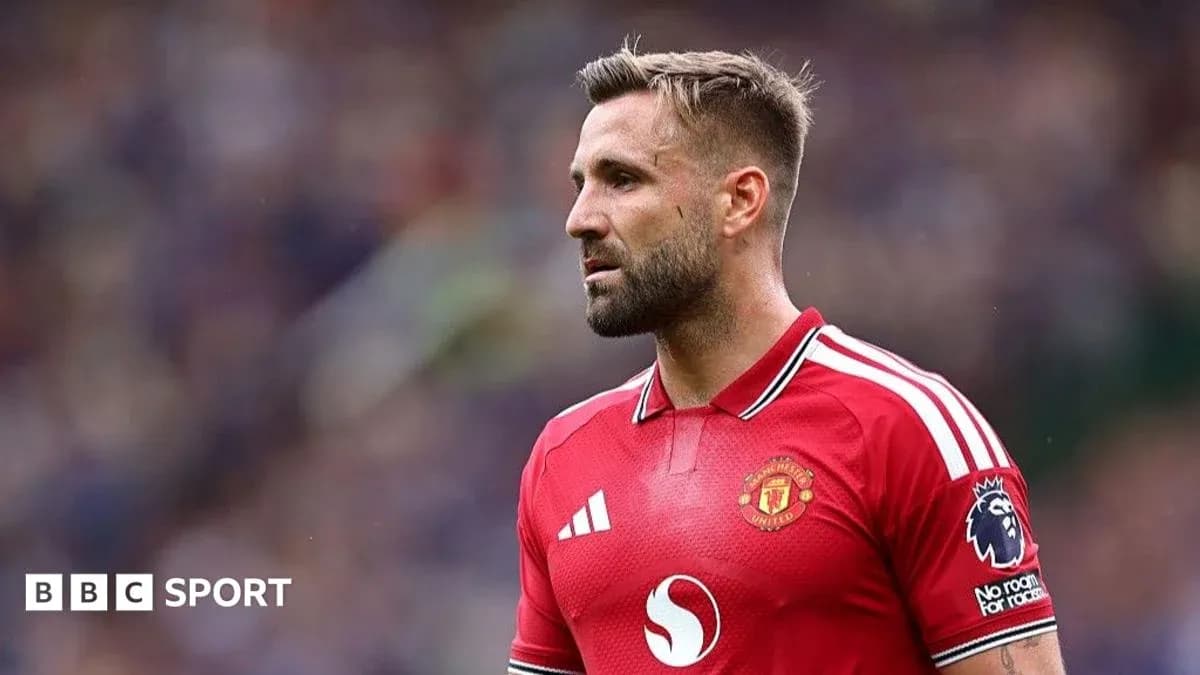
Luke Shaw stands alone as the only senior, natural left-back in the squad. He started all 38 Premier League games last season, a remarkable achievement given his injury history and the physical demands of the modern schedule.
No-one at the club expects that to happen again.
Tyrell Malacia’s departure at the end of June, his contract allowed to run down without fuss, only sharpened the sense of vulnerability. With a season that could stretch beyond 60 matches across competitions, the logic was simple: Shaw needed proper cover, maybe even a long-term successor.
Targets were lined up. Names circulated. Newcastle’s Lewis Hall. Barcelona’s Alejandro Balde. Racing Santander’s Jorge Salinas. Each represented a different profile, a different route to solving the same problem.
In the end, United’s last serious move was an attempt to prise Rayan Ait-Nouri from Manchester City on loan, a rare and audacious proposal to tempt a player across the divide. City refused. The deal would have required an obligation to buy; United balked, choosing patience for their preferred options instead.
The window closed. The risk remained.
Hall, Baleba and a budget with limits
Inside Carrick’s camp, the admiration for Lewis Hall is genuine. If United could have struck an agreement with Newcastle, they would have.
But the market bit back.
Newcastle, already raided for key players by Premier League rivals this summer, treated Hall as a prized asset. Any deal, United quickly realised, would carry a huge fee. With a finite budget, something had to give.
The club chose midfield.
United committed £70m to bring Carlos Baleba from Brighton, addressing what they had long identified as their priority area. In that context, Hall became a player to revisit next summer, not a solution for now.
Balde was available only on a permanent deal, Barcelona unwilling to entertain a loan. Salinas’ relatively modest release clause made him attractive, but Atletico Madrid moved into pole position. By the time United pivoted to Argentina defender Nicolas Tagliafico, they missed out again – and, crucially, their own focus had already started to drift elsewhere.
The late enquiry for Ait-Nouri, sparked by an agent’s approach, felt like an admission: even United were not entirely convinced by the path they were taking.
A patchwork plan at left-back
Carrick’s solution, at least until January, is a blend of trust, improvisation and hope.
Shaw remains first choice. Behind him, Noussair Mazraoui is viewed as the primary alternative, a role he understands from his time with Morocco, even if right-back is his natural home. Diogo Dalot, who has switched flanks before, offers another layer of cover. Then comes Harry Amass.
On paper, it is a structure. In reality, it is a gamble.
The Amass situation is particularly curious. A natural left-back, highly regarded in United’s academy, he impressed during a loan spell at Sheffield Wednesday last season before injury struck soon after a move to Norwich in the winter window. This summer, at 19, he caught the eye again, shadowing Shaw and performing well in pre-season.
Yet United were prepared to let him go.
The pattern stretches back. In the summer of 2024, Erik ten Hag left Amass out of his Community Shield squad, despite the teenager having held his own against Mo Salah in a pre-season game in the United States a week earlier. Ten Hag felt Amass was not yet physically ready for the senior level.
Two years on, the defender should be stronger, more mature, closer to that threshold. Interest in him has been consistent, with multiple clubs enquiring. Even on deadline day, his absence from United’s Premier League 2 fixture against Leicester on Monday only fuelled the expectation that he would depart, most likely on loan.
He didn’t. He stayed. And no-one quite knows what his role will be.
Yoro’s emergence and a defensive reshuffle
United’s willingness to lean on Mazraoui as a left-back option owes a lot to Leny Yoro’s development.
Signed from Lille in 2024 for £52m as a central defender, Yoro spent this pre-season being nudged out to the right. Carrick used him mainly at right-back, testing his mobility and decision-making in wider areas.
Against Ipswich on Sunday, that was again his role. Yoro came on for Dalot at right-back, while Mazraoui replaced Shaw on the opposite flank. The shape held. The idea gained more weight.
At 20, Yoro is still learning the nuances of playing full-back – the timing of overlaps, the body shape in one-on-one duels, the angles in transition. But he has the tools: pace, strength, composure on the ball. United fans only have to look across town at Josko Gvardiol’s transformation at Manchester City, shifting from central defence to a modern, aggressive full-back, to see how such experiments can succeed.
This is the essence of United’s calculated risk: internal solutions, positional flexibility, and a refusal to panic.
Scar tissue from past mistakes
Behind the decision lies another truth. United are determined not to repeat old errors.
For years, the club paid over the odds for short-term fixes who never reached the required standard. Alex Telles. Matteo Darmian. Sergio Reguilon. All arrived as answers to questions at full-back. None provided a lasting solution.
This summer, United took a hard line. They set valuations and stuck to them. They refused to be dragged into late-window desperation. No inflated fees. No signings made just to quieten the noise.
From a distance, the logic is sound. Protect the budget. Back the coaching. Trust Shaw, Mazraoui, Dalot and Yoro to share the load, with Amass waiting somewhere in the shadows.
But football is not played from a distance.
The emotion of a tight game at Anfield when Shaw pulls up on 32 minutes. The sight of a makeshift back four chasing a winger into the corner in the 88th minute of a Champions League tie. The scrutiny when a patched-together defence concedes from the left side, again.
Those are the moments that will judge this decision.
On paper, it makes sense. In the cold language of budgets and long-term planning, it is probably the right call.
The season will decide whether Manchester United have been admirably disciplined – or dangerously brave.