Lehečka Leads Czech Republic to Davis Cup Finals Victory Over USA
The old competition still knows how to bite.
In a packed Prague arena thick with noise and nerves, the Czech Republic once again sent the United States tumbling out of the Davis Cup, winning a taut qualifying tie 3–2 to book their place in November’s Finals in Bologna. For the second straight year, it came down to a decisive rubber against the Americans. For the second straight year, the Czechs didn’t blink.
This time, Jiří Lehečka carried the weight.
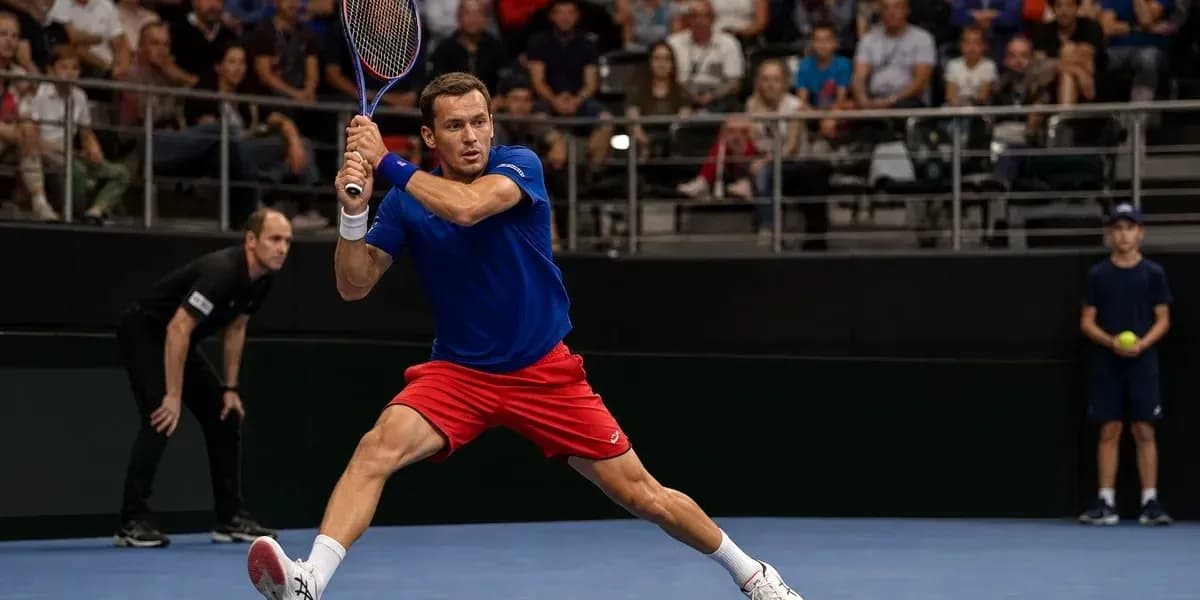
Already the home hero after beating Ben Shelton in straight sets on the opening day, Lehečka returned to court with everything on the line and subdued Learner Tien 6–3, 7–5 to close out the tie. It was not straightforward. It rarely is in this competition.
Lehečka fell behind an early break in the first set, the tension in the stands rising with every missed chance. Tien, fearless and loose, swung freely and briefly silenced the crowd. Lehečka steadied, broke back, and then imposed himself with the kind of heavy, aggressive baseline game that has become his calling card. The first set belonged to him; the momentum did not, at least not yet.
The second set turned into a test of nerve. Tien surged to a 3–0 lead, threatening to drag the contest into a decider and shift all the pressure back onto the Czech No. 1. The arena tightened. The Czech bench did not.
Lehečka clawed his way back, point by point, game by game, until the match sat again in his hands. On his fourth match point, with the crowd on its feet, he slammed the door on the American challenge and sent his team to Bologna.
Doubles drama, Menšík’s statement win
The day had begun on a knife-edge at 1–1, and the first swing of momentum belonged to the visitors.
Christian Harrison and Austin Krajicek dragged the United States in front with a gutsy doubles win over Adam Pavlásek and Patrik Rikl, 5–7, 6–3, 7–6 (10–8). The Americans stared down four match points in that deciding tiebreak and survived them all, a defiant stand that briefly made them favourites to close out the tie.
The arena fell quiet. The tie, and the pressure, shifted to 19-year-old Jakub Menšík.
He responded like a veteran.
Facing recent US Open finalist Ben Shelton, Menšík dropped a tight first set 5–7 but refused to retreat. He raised his level on return, tightened his margins, and began to blunt Shelton’s power. The American’s forehand firepower met a wall of resilience as Menšík turned the match around to win 5–7, 6–4, 6–3, dragging the Czechs back to 2–2 and handing Lehečka the chance to finish the job.
Afterward, Lehečka underlined what every Davis Cup player knows: these wins feel different. The decisive point might sit next to his name, but he acknowledged that without Menšík’s comeback against Shelton, he would never have stepped on court for the final rubber.
For the United States, it was a familiar sting. A year ago in Delray Beach, it was also Menšík who delivered the knockout blow, beating Frances Tiafoe in the decisive match to send the Czechs through. Different venue, same story.
New faces in the Final 8
While Prague delivered drama, history was being made in Seoul.
South Korea reached the Davis Cup final eight for the first time, beating India 3–1. Kwon Soon-woo sealed the landmark achievement with a commanding 6–1, 6–2 victory over Sumit Nagal, a scoreline that underlined the Koreans’ growing authority on home courts.
In Vienna, Austria joined the party.
Backed by a partisan crowd, the Austrians defeated Belgium 3–1, with Jurij Rodionov providing the decisive point. He edged a tense first-set tiebreak 7–6 (8–6) against Zizou Bergs and then accelerated through the second 6–3 to clinch the tie and secure their ticket to Bologna.
Waiting in Italy will be the hosts, chasing a fourth consecutive Davis Cup title and carrying the aura of a modern dynasty. The United States, 32-time champions and still the most decorated nation in the competition, remain stuck in a long drought. Their last triumph came in 2007, a different era of American tennis.
The Czechs, though, are heading to Bologna with something the record books cannot quite capture: the confidence that comes from winning tight ties under pressure, from young players delivering when it matters most, and from beating the United States in back-to-back decisive rubbers.
In a competition that thrives on history and hostility, that edge might matter more than any ranking.