.svg&w=384&q=75 "logo")
Leah Poulton Takes Charge of England Women's Cricket
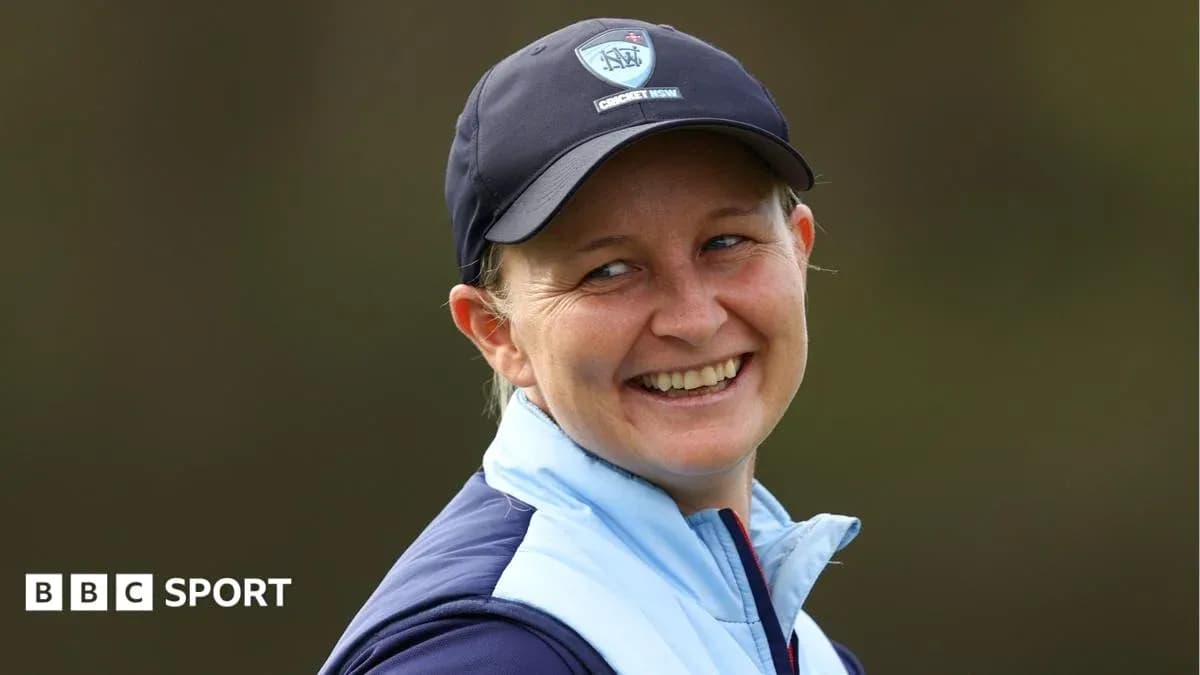
The England and Wales Cricket Board has turned south again for leadership. This time, it is Leah Poulton, a former Australia batter with 90 caps, who will steer the England women’s programme as managing director.
She starts in November, stepping into a space once occupied – and heavily populated – by Clare Connor.
A specialist for a pivotal moment
Poulton arrives with a CV rooted in the sharp end of the women’s game. She has worked as assistant coach at Sydney Thunder and Sydney Sixers in the Women’s Big Bash League, then climbed through the structure at Cricket New South Wales as pathway manager and assistant coach for the NSW Breakers.
From there, she moved into high performance at Cricket Australia before taking charge as head of elite female cricket at Cricket NSW, a role she has held for the past six years. That is not a ceremonial title. It is the job of building and feeding a system, of turning potential into caps and trophies.
Now she is asked to do the same in England.
The ECB has made her responsibilities plain. Poulton will be accountable for the performances of England women, England women A, England women U19s and the overall effectiveness and reputation of the women’s high-performance system. Every rung, from teenage hopeful to Ashes veteran, falls under her watch.
Crucially, she will work in lockstep with head coach Charlotte Edwards and captain Nat Sciver-Brunt to set what the ECB calls a “clear, unified vision” for England women to “consistently succeed on the world stage”. Vision is one thing. Delivering it against the best side in the world, her home nation, is quite another.
An Aussie tasked with reclaiming the urn
Next summer, England host Australia in a women’s Ashes that already carries a sharper edge. The team trying to wrest back the urn will be led, structurally at least, by an Australian.
Poulton does not shy away from the scale of it. She called the role “incredibly exciting and honoured”, speaking of the chance to shape programmes and, as she put it, “most importantly, invest in our people”. Her emphasis, as ever, ran towards the system beneath the shirts.
She talked of working with Edwards, Sciver-Brunt and the wider team, “building on the strong foundations already in place and taking the programme forward”. The language is familiar, but the record behind it is not empty. At Cricket NSW, she has spent years knitting together pathways and domestic strength, the very things she says are “vital” to sustained success.
Her focus now will be to “give the next generation of English players every opportunity to thrive”. For a country that has rapidly professionalised its women’s domestic structure, that promise lands at a critical time.
A streamlined role after a heavyweight era
Connor’s departure marks the end of a heavyweight tenure. During her time at the ECB, she wore a string of titles: deputy chief executive, influential figure at the International Cricket Council, leading voice at Marylebone Cricket Club. She was more than a managing director; she was part of the game’s establishment architecture.
Poulton’s brief is tighter, and that is deliberate. She will concentrate on everything to do with the senior women’s team and the pathways that feed it. No boardroom sprawl. No split focus. Just performance, development and the conveyor belt in between.
She effectively replaces not only Connor but also women’s performance manager Jonathan Finch, who has also left the ECB. One appointment, two departures, and a clearer line of accountability.
This clarity is likely to make her more hands-on than her predecessor. Fewer titles, more time on the ground.
Trusted operator, familiar faces
Inside the women’s game, Poulton is not an unknown quantity. She is regarded as a calm, clear communicator, someone prepared to have hard conversations when standards slip. That matters in a dressing room that has grown used to professional expectations and public scrutiny.
She also walks into a set-up containing familiar allies. She has previously worked with Edwards and selector Lydia Greenway in the Big Bash. Those relationships should shorten the bedding-in period and help her read the room quickly.
The timing helps too. Poulton arrives at a rare moment of calm for the senior side. England women are not back in action until after Christmas, which means the early part of the winter will tilt towards England women A, the U19s and the wider pathway squads. It is a window to assess, to listen, and to start reshaping without the weekly noise of international results.
English cricket’s southern habit
This is not the first time English cricket has looked across oceans for leadership. The men’s side is already shaped by New Zealanders Stephen Fleming and Brendon McCullum as head coaches, with Australian Marcus North involved as a selector.
Now Poulton joins that southern spine at the top of the English game. Another overseas voice. Another outsider trusted with the keys.
She is believed to have beaten some significant domestic candidates to the post, a decision that underlines the ECB’s willingness to look beyond nationality in the hunt for an edge.
The stakes could hardly be clearer. The new year brings a home Ashes series, the ultimate measure for any England side. When the urn goes up for grabs next summer, it will be an Australian architect trying to plot the downfall of Australian dominance.
If England finally prise it back, the story will not just be about runs and wickets. It will be about the system that put them there – and the Australian who built it.