.svg&w=384&q=75 "logo")
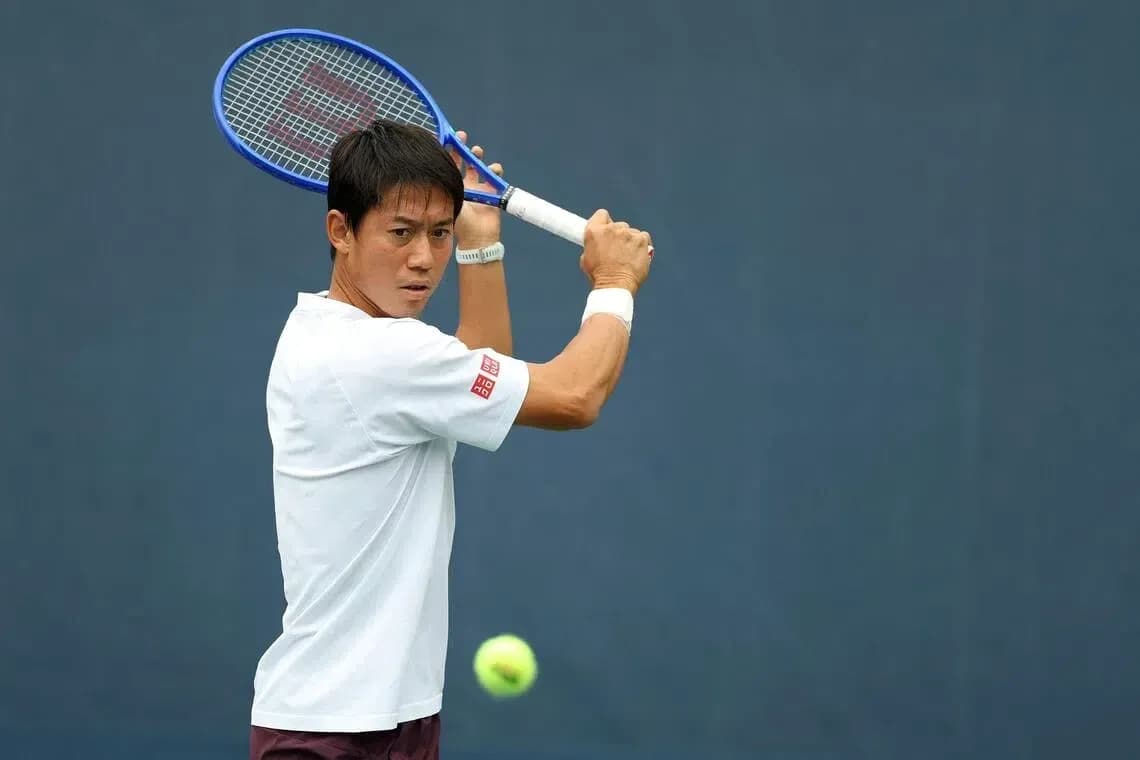
Kei Nishikori's US Open Journey Ends One Step Short
Kei Nishikori walked off Louis Armstrong’s outside courts for the final time at a US Open with no roar, no deep run, no miracle escape. Just a straight-sets loss to a countryman 16 years his junior and the quiet realisation that the candle is almost out.
The 36-year-old, playing his final season before retirement, fell 6-4, 7-6 (7-3) to 20-year-old Rei Sakamoto in the third round of qualifying on Aug 28, leaving him a single win short of one last main-draw appearance in New York.
“It’s a refreshing emotion, as if he totally blew out the last flame of a candle,” Nishikori said, capturing the moment with the same clarity that once defined his backhand.
A decade ago, Nishikori became the first Asian man to reach a Grand Slam final when he stormed into the 2014 US Open title match. On Wednesday, the former world No. 4, competing on a qualifying wild card for the 2026 tournament, could not live with the pace and weight of Sakamoto’s game.
The numbers told the story. Sakamoto fired 19 aces; Nishikori had none. The younger man finished with 33 winners to Nishikori’s 14 and, crucially, never blinked when the finish line appeared.
Nishikori actually started like a man determined to script one more chapter. He broke early and moved out to a 2-0 lead in the opening set, his timing sharp, his court craft intact. Then the match tilted.
Sakamoto settled, found his range on serve and began to swing freely. He broke back, then broke again, turning the set on its head and taking it 6-4 with a barrage of first serves and flat, fearless groundstrokes.
“I felt I wasn’t able to cope once the level went up slightly,” Nishikori admitted.
The second set became a test of nerve. Both men held serve, Nishikori probing, Sakamoto refusing to yield. There were no breaks, no wild momentum swings, just the slow tightening of tension as the tie-break loomed.
When it arrived, the veteran blinked first. Sakamoto surged to a 6-1 lead in the breaker, hammering serves and stepping inside the baseline whenever he saw a short ball. Nishikori saved a couple of points, but the gap was too large. After 1 hour 42 minutes, Sakamoto closed it out, sealing his place in the main draw starting Aug 30.
For Sakamoto, ranked No. 157 in the world and very much at the beginning of his story, it was a breakthrough win and a symbolic one.
“My serves were really good, and I also managed to play aggressively,” he said. “I hope to become a player on par with Kei.”
Nishikori, gracious as ever in defeat, did not hide his disappointment but quickly turned the spotlight onto the man who had just beaten him.
“Not happy to lose today, but I mean I’m happy for Rei, he’s the next Japanese top player so I hope he can make the top 10 soon,” he said. “It was a great week for me. I was really enjoying it.”
Enjoyment has not always been possible in recent years. Since undergoing left hip surgery in January 2022, Nishikori has been plagued by injuries that repeatedly stalled his comebacks and ultimately pushed him toward retirement. The body that once carried him to a Rio 2016 Olympic bronze medal and deep into the second week of majors could no longer keep pace with his ambition.
Yet at Flushing Meadows, the place where he played a Grand Slam final, reached semi-finals and delivered some of the most gripping matches of his career, the joy briefly returned.
“I really enjoyed my entire tennis life,” he said. “It was almost 20 years with the pros and especially here I had great memories, one time final, semis, many great matches I played here in New York so happy to play in the last moment.”
He had been slated to play mixed doubles with Naomi Osaka at this US Open, a pairing that would have carried enormous attention, but those plans did not materialise. The farewell tour is not over, though. Nishikori is scheduled to compete at the Japan Open in Tokyo in late September, a fitting stage for a final bow on home soil.
Sakamoto now steps through the door his idol helped open for Japanese tennis, into a main draw Nishikori once lit up. Whether he can follow the path to the world’s top 10, as Nishikori hopes, remains to be seen.
What is certain is this: in New York, on a hot August afternoon, one era of Japanese men’s tennis edged towards its end, and another quietly began.