.svg&w=384&q=75 "logo")
Katie Taylor's Final Fight at Croke Park: A Legacy Defined
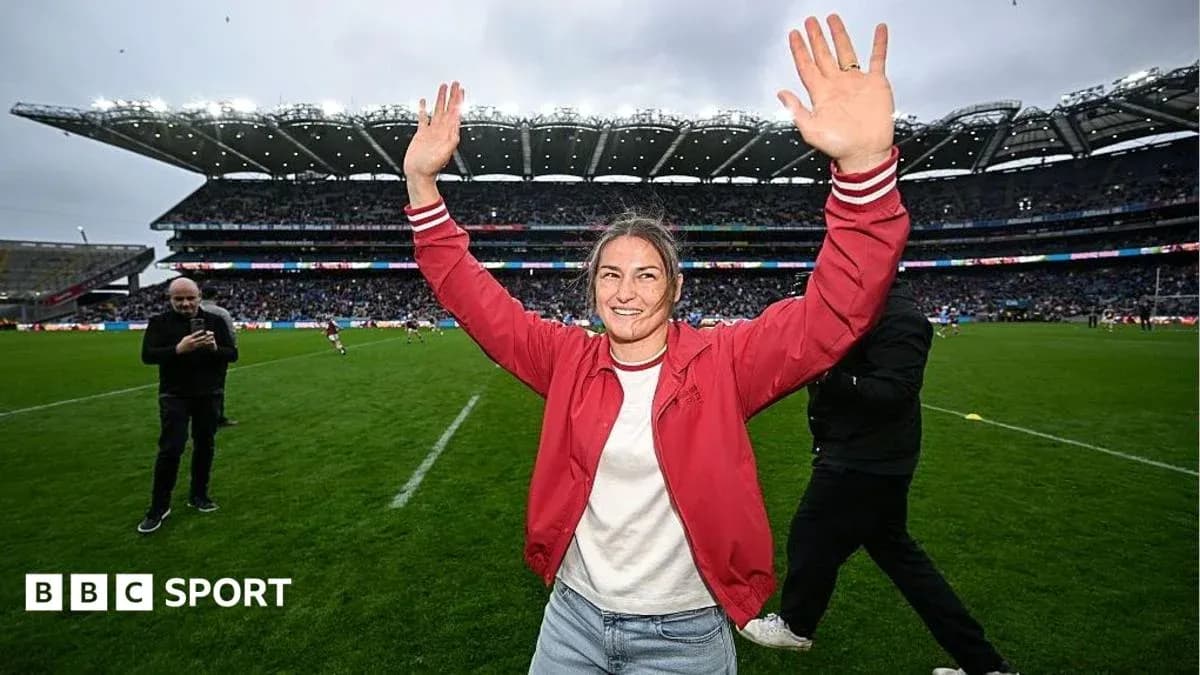
On Saturday night, Katie Taylor will walk out at Croke Park and feel the weight of a nation on her shoulders one last time.
Eighty-two thousand seats. A farewell fight. Flora Pili in the opposite corner and the undisputed light-welterweight title on the line. One final chance to close the book exactly as she always imagined it – with a belt around her waist and Dublin roaring her name.
It is the culmination of a career that didn’t just win medals and belts. It changed the sport.
A letter from Bray
Before Olympic gold, before Madison Square Garden, before pay-per-view headliners, there was a 10-year-old girl in Bray who simply wanted to box.
There was nowhere for her to go. Women’s boxing in Ireland wasn’t sanctioned. The Olympics didn’t recognise it. Professional opportunities were almost non-existent. The pathway was a dead end.
So she wrote a letter.
Not to a federation or a politician, but to Deirdre Gogarty – the Irishwoman who had packed her bags for the United States and, in 1997, beaten Bonnie Canino in Louisiana to become WIBF featherweight world champion.
“How did you do it when everyone tried to stop you?” the young Taylor asked.
Gogarty wrote back. The message was simple, but it lit a fuse.
If you keep working, if you keep showing your skills, somebody will have to let you box.
Years later, Gogarty would look back at that letter and recall the line that stopped her in her tracks: “Maybe one day they’ll let us box in the Olympics.”
Without that exchange, Taylor might still have forced her way through. But in a landscape with no signposts, Gogarty’s reply was a flare in the dark.
Forcing open the Olympic door
The Olympics became Taylor’s obsession. The problem was that women’s boxing still didn’t exist on the programme.
When the International Olympic Committee hesitated over bringing it in, Taylor was summoned to do what she has always done best: fight.
Showcase bouts in Chicago, in front of sceptical officials, turned into something more than exhibitions. Taylor’s performances shredded the arguments against the sport in real time. Speed, skill, relentlessness – every round asked the same question: how could this possibly be kept out?
Her manager, Brian Peters, doesn’t sugar-coat it.
“Katie won’t say this, and I’ve been holding back from saying this, but single-handedly, Katie Taylor got women’s boxing into the Olympics,” he says.
London 2012 answered that childhood wish. Women’s boxing made its debut. Taylor carried the Irish flag in all but name and left with lightweight gold.
Four years later in Rio, the dream cracked. A split-decision defeat in the quarter-finals ended her title defence and, with it, her amateur chapter.
“It was probably the worst year of my career,” she admitted. “I needed a change. I needed a new mindset.”
Had she won a second Olympic gold, the hunger to rip up her life and jump into a neglected professional scene might have faded. Instead, the pain of defeat drove her towards reinvention.
A DM that changed everything
Turning professional was only half the battle. Doing it right was the real challenge.
Peters came first, stepping in more out of concern than ambition.
“I only took her on not to see her end up with people who didn’t know what they were doing,” he says.
Then came the moment that would quietly reshape the commercial landscape of women’s boxing: a direct message on Twitter.
On 4 October 2016, Taylor opened the app and wrote to Eddie Hearn of Matchroom, asking if he would consider promoting her. No entourage. No grand negotiation. Just a message and a question.
Hearn replied the next day. He invited Taylor, Peters and her mother Bridget to a London restaurant. He even borrowed his father’s car to make the right impression.
The charm offensive worked. A month later, Taylor made her professional debut at Wembley Arena. The partnership was born.
In a business built on fallouts and fractured loyalties, Taylor’s inner circle has barely changed: Peters, Hearn, trainer Ross Enamait. The same voices, the same trust, from the first pro ring walk to this final one at Croke Park.
“In a business full of egos, she’s stayed loyal to everyone around her and remained the most humble person you could ever meet,” Peters says.
If Hearn had ignored that DM, or if Taylor had drifted from the people who understood her best, the promotional machine that dragged women’s boxing into the mainstream might never have left the ground.
The night everything shifted at the Garden
By April 2022, Taylor had become undisputed lightweight champion. She had already survived a razor-thin majority decision against Delfine Persoon at Madison Square Garden three years earlier – a brutal night when many felt her aura had finally been dented.
The return to MSG, this time against Amanda Serrano, felt different. Bigger. Riskier.
Seven-division champion. Ferocious puncher. A stage that had never before belonged to two women in the main event.
Nineteen thousand one hundred and eighty-seven people packed into the arena. The noise, the stakes, the scrutiny – all of it pointed towards a single question: could women’s boxing carry a true blockbuster?
Taylor and Serrano answered with a classic. Ten rounds of shifts in momentum, of survival and surge, ending with Taylor’s hand raised on a split decision. The fight was hailed as the best of the year.
One more judge’s mark in the other direction, or a damp squib of a contest, and the momentum behind women’s mega-fights might have slowed. Instead, the sport accelerated.
The rivalry exploded. Their 2024 rematch, on the undercard of Jake Paul v Mike Tyson, drew huge global numbers on Netflix. Taylor then closed the trilogy back at the Garden in 2025, underlining her status as the defining fighter of her era.
Croke Park or nothing
Which brings it back to Dublin. To Croke Park. To the final act.
After beating Serrano in last year’s trilogy decider, Taylor made her decision quietly.
“She actually retired that night,” Peters reveals. “She said, ‘We convincingly beat Serrano – where do we go from there?’ I said I’ll agree on one condition.”
That condition was simple: Croke Park or nothing.
“Croke Park – no disrespect to Wembley – is the greatest stadium in the world,” Peters says. “You cut an Irish person and they’ll bleed Croke Park.”
This is not a tune-up. Not a farewell tour. It is the last stand of a fighter who has always kept her word.
Peters is adamant there will be no Cameron trilogy, no late-career detours, no comeback whispers.
“When Katie gives her word, that is it,” he says.
Whatever happens against Flora Pili on Saturday, the verdict on Taylor’s legacy is already in. She did not just walk through the door when it finally opened.
She kicked it off its hinges so that every woman who followed would never have to ask if they were allowed in.