.svg&w=384&q=75 "logo")
Katie Taylor's Final Fight: An Emotional Farewell at Croke Park
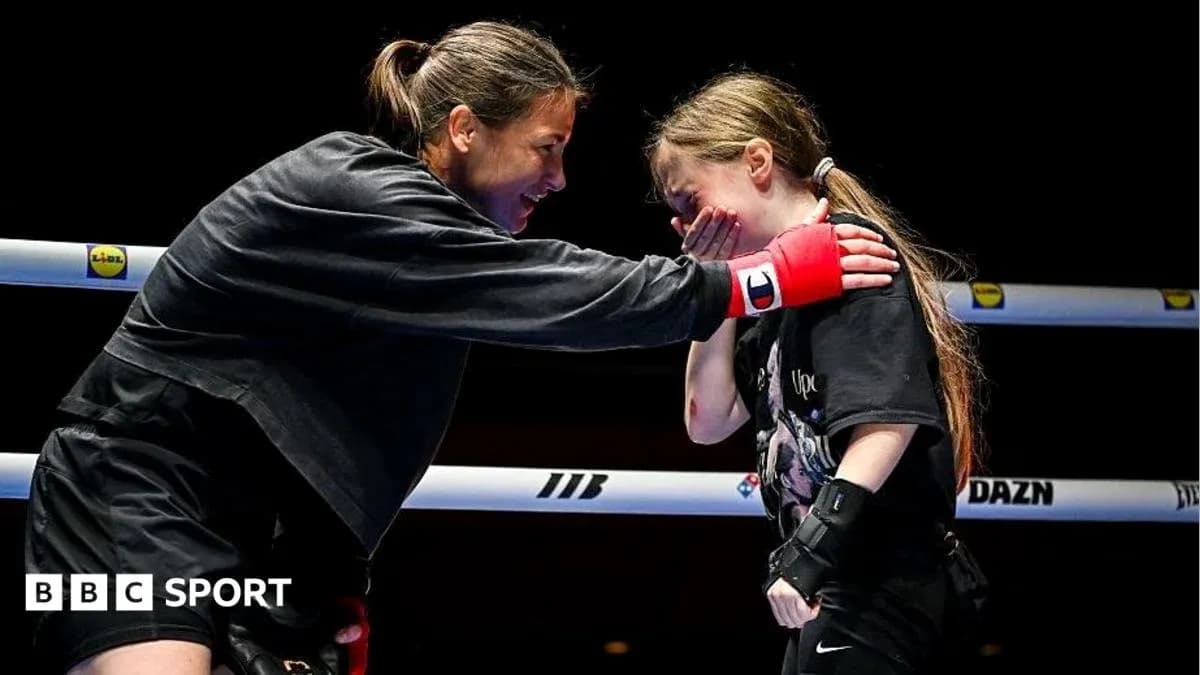
Katie Taylor smiles as she sits down, but the mask slips the moment she looks up.
On Saturday night, in the vast bowl of Croke Park, she will walk to the ring one last time. Across from her, unbeaten French challenger Flora Pili. Around her, 80,000 voices. Behind her, a lifetime spent forcing open doors that were bolted shut to women when she first laced up gloves.
The weight of all of it is starting to land.
“I thought I was handling all the emotions until today,” the 40-year-old tells BBC Sport.
For once, the usual fight-week armour isn’t quite in place. There is no talk of “next time”, no future name lurking in the shadows. Just a farewell in front of a nation that watched her disguise herself as a boy to box, then watched her climb to Olympic gold and the undisputed summit as a professional.
“This is the stuff of dreams and I’m pinching myself that it’s happening,” she says. “I look back at my career and think how remarkable it has been. The highs, the lows, the failures, the disappointments and the successes.”
Taylor has never enjoyed the circus. The staged face-offs, the endless interviews, the bright lights that come with being the face of a fight week. Her comfort has always been the gym, the grind, the silence.
Yet this week, under the lights, she has blinked back tears. She has lingered for a heartbeat longer during the staredowns, as if trying to bottle the noise and the colour for when it’s gone.
“Every fighter in the world wishes they were in this position,” she says. “I’m just blown away from the support from this country. I don’t think there are many other countries where 80,000 show up for a female athlete.
“The crowd – hearing ‘ole ole ole’ one last time – feeling the atmosphere, seeing the tricolours all over the place…”
An arena, a nation, a goodbye
The emotion has spread through her camp. Eddie Hearn, the promoter who has stood beside her on so many fight weeks, choked up mid-sentence at the final news conference when the reality hit: this is the last time.
“When it’s all said and done you will look at your belts, you might look at your bank balance. But you will sit there, close your eyes and recall all those incredible moments in your life that made you cry,” he later told BBC Sport.
“I will cry on the ring walk. I will cry in the [post-fight] interview.”
Taylor, usually reserved and relentlessly focused, has allowed a different side to surface. She joked about flipping the table during her last round of media duties, just to break the monotony.
“Katie Taylor is one of the funniest people I’ve met. Unexpectedly funny,” Hearn says. “She’s so strong and determined. But people who know, she’s very jovial, she’s got great energy and I think she’s soaking all that up.”
Around her, friends and colleagues have spent the week making their own declarations. To them, this is Ireland’s greatest sportsperson taking her final bow. Manager Brian Peters even felt the need to offer a tongue-in-cheek apology to Roy Keane, assuring him he was a “close second”.
The country has responded in kind. Taxi drivers stuck in gridlock, bar staff pulling pints in Temple Bar, people on building sites and in offices – all of them asking the same question: any spare tickets?
A farewell that had to be earned
Selling out Croke Park is never guaranteed, even for an icon. Taylor’s reputation has always been that of a fighter who buries herself in training, not one who courts the spotlight.
This time, she went after it.
Peters led an exhausting, 1,500-mile bus tour across all 32 counties. Four days. Dozens of radio slots. Community visits. Handshakes, selfies, school halls, town squares. A farewell sold not through hype, but through presence.
“No-one works as hard as Katie,” Peters says. “Those four days she did not stop working. These stadiums don’t sell out on their own.”
At one stop in Kilkenny, the schedule was already shot. Thousands had gathered at the gates. The easy option was to roll past, wave, stay on time.
Taylor wouldn’t have it.
“Ah Brian, we can’t drive past them,” Peters recalls her saying, insisting they pull over. She climbed down, posed for group photos, gave the crowd their moment.
That decision, repeated in different forms across the island, has turned Saturday into something more than a boxing match. About 80% of those inside Croke Park will be watching live boxing for the first time. Sixty-five percent of tickets have been sold outside Dublin. This isn’t just a capital city event; it’s an all-Ireland occasion.
With the fight airing free-to-air across the country and Westlife providing the soundtrack, Taylor’s last stand has become a national celebration wrapped around a prizefight.
The threat in the other corner
Somewhere within all of this noise, Flora Pili has been moving quietly through hotel corridors, slipping in and out of gyms while the spotlight burns on Taylor.
She arrives unbeaten, 12-0, a 29-year-old challenger with a chance to rip up the script.
“I have nothing to lose and everything to win,” she says.
Taylor knows that sentiment well. It fuelled much of her own rise. She also knows that sentiment can be dangerous if you let the moment swallow you.
That is why her team front-loaded the media work. The interviews, the fan events, the nostalgia – all pushed to the start of the week. Time banked for the tears, the tributes, the reflection, so the final days could belong to the fighter, not the farewell.
“I don’t think I can prepare for what happens on Saturday, but I’m going to try and keep emotions in check and try and enjoy the ringwalk. But the most important thing is to win,” she says.
And after? When the ring is dismantled, the lights dim and the songs fade?
“Probably a bit relieved – I don’t have to take any more punches again.”
The tears will almost certainly return when the final bell sounds. This time, though, there is no rematch clause, no next date, no “we go again”.
When the bell rings on Saturday night, it really will be the end.