.svg&w=384&q=75 "logo")
Katie Taylor’s Last Walk: A Farewell Night at Croke Park
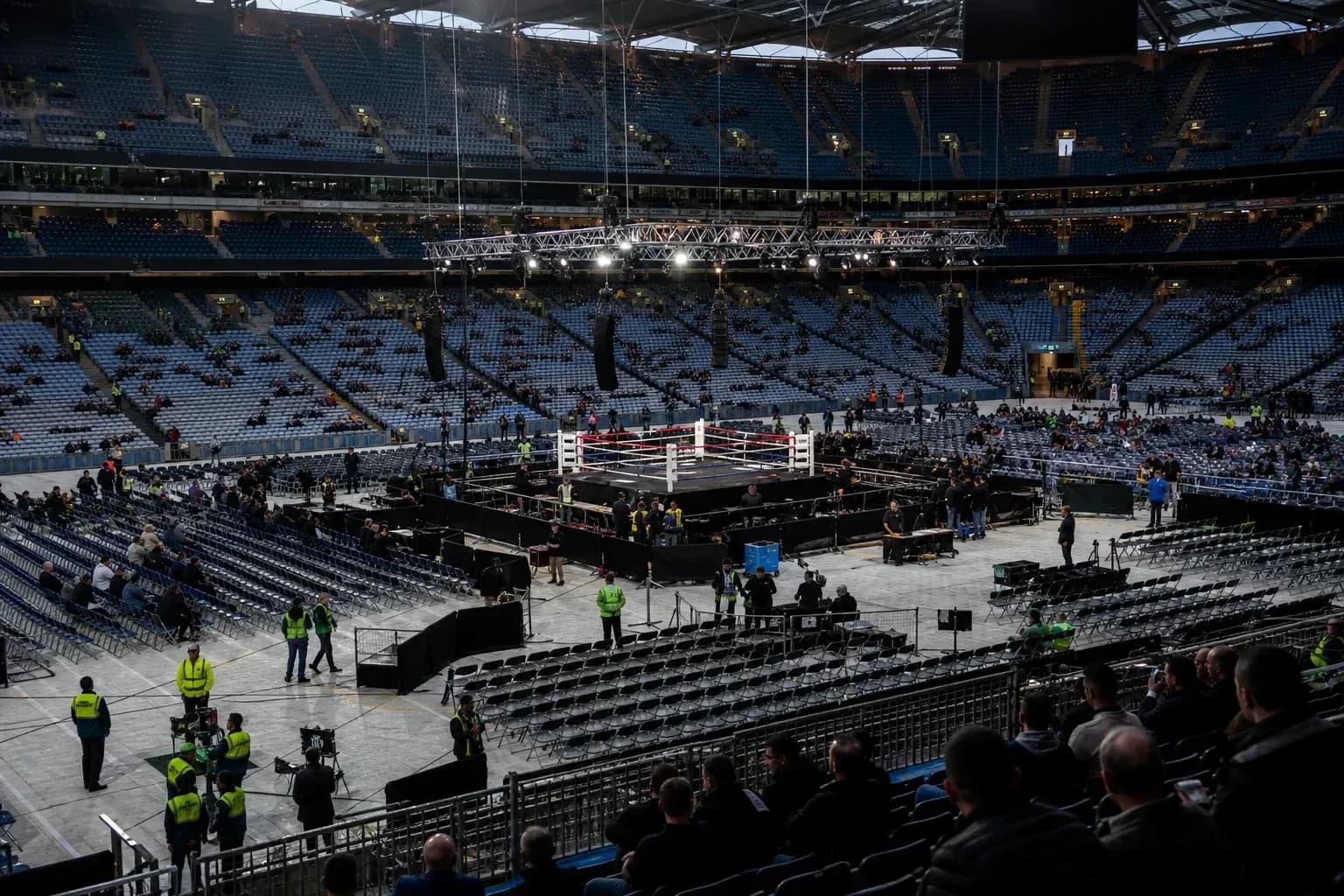
Katie Taylor’s career will end where Irish legends are usually only sung about, not seen: under the floodlights of Croke Park, in front of 80,000 people, on a Saturday night in Dublin.
At 40, the Olympic champion and undisputed star of women’s boxing will defend her light welterweight belts one final time, turning a stadium built on Gaelic games into a cathedral for a sport she helped drag into the mainstream.
The tickets vanished in 17 minutes. Not an hour, not an afternoon. Seventeen minutes after sales opened in June, the show was gone, snapped up by a country determined to say goodbye properly. National broadcaster RTÉ will carry the event free-to-air, opening the doors even wider. It will be more than a fight card; Westlife and other performers are on the bill, turning the night into a national occasion rather than just another entry on a boxing record.
A Stadium, a Memory, an Era
Croke Park does not host boxing often. The last time it staged a major bout was 1972, when Muhammad Ali met Alvin Lewis. Since then, generations have passed without seeing a ring in the middle of that vast bowl.
Now, Taylor brings it back.
Her brother-in-law, Trevor McMahon, founder of Liberty Boxing Gym, has already framed it in the only way that makes sense: the end of an era. The tone around the camp is clear. This will be special. It will also hurt.
Because this is not simply a retirement. It is the closing of a story that began far from the roar of 80,000 people, in a place called Tin Can.
From Tin Can to Croke Park
Before the medals, before the belts, before the sold-out arenas, there was a girl who was not allowed to step into the ring.
As a child, Taylor trained in a modest gym named Tin Can. At the time, women and girls were barred from entering the ring in Ireland and the United Kingdom. The solution was simple and subversive: she registered for fights as “K Taylor,” passing as a boy to get the rounds she needed.
She and her father, Pete, did more than just work the pads. They pushed against the rules themselves. Their efforts helped force change in Ireland, where the ban on women and girls boxing was lifted in 2001, when Katie was just 15. That decision did not just free her path. It opened the door for every girl who has laced up gloves in the country since.
From there, her rise became impossible to ignore. Gold at the 2012 London Olympics, a landmark moment for women’s boxing on the biggest stage. Headlining nights at Madison Square Garden, a venue that has defined greatness across generations. A trilogy of punishing, high-level battles with Amanda Serrano that reshaped expectations of what women’s fights could draw, command and deliver.
On Saturday, that entire journey converges on one canvas in Dublin.
A Town Dresses for Its Hero
Down the coast in Bray, County Wicklow, the preparations have a different rhythm. This is Taylor’s hometown, and it is dressing for the occasion.
Shops are selling hats, flags and posters with her image. Streets that watched her grow up now carry her face in windows and on walls. In Bray, this is not a distant spectacle; it is personal.
Local resident Catherine Hill put words to what many there feel: Taylor has become a model for young girls who want to step into boxing or any other sport. For them, she is proof that the barriers they see are not permanent. They are there to be pushed over, the way she did two decades ago.
That is the legacy walking into Croke Park.
One Last Test
A farewell fight in front of a home crowd can be sentimental. It will not be soft.
Taylor’s opponent is 29-year-old French fighter Flora Pili, unbeaten as a professional with 12 wins from 12 and the IBO light welterweight title around her waist. She is not coming to Dublin as a supporting act. She is arriving as a champion in her own right, with youth on her side and nothing to lose against a legend on her final night.
The matchup underlines what has defined Taylor’s career: no easy routes, no gentle exits. Even at the end, she chooses a live opponent, a fellow titleholder, a genuine threat.
The stakes are obvious. Taylor defends her belts one last time. Pili has the chance to turn a farewell into an upset that would echo across the sport.
What Remains After the Final Bell?
When the ring is dismantled and the lights go down at Croke Park, the numbers on Taylor’s record will tell only a fraction of the story.
This is the fighter who helped force open the doors of her own sport as a teenager. The champion who carried Irish boxing on her shoulders. The headliner who proved women’s bouts could sell out major arenas and command prime-time slots.
On Saturday, 80,000 people will watch her walk to the ring for the final time. Millions more will follow from homes and pubs across Ireland and beyond. Some will come for the nostalgia, some for the spectacle, some just to see if she can summon one last performance on the biggest of stages.
However the fight ends, the question that lingers is not what Katie Taylor has left to give. It is who will dare to follow the path she carved, from Tin Can to Croke Park, and what women’s boxing will look like now that its defining pioneer is taking her final bow.