.svg&w=384&q=75 "logo")
Katie Taylor's Historic Farewell: A Legacy in Boxing
Katie Taylor walked away from boxing the way she lived inside the ropes – on the front foot, dictating the terms, leaving everyone else to catch their breath.
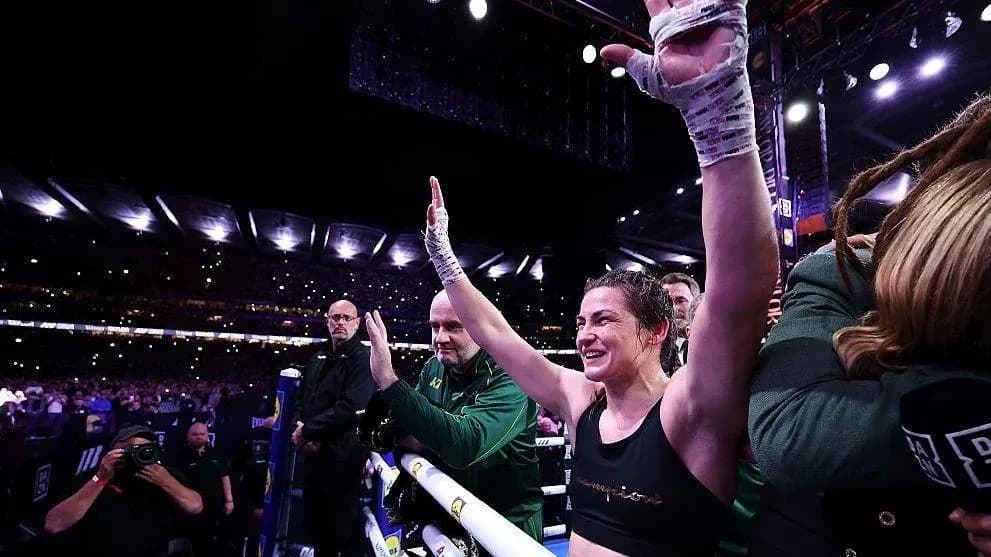
On a charged night at Croke Park, in front of more than 80,000 people, the Irish icon outboxed France’s Flora Pili to become undisputed light-welterweight champion, then laid her gloves in the centre of the ring and closed the book on one of the most significant careers the sport has ever seen.
Forty years old. Twenty-six wins from 27 professional fights. Olympic gold. Three undisputed reigns across two divisions. And now, a final ovation that felt less like a goodbye and more like a nation saying thank you.
A final masterclass under the lights
From the opening bell in Dublin, Taylor looked like a fighter determined to leave no doubts. She was sharper, quicker, meaner with her timing. Time and again she beat Pili to the punch, sliding in with those familiar bursts, then slipping away before the Frenchwoman could respond.
The pattern rarely changed. Pili pressed, but Taylor’s feet and hands were a step ahead. The noise inside Croke Park swelled every time the Irishwoman let her hands go, and in the closing stages she emptied what was left in the tank.
Those last 20 seconds will sit alongside the very best of her career. A furious flurry of rapid-fire combinations, the kind that once broke open Olympic finals and world title fights, now used one last time to slam the door shut on a remarkable journey. It was exactly the image former world champion Barry Jones highlighted on the Dazn broadcast: the rallies, the volume, the refusal to coast to the finish.
When the final bell rang, the crowd rose as one. The decision was a formality. The moment was not.
‘One of the best to ever do it’
The tributes from within the sport came quickly and carried weight. Unified lightweight champion Caroline Dubois, one of the heirs to the division Taylor dominated, captured the mood with a simple message on X, calling her “one of the best to ever do it” and thanking her “for paving the way”.
American superstar Claressa Shields, who calls herself the Greatest Woman of All Time, did not argue with the idea that Taylor belongs in that conversation. “Congrats Katie. Now ride off into the sunset. You deserve it all,” she wrote, a nod from one generational figure to another.
Super-featherweight champion Alycia Baumgardner called Taylor “a trailblazer who helped set the stage for all of us”, adding: “What a legacy. It’s been a privilege watching your journey from the beginning.”
These are not empty compliments. They come from women whose careers exist, in part, because Taylor kicked down doors that had been bolted shut for decades.
An Irish relationship like no other
If the belts told one story, the stadium told another. Taylor had long spoken about Croke Park as the dream venue for her farewell, the place she wanted for the final chapter. On Saturday night, she got it – and it felt like the country turned up with her.
Westlife performed before the main event, a distinctly Irish prelude to a distinctly Irish occasion. By the time Taylor made her ring walk, the arena had the feel of a homecoming and a coronation rolled into one.
Former world champion Carl Frampton, who knows a thing or two about carrying a nation’s hopes into a ring, tried to explain the bond between Taylor and the Irish public.
“You can tell that she doesn’t enjoy doing stuff in front of the media, but she still has this adulation from everybody,” he said. “Katie Taylor is different, she’s special and there will never be another one like her.”
She never chased the spotlight. It chased her. And on this night, it refused to let go.
A rare exit in a brutal game
Boxing is not kind to its heroes. Most stay too long. Most leave damaged, diminished, or on someone else’s terms. Taylor did not.
Former cruiserweight world champion Tony Bellew, watching on, struggled to recall anything quite like it.
“I don’t think in all of my years of watching this game, I have seen an exit as beautiful, amazing and fitting,” he said. “She has just retired as the greatest champion ever. I have never seen a fighter leave as an undisputed champion on their own terms.”
Bellew is convinced this is it. “No way,” he insisted when asked if she might return, though he can see her remaining close to the sport as a mentor, a quiet presence guiding the next wave. “She will always be there to give her advice, speak to her and help her. But ultimately she will sail off into the sunset and who could possibly deserve it more.”
Ringside, American Mikaela Mayer watched Taylor place her gloves in the centre of the ring and understood the symbolism immediately. “It’s like a story,” she said. A simple act, heavy with finality.
A legacy that won’t be replicated
Taylor’s legacy is not built solely on numbers, though the numbers are staggering. It lives in the way arenas began to fill for women’s fights. In the way promoters reshaped cards to accommodate them. In the way young boxers like Dubois, Baumgardner and Mayer talk about what was possible once Taylor stepped through the ropes.
She turned a niche into a main event. She made nights like Croke Park feel normal for female champions, when not long ago they would have been unthinkable.
The last image is of a 40-year-old champion, gloves left in the ring, Croke Park still roaring. The belts will move on, the divisions will reset, the next contenders will circle.
But replacing Katie Taylor? That is another fight entirely.