.svg&w=384&q=75 "logo")
Katie Taylor: The Early Signs of a Champion
The first time I saw Katie Taylor, she was a 10-year-old in an oversized headguard, standing in a Bray boxing gym that smelled of leather, sweat and old ambition.
I was there on assignment for The Big Issue, the street magazine that gave people affected by poverty and homelessness a way to earn. Its motto was simple and sharp: “A hand up, not a hand out.” That day, the brief was straightforward – photograph a young girl who loved boxing. Nothing in that description hinted at what was coming.
Bray Boxing Club sat quietly in Co Wicklow, a modest room with scuffed floors and heavy bags swaying on tired chains. Inside, Pete Taylor greeted me with the relaxed ease of a man at home in his surroundings. Then he turned and introduced his daughter.
“This is Katie.”
She was small, slight, and utterly unfazed by the stranger with the camera. Gloves on, head down, eyes already locked on the ring. There was no shyness, no performance. Just intent.
She started off working with Pete, smacking his hand pads with a ferocity that didn’t fit her age. Each punch had a snap, each combination a purpose. Pete called the shots, but it was clear who was driving the tempo. She wasn’t just copying movements; she was trying to break through them.
Then she stepped in with a boy.
That was the moment everything changed. Her whole expression sharpened. The playful edge vanished. She began to stalk him, cutting off the ring in short, quick steps. He moved back, always back, trying to find space that didn’t exist. Katie refused to give him any.
She hunted him down, punch after punch, relentless. No malice. Just a cold, clear determination to land her shots and win the exchange. For a photographer, it was gold. For anyone watching closely, it was something else: the first, unmistakable glimpse of a champion’s mentality.
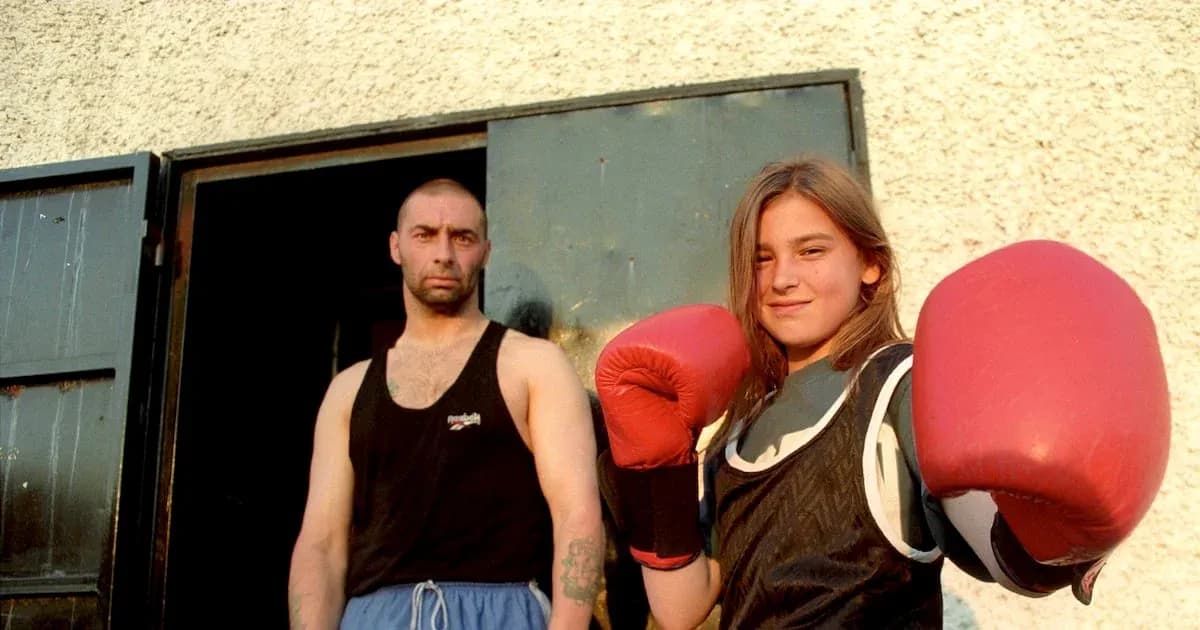
Later, as the session wound down and the gym emptied, we stepped outside. The Bray evening had turned soft and golden, the sun dropping low over the town. I asked her to stand for a few portraits. She did, patient and still, the gloves now hanging loose at her sides.
In that light, the background faded. What stayed were the eyes – hard, focused, carrying a steel that didn’t belong to a child. You could see it even then, in that quiet street in Wicklow: the drive that would push her to Olympic gold and world titles.
At the time, she was just a kid in a local club, fighting boys, chasing them around the ring as the day slipped into dusk.
Looking back, it was something else entirely. It was the start of a story the whole world would soon learn.