.svg&w=384&q=75 "logo")
Katie Taylor: The Champion Who Transformed Boxing
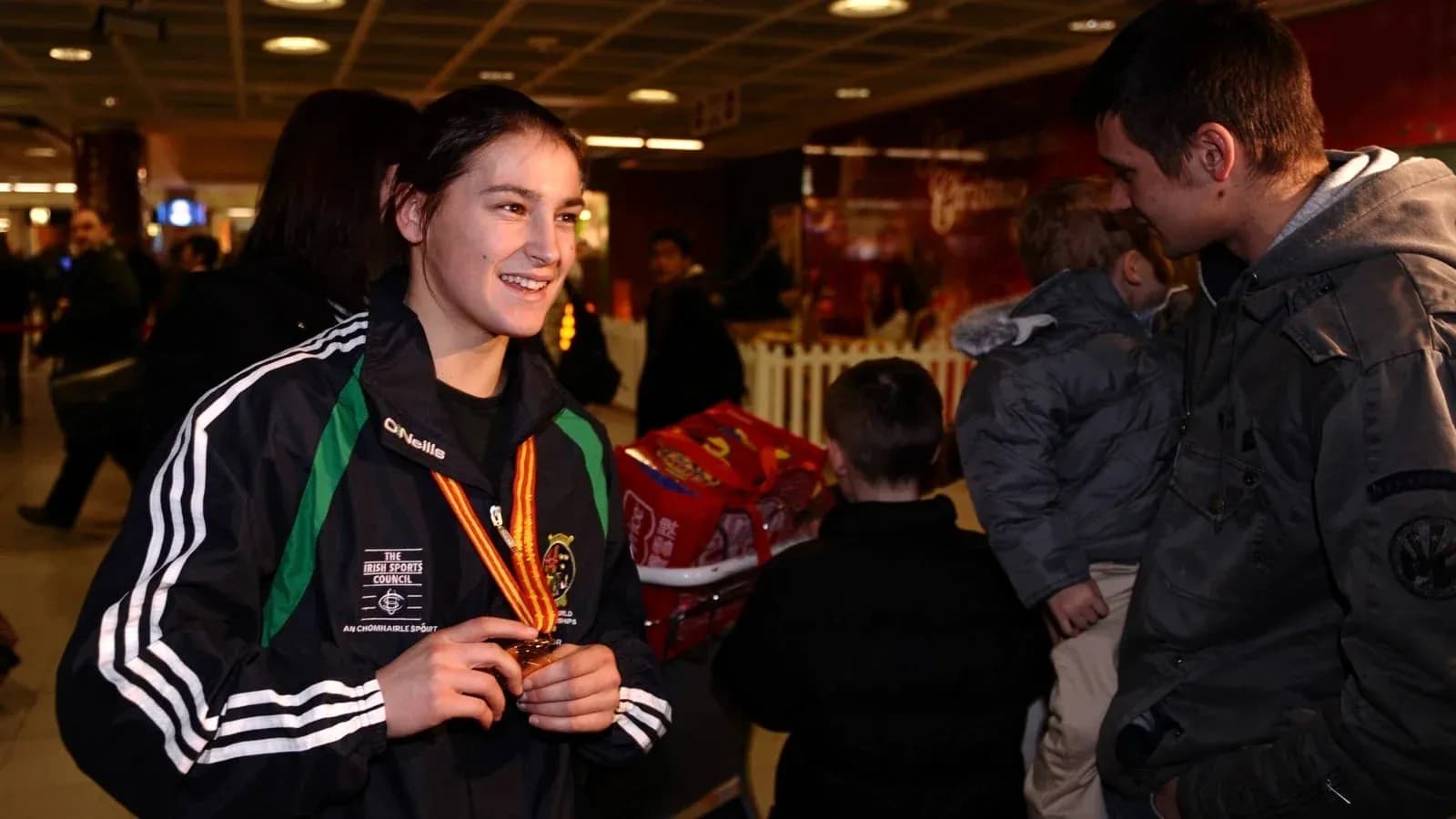
On the eve of her Croke Park farewell, Katie Taylor stands as the defining figure of Irish boxing’s modern era. Not just the champion. The catalyst. The kid in oversized headgear who walked into a male-dominated gym and quietly forced everyone to change how they thought about the sport.
Those who were there at the start remember it with startling clarity.
“She’s a girl – but she is a champion”
Eric Donovan was a teenage prospect when he first shared a ring with Taylor. Same age, same weight, same dreams. Only one of them was a girl in a gym full of boys.
“At the very beginning, I used to take it easy on her,” he recalls. She was the lone female in among a pack of young men, and the instinct – his and everyone else’s – was to ease off.
His coach, the demanding, unblinking Zaur Antia, saw it differently.
Donovan remembers the rebuke as if it was yesterday. Antia tearing into him for what he called “very bad sparring”. Donovan tried to defend himself: he was sparring a girl. Antia was having none of it.
“She’s a girl but she is a champion! She wants to be Olympic champion. You have to be serious about this!”
That was the line in the sand. From then on, Donovan treated Taylor like any other elite fighter. The spars became fierce, technical, high-speed. No malice, but no kid gloves either. She gave as good as she got, and in the early days she took plenty too, especially in those punishing sessions with Paddy Barnes, who was conceding weight but never intensity.
Taylor never wilted. Never looked out of place. Never looked vulnerable.
She was part of a tiny vanguard of Irish women pushing into the elite game. Deirdre Gogarty had blazed the first trail from afar, forced to leave Ireland to fight. Taylor picked up that mantle at home, battering down doors, forcing law changes, demanding that the sport make room for women like her.
By 2005, she was a world champion. By 2007, she was the standard-bearer.
In Chicago that year, at the men’s World Championships that doubled as qualifiers for Beijing, Taylor was there not as a competitor but as a symbol. She was told in the dressing room she was boxing an exhibition for something far bigger than herself: to push women’s boxing into the London Olympic Games.
The pressure sat squarely on her shoulders. She walked out and delivered a masterclass.
Donovan watched from the stands, surrounded by some of Britain’s finest talents – Frankie Gavin, Billy Joe Saunders, Luke Campbell, James DeGale – all of them stunned, asking the same question: “Who’s this?”
“That’s my sparring partner,” Donovan told them. It wouldn’t be long before the rest of the world knew her name.
From super-fan to teammate
For Gráinne Walsh, Taylor wasn’t just a champion. She was the reason boxing ever entered her life.
Walsh grew up a “full soccer head”, dreaming of a professional football career. Boxing wasn’t in the family. No lineage, no tradition, no father or uncles dragging her to smoky clubs. Then, in 2012, a small twist of fate: no summer soccer league, a need to stay fit, and a new boxing club opening across the road in Tullamore.
Katie Taylor came to cut the ribbon.
Taylor had just returned from the World Championships in China, a five-time world champion on the brink of the London Games. Women’s boxing was about to make its Olympic debut. The sport was changing in real time.
Walsh walked into that club, met Taylor, and everything shifted. “Once you get involved in boxing and it touches your heart, it’s hard to get out of it,” she says now.
She watched London 2012 glued to the screen, watching Taylor carry a dream that, for years, had not even been a theoretical possibility. The Olympics had never opened their doors to women boxers before. Taylor fought to make it real, then walked through the door herself.
Walsh followed, years later, on the path Taylor had carved. She pestered her coach, who knew Antia, to let her into the high performance unit just to sit in the corner and watch Taylor train. No selfies, no fuss. Just study.
Within four years of first lacing gloves, Walsh had national titles and an Irish vest. In 2016, at the World Championships in Kazakhstan, she boarded a plane as part of the same team as the woman she once queued to meet.
She was still a super-fan. Only now, Katie Taylor was her teammate, sitting beside her on flights, sparring in the same colours, sharing the same dressing room. The awe never quite left.
London 2012: “A different level entirely”
For many, the defining image of Taylor’s career will always be London 2012. The gold medal bout. The green, white and gold flags. The noise.
Marty Morrissey, the RTÉ Radio 1 commentator that night, has called it his greatest moment behind a microphone – even above Clare’s hurling triumphs that shaped his career.
The Excel Arena was a cauldron. The Fields of Athenry rolled around the stands, echoing, crashing off the walls. This wasn’t just a boxing match. It was a social event, a national moment, a first.
Inside the ring, it was brutal and close. When the final bell rang, Taylor herself didn’t seem sure. She turned to her father Pete and to Antia, searching their faces. Had she done enough?
They told her they believed she had. Moments later, the announcement confirmed it. Katie Taylor, Olympic champion.
Around them, history and humour collided. British army soldiers guarded every exit, a quirk of security that didn’t stop delirious Irish fans from wrapping arms around them, posing for photos, dragging them into the celebration.
Up in the commentary positions, another surreal scene unfolded. Jimmy Magee called the action on TV, Morrissey on radio. Then Kate Middleton appeared at their elbow, a royal spectator in among the headsets and cables. Prince William may have been there somewhere, but he never reached the commentary gantry. Kate did.
When it was over, RTÉ’s bosses wanted the new champion on television with Bill O’Herlihy. There was one problem: they couldn’t get her. Taylor wasn’t answering her phone. She was busy. Her father insisted they were doing no media. This was their night, a private moment.
Morrissey, tipped off that Taylor was undergoing a medical, improvised. He spotted a doctor’s coat and lanyard, slipped them on, and walked straight into the medical centre. Members of the Irish team burst out laughing at the sight of him. “What the hell are you doing here?”
Inside, he found Katie and Pete. Pete refused again. But Katie understood what was at stake. She turned to her father and said they should do the interview.
They did. Then came one more twist. The Taylors were told they were expected at the “Irish embassy”. A car took them to what turned out not to be a diplomatic building but a pub. A raucous, welcoming, utterly unsuitable pub.
They were mobbed, cheered, engulfed. It was not where they wanted to spend their first night as Olympic royalty. Pete rang back, asked for another car, and they were brought to RTÉ studios, where Taylor finally sat down with O’Herlihy, the new face of a new era.
“A mad concept at the time”
Hugh Cahill, another RTÉ voice, knew of Taylor before he knew her. He grew up in Greystones, just along the coast from Bray, where stories of a teenage girl battering boys in sparring sessions filtered through like urban legend.
It sounded exaggerated. Local myth. “People were getting carried away,” he thought. Then he saw her train.
Pete Taylor worked the door at Jim Doyle’s on the seafront, a pub that sponsored Greystones Rugby Club. Cahill knew Pete from there. When he finally watched Katie in the gym, the myth melted into something more solid. She was as good as the stories. Better.
Women’s boxing then was treated by many as a curiosity, a sideshow. A novelty. Taylor erased that idea with every combination.
By the time she walked into the Excel Arena for that Olympic final against Sofya Ochigava, the novelty had vanished. What remained was something close to a movement.
Cahill remembers the venue like a nightclub – tight, loud, claustrophobic. The roars ricocheted off the walls. Almost nobody backed Ochigava. A smattering of Russians, her teammates and officials, were engulfed by a sea of Irish support.
Taylor won gold, but Cahill believes the person behind the medals remains something of an enigma to the wider public. Surveys show she is one of Ireland’s most admired figures. Those within the sport know the quiet charity work, the deep religious faith. Yet beyond the gloves and the podiums, most people would struggle to sketch a full picture of who she is.
Maybe that mystery only adds to the aura.
“She was good, she was deadly”
Long before the Olympic medals and the world titles, before the sold-out arenas and the professional superfights, there was a young girl walking into Mount Tallant Boxing Club in Terenure with her father.
Mick Dowling, two-time Olympian and long-standing coach and analyst, knew Pete Taylor well. He watched Katie up close in those formative years.
What he saw was not a knockout artist but an engine. A fighter built on movement and relentlessness. She bobbed, weaved, slipped, slid. She threw punches in bunches, an all-action style that demanded extraordinary fitness.
“She wasn’t a big hitter,” Dowling says, “but she was so, so fit.” He loved that style. Loved the work rate, the willingness to stand in the pocket and trade when needed.
Pete’s influence loomed large. He was everywhere in those early days, shaping, pushing, believing. Dowling is adamant his contribution should never be forgotten.
The talent was obvious. Like spotting a future star footballer on a muddy pitch, you just knew. She could take a punch too. Plenty of fighters never develop that chin. Taylor had it. She didn’t go looking for shots, but she accepted that she would have to walk through some to land more of her own.
Dowling, working with the Irish team and travelling constantly, still found himself drawn back to this young prospect. “A real, real up and coming young star,” he thought at the time.
She proved him right. And more.
Now, as she walks into Croke Park for the last time, the stories from the gyms, the pubs, the commentary boxes and the high performance units all converge on one simple truth: Katie Taylor didn’t just fight her way to the top. She changed what the top looked like.
The question now is not what she has left to prove, but how long it will take before Ireland truly grasps the scale of what she has already done.