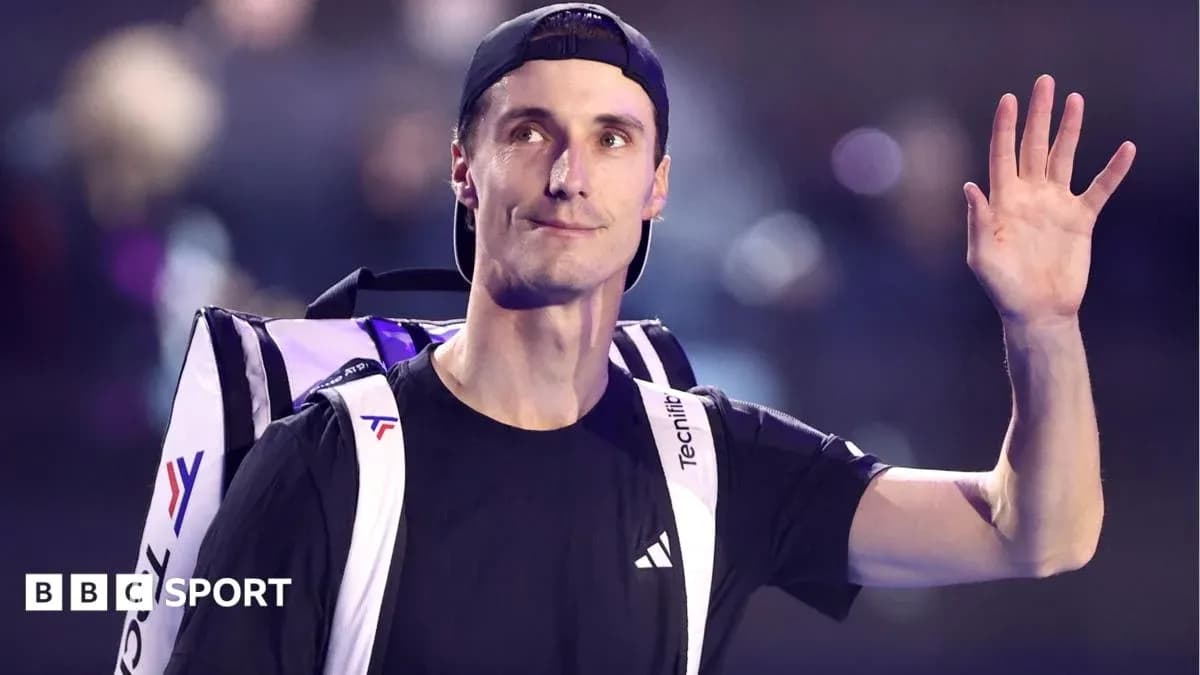
Joe Salisbury Retires: Britain’s Doubles Champion Ends Career on His Terms
Joe Salisbury chose to walk away from tennis in the place that defined him. Not Wimbledon. Not Melbourne. New York.
The former world No 1 doubles player and six-time Grand Slam doubles champion has retired from professional tennis, signing off at this month’s US Open, where he and long-time partner Rajeev Ram reached the semi-finals in what proved to be a joint farewell.
It felt like the only stage that made sense. In 2023, Salisbury and Ram became the first pair in history to win three consecutive US Open men’s doubles titles, turning Flushing Meadows into their own late-summer stronghold. Every year they came back, the partnership seemed to grow in authority, their understanding almost telepathic in the chaos of New York nights.
This time, the run stopped in the last four. The careers stopped with it.
Britain’s most decorated doubles man
Salisbury leaves as Britain’s most successful men’s doubles player of the Open Era, a sentence that would have sounded fanciful when he first began to carve out a living on tour.
The numbers are clear enough. Four men’s doubles majors: the 2020 Australian Open and that remarkable US Open hat-trick with Ram. Two mixed doubles titles alongside Desirae Krawczyk. Seventeen tour-level titles in all, including back-to-back triumphs at the season-ending ATP Finals in 2022 and 2023, where only the very best qualify and even fewer thrive.
Yet his career never felt like a simple accumulation of trophies. It was built on graft, late blooming and the willingness to specialise in a discipline that rarely commands the headlines it deserves.
A decision years in the making
At 34, Salisbury has not been forced out by a sudden injury or a dramatic loss of form. The choice has been slower, more introspective.
He has “been thinking about his future for a while” and now, he says, is “very happy with the decision”. That contentment has been hard won.
Earlier this year he stepped away from the tour for three months, speaking candidly to BBC Sport about the anxiety that had begun to shadow his life on the road. He felt a “feeling of dread” around travel and the relentless churn of tournaments. He insisted it did not significantly damage his tennis, but it eroded the joy around it, the simple pleasure of competing and moving from city to city with a racket bag and a plan.
For a player whose success came late and whose game relied on clarity under pressure, that kind of emotional toll matters.
No regrets, only perspective
Salisbury announced his retirement on Instagram, the modern way for a career to end but the sentiment behind it was old-fashioned and strikingly sincere.
“Tennis has been my life for as long as I can remember and I have been incredibly fortunate to have had all the opportunities, experiences and success that I have,” he wrote. “To be able to travel the world and call playing tennis my job has been a dream come true and I never believed I could have lived the life and had the career that I have.
“I gave it my all and know I can be proud and look back with no regrets.”
There is no sense of unfinished business in those lines. No hint that one more run might have changed anything. He sounds like a man who has squeezed everything he could from his talent, his body and his sport.
The end of a partnership, the end of an era
Ram’s decision to retire alongside him underlines how deeply their careers intertwined. They were not just a successful pairing; they were a constant presence at the sharp end of the biggest events, a team whose names were announced together so often that they almost became one word.
Their game was built on contrast and trust. Ram’s smooth serve, Salisbury’s sharp returning and net coverage, both men reading each other’s movements with a precision that only years together can produce. At the ATP Finals, against the very best, they looked entirely at home, twice lifting the trophy as if to prove that their US Open dominance was no fluke.
When that kind of partnership ends, it leaves a gap on tour that rankings alone can’t measure.
What remains
Salisbury walks away with 17 titles, a former world No 1 ranking and a body of work that quietly reshaped what British success in men’s doubles looks like. For a country that often measures itself through singles milestones, his career has forced a broader view of what elite achievement can be.
He leaves with something else too: control over the final chapter. No long fade, no desperate wildcard chases, no awkward half-comebacks. Just one last run in New York, a semi-final with Ram, and a decision made on his own terms.
The courts will move on quickly. The rankings will reset. New pairings will emerge.
But for anyone who watched those three straight US Open titles, or those back-to-back ATP Finals triumphs, the question lingers: who will be the next British doubles player to match that standard—and how long will the wait be?